

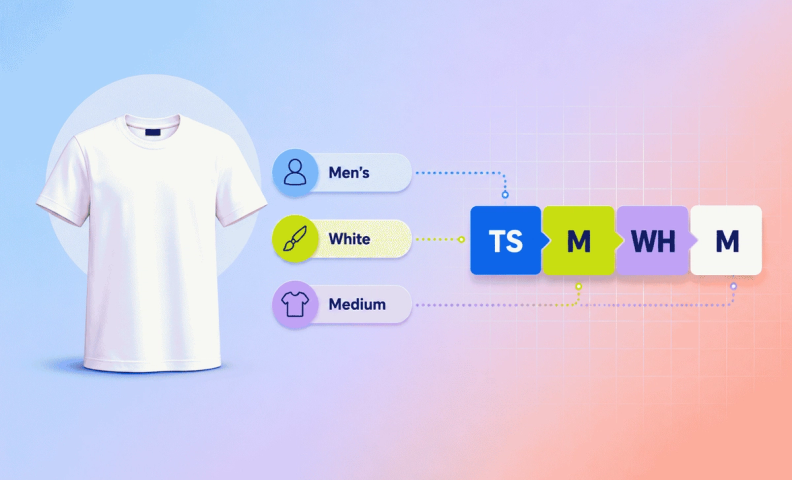
“How do I name my SKUs?” This is a very common question among product businesses trying to get started. This can be more painful than coming up with names for your children! Creating a consistent naming system for all your SKUs, whether you have two or 2000 products, will help you become more efficient and save you a lot of time and hassle in the long run. Naming all future SKU's will become much easier after you come up with a standard methodology you can fall back on whenever you need a new SKU.
If you'd rather, watch How to Create a SKU System That Actually Makes Sense (and Scales With You)
What is a SKU number?
SKU stands for “Stock Keeping Unit.” A SKU number is a number or short abbreviation that retailers use to identify their products and variations. Each unique product typically has a unique SKU. That SKU can be used internally, as well as on your channels and with your suppliers when you order.
Why SKUs are important for your business
SKUs are important because they help you track your inventory for many purposes, including:
- Inventory quantity tracking
- Fulfillment purposes
- Forecasting
- Ordering
SKU codes are an integral factor in scaling a business. They can be used across many areas of your business, including:
- Product packaging
- Product shelves in warehouses or product fulfillment centers
- Picking lists
- Order receipts and invoices
- Online store dashboards, including marketplaces
- Sales reports
- Accounting dashboards
- Inventory management system dashboards
SKUs are also the backbone of your product cost catalog, since every cost you track ties back to a specific SKU. They help shorten identifiers from long & lengthy descriptions, while staying specific to an item.
Imagine trying to use a description for everything instead of a SKU. If you had to type “Yellow shirt, size 4, puff sleeves” every time you were referencing this one product, it would be very difficult to keep things clean. If instead this product is consistently referred to as YSH-4-PS, it becomes much easier to reference consistently across the different areas of your business.
Some of the benefits of proper SKU naming include:
- Easy identification of products and their variations
- Increased efficiency, accuracy, and speed of fulfillment
- Reduced errors in product warehousing & shipping
- Assistance in inventory tracking and management
- Increased speed and accuracy when ordering
How to create SKU numbers
You can always randomly generate number and letter combinations when coming up with SKUs but we strongly recommend against going with this approach. SKUs are much more useful and easier to use when they can be read as a description of the product, identifying many of the product's most important characteristics.
Any parameters you use to identify your products can be abbreviated in the form of letters and numbers that enable you to easily distinguish one product from another. You can create it based on:
- The product's manufacturer
- Product name
- Model
- Size
- Color
- Description
- Material
- Any other specified parameters
For example, consider in the table below how the ending SKU clearly identifies the style, color, and size of the product.
| Style | Color | Size | SKU Example |
|---|---|---|---|
| Long sleeve tee | White | Medium | LST-WHT-M |
| Short sleeve tee | Gray | Extra large | SST-GRY-XL |
| Leggings | Black | One size | LEG-BLK-OS |
| Dress | Pink | Small | DRS-PNK-S |
Here is another example of a cleaning company’s products:
| Product Type | Scent | Pack Qty | SKU Example |
|---|---|---|---|
| All-purpose cleaner | Citrus | 3 | ALL-CIT-3 |
| All-purpose cleaner | Citrus | 1 | ALL-CIT-1 |
| Window cleaner | Fresh | 2 | WIN-FR-2 |
| Toilet cleaner | Fresh | 1 | TOI-FR-1 |
Someone with a little experience in these companies could tell you exactly what product the SKU was referencing, without needing a lengthy product description.
These are some best practices to consider as you get started:
- Try to stick to one SKU naming formula for all products.
- The best SKUs are between 8-12 characters, and definitely under 16.
- Keep them easy to read and understand.
- Try to avoid confusing letters, numbers, and special characters.
- Avoid starting a SKU with a zero (Excel will edit out the beginning zero if you put it in a spreadsheet, creating a lot of hassle and headache).
- Arrange SKU in order of importance, typically generic to specific attributes.
- The best SKUs have easily identifiable attributes and qualities.
These are the steps we recommend for coming up with SKUs for your products:
Step 1: Start SKU numbers with the main identifier
What is the most important identifying feature of the item? The first 2-3 letters or numbers of the SKU should indicate this. This can be a category, department, manufacturer, or some other main identifier.
Step 2: Use middle numbers for unique identifiers
What is the next most important thing that identifies the item? The middle section is best for colors, sizes, item type, etc.
Step 3: Use last numbers for additional identifiers
Is there anything else you need to identify this item quickly and easily? Use the last few letters/numbers for it. This can also be a sequential number (ex. 001, 002, or 003) to identify how old an item is (older items will have smaller numbers).
Establish a coding system around some of your identifiers. Ask yourself “What makes this product different from my other products?” Make a list of all the parameters for all your products and how you will identify various aspects of them. Consistency is crucial in this process.
Here are some examples:
| Color | Size | Brand |
|---|---|---|
| Black = BK | Small = SM | Nike = N |
| Red = RD | Medium = MD | Vans = V |
| Green = GR | Large = LG | Skechers = SK |
| Pink = PK | Extra large = XL | Ann Taylor = AT |
Creating these coding systems will make it easier to scale later as you add more products to your catalog. Here are some examples:
- If you sell apparel, you can include brand, item type, material, color, size.
- If you sell computers, you can include brand, model, color, warranty, and accessories.
- If you sell coffee mugs, you can include design, size, and color.
- If you sell crockery sets, you can include brand, item type, material, color, size, and quantity of items within the set.
If this seems too complicated, especially if you have a LOT of products to name, you may want to consider a SKU name generator like Zoho or 3DSellers.
More examples of SKU naming:
| Category | Product | SKU |
|---|---|---|
| T-shirts | Men's T-Shirt, White, Medium | TS-M-WH-M |
| Women's T-Shirt, White, Small | TS-F-WH-S | |
| Plates | 10-inch Dinner Plates, White, Set of 6 | DPLT10-WH-6 |
| 8-inch Dinner Plates, Blue, Set of 10 | DPLT8-BL-10 | |
| Shoes | Under Armour Blue Tennis Shoes, Size 10 | UA-T-BL-10 |
| Nike Orange Running Shoes, Size 8 ½ | N-R-OR-8.5 | |
| Daily planners | 2021 Daily Planner, Red with Color-Coded Tabs | DP21-RD-T |
| 2022 Daily Planner, Black with Color-Coded Tabs | DP22-BK-T |
Frequently asked questions
What's the difference between a good SKU and a bad SKU?
A good SKU is descriptive, it encodes key product attributes like category, color, size, or material so it can be read almost like a short description of the item. A bad SKU is a random string of letters and numbers that tells you nothing about the product itself.
How long should a SKU be?
Ideally between 8 and 12 characters, and definitely under 16. Longer SKUs become harder to read, type, and use consistently across your systems.
Should I ever start a SKU with a zero?
No. Spreadsheet programs like Excel will automatically strip a leading zero, which can cause mismatches and headaches down the line. Avoid starting any SKU with 0.
What should I use to build my SKU numbering system?
Pick the identifiers that matter most for your products, category, manufacturer, size, color, material, etc., and order them from most general to most specific. The exact attributes will vary depending on what you sell.
What if I have too many products to name SKUs manually?
Consider a SKU name generator tool (like Zoho, TradeGecko, Gorgias, or 3DSellers) to speed up the process, especially once you're naming SKUs at scale.
When should I move beyond manual SKU tracking to an inventory management system?
Once you're managing hundreds or thousands of SKUs, manual tracking becomes burdensome, and that's usually the sign it's time to consider whether an inventory management system is right for you.
Ready to move beyond spreadsheets
Keeping track of SKUs manually isn't all that difficult if you only have a few. But once you're managing hundreds or thousands, doing it by hand becomes burdensome, and that's usually the sign it's time for a real inventory management system.
If you're asking questions like:
- How do I figure out my true cost of goods sold (COGS), or even whether I'm profitable?
- How do I track and manage my inventory across all my channels?
- Is there an easier way to know how much stock I have on hand and how much I need to order?
- Why do I keep finding inventory count discrepancies?
LedgerGurus can help. Our team of ecommerce inventory experts works with businesses on exactly these problems.
