
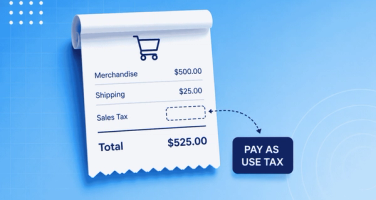
Article
Use Tax for Ecommerce Businesses: The 2 Ways It Catches Sellers Off Guard
Use tax is sales tax's lesser-known sibling, owed on untaxed vendor purchases and inventory used internally. This covers both scenarios, and what to check.
Topic hub
Articles, videos, podcasts and webinars on Sales Tax for ecommerce brands.
Free assessment · 20 questions · 6 min
Most ecommerce sellers have more sales tax exposure than they realize, especially once economic nexus, marketplace sales, wholesale transactions, and registration timing all get factored in. This assessment scores your exposure across nexus awareness, registration status, historical risk, and enforcement factors, then tells you exactly where you stand and what to do next.
Use tax is sales tax's lesser-known sibling, owed on untaxed vendor purchases and inventory used internally. This covers both scenarios, and what to check.

Streamlined Sales Tax lets qualifying remote sellers get registration, calculation, and filing free across 24 states. This covers who qualifies, and limits.

The Shopify sales tax report is dense enough that most sellers need a system to make sense of it. This covers key columns and building a pivot table by state.

Shopify isn't a marketplace facilitator, so collecting sales tax correctly is entirely on you. This covers nexus, registration, and taxability before setup.

Shopify sellers have two sales tax options: Shopify Tax or Avalara for Shopify. This compares pricing, features, and limits on automated filing for each.

Sales taxability comes down to three questions: where, who, and what. This breaks each down with examples, from Colorado's rates to Massachusetts's cutoff.

Sellers turn on Shopify tax collection, sell on Amazon, and assume compliance is handled. This walks through the gaps that assumption leaves behind. Amazon remits under marketplace facilitator laws but never registers you, and FBA inventory creates physical nexus in every state it sits in. Shopify collects nothing on its own. You also get the difference between collecting without remitting and never collecting at all, plus a five step cleanup plan.

Every month you put off sales tax, your exposure grows. Interest runs from the day the tax was due, and states will not waive it. Penalties range from 10% to 50%, and most states waive them through a voluntary disclosure agreement (VDA), but only if you come forward before a state contacts you. Kelley Birrell explains why never filing brings a longer lookback than filing late, and what shifts the moment a state's letter arrives.

A Washington seller got a polite letter asking about their sales. No threats, no penalties named. It was a nexus questionnaire, and because they paused before answering, they still had time to file a voluntary disclosure agreement (VDA) first. Stacy Walker sorts the four notices states send: nexus questionnaires, missing return notices, audit letters, and assessments. She explains the deadline attached to each and what answering too fast costs you.

Sell one unit into the UK and you owe VAT from that first sale, with no threshold to hide behind. Oliver Blackmore of Elver Ecommerce Accountants walks Stephen Brown through UK registration and why it now takes months, the EORI number that keeps your goods out of customs limbo, how Amazon's marketplace rules change who pays, and how postponing import VAT protects your cash. He closes with the EU, GST, and the end of drop shipping.

The legacy integration between Shopify Plus and Avalara shuts off on April 30, 2025, leaving roughly 6,300 businesses with a decision to make. Mac Wright explains what changed and what the migration involves. Then he and Stephen Brown pull apart what a tax engine actually does on every order: where, who, and what. One street in Aurora, Colorado is taxed at 4% on one side and 7.5% on the other.

An HS code is a passport for your product. Get it wrong and the parcel sits in customs, the carrier guesses a code that errs high, and your customer gets a surprise bill at the door. Brian Kelly of Avalara maps US sales tax concepts onto their global equivalents, explains what drives a tariff percentage, and covers the EU de minimis repeal taking effect July 1, 2026.

Forty-five states rely on sales tax as their single biggest revenue stream, which is why they keep hiring auditors and lowering thresholds. Christopher and Kevin from Avalara walk through the five steps of compliance, from working out where you have nexus to remitting the returns. Along the way: why New York taxes tacos but not burritos, why one neighbour gets all the packages, and what a VDA does to a Texas look-back period.
Six years after Wayfair, the grace period is over. States are buying seller lists, pulling data from marketplaces, and auditing back to 2018. Lauren Maillard walks through the business activity questionnaires arriving from Illinois and Washington, the two ways to get compliant, and how to decide between them. Stephen Brown fields a heavy stream of audience questions on nexus, drop shipping, exemption certificates, and the new retail delivery fees.
A sales tax checklist for ecommerce sellers covering nexus, taxability, use tax, exemption certificates, audit prep, license renewals, and state changes.

A step-by-step guide to the 10 steps of ecommerce sales tax compliance, from finding nexus to filing, plus software comparisons and a state threshold chart.
The five steps international sellers must take before applying for a US sales tax permit, from getting an FEIN to handling paper registrations.


LedgerGurus resolved years of sales tax issues, cleaned up the books, and created clear channel-level reporting. Micro Balance Health Products can now see what’s profitable, make smarter decisions, and plan with confidence.
“We can plan everything with confidence. We know how each part of the business is doing and how our decisions will impact it. It’s been game-changing for all of us.”: Micro Balance Health Products


LedgerGurus took over sales tax, bookkeeping, and reconciliations, with monthly gross profit margin reports and KPIs. Beddy’s gets a full team of specialists through one company.
“Whenever I have a question, I know exactly who to contact, and I get an answer quickly, and I’m confident that the answer that I’m getting is correct.”: Beddy’s
Yes, dozens of states run temporary sales tax exemptions each year, most commonly back-to-school (clothing and school supplies), disaster preparedness, energy-efficient products, and a handful of miscellaneous categories like hunting gear. Most states require every registered seller to comply, online included, and using an automated sales tax engine doesn't remove the responsibility, your product tax codes still need to be mapped correctly for the exemption to actually apply.
Read: Sales tax holidays sellers need to knowYes. US sales tax is based on where your buyer is, not where you're located, so selling into the US can create obligations wherever your business is based. Before registering in any state, you'll need an FEIN, a state business registration, and usually a US bank account and mailing address.
Download: Get the international seller checklistYes. When products leave inventory for donations, giveaways, marketing, or internal use like R&D, you should accrue and pay use tax on them through your sales tax returns. Use tax is a frequently audited area, so it's worth checking every year.
Download: Check use tax in your year-end reviewWe use cookies to improve your experience and to measure how our site and ads perform.Read our Cookie Policy