

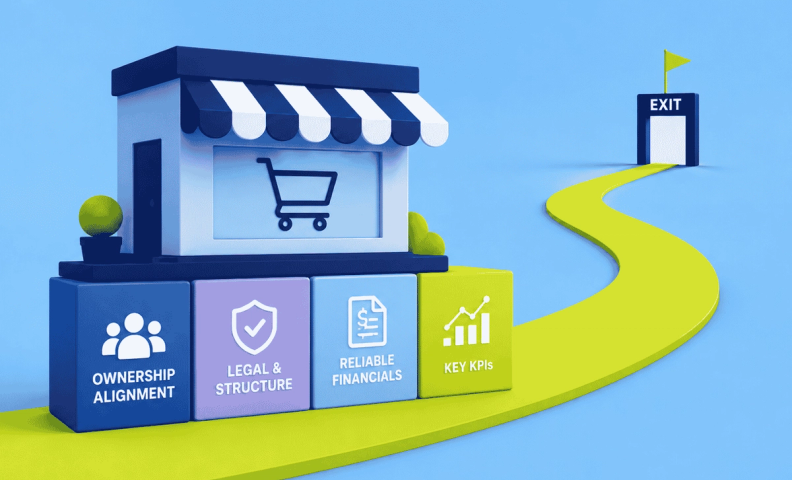
Whether you're ready to exit your ecommerce business soon or not, these four areas are worth paying attention to now. (If you're already within 12-18 months of selling, you may want to jump straight to our tactical sale-prep checklist instead.)
Here are 4 specific areas that will help you improve your current business performance now and maximize your exit later.
Why should you care about this right now?
Maybe you are wondering why we're talking about an exit plan when you're still in the throes of building your business. Fair question.
It's kind of like when you go to sell a house. Many people move into a new house and have lots of ideas for things they want to change & update. But then they get comfortable and/or busy and never get around to it, even though these projects will make their home more comfortable and enjoyable to live in now, along with increasing the market value.
Instead, they wait until just before they put their house on the market to work as hard as they can to whip it into shape. If they're lucky (and if there's not too much work to do), after it's beautiful and ready to sell, they often wonder why they didn't do it sooner so they could enjoy it, too.
Or, they run out of time to finish all the things they want or need to do and end up taking a lower price on the house because it wasn't in tip-top condition. They waited too long and let too many things slide, so it cost too much time & money to fix it all, let alone make it highly desirable to the highest bidders.
Does this sound familiar?
Let's apply this to your ecommerce business
Strategically planning and preparing for an exit from their ecommerce business is something a lot of owners fail to do. But the consequence of this failure to act is that the business may not be in good shape or may not be ready to sell when the owner is ready to exit.
On the other hand, most successful entrepreneurs are thinking about their exit strategy from the very beginning. Knowing you plan to hand over the reins and get the best return on your investment of time, money, and effort means it's a good idea to structure things now so that you can go through the process as smoothly and easily as possible when you are ready. It makes it easier to see the big picture and put a plan in place to improve business practices now and maximize its value for your exit.
If you focus on these areas now, you can enjoy the benefits of a solid business today AND have it in tip-top condition and worth its max value when you're ready to exit later.
Here is more detail on 4 of the most important areas to pay attention to now to prepare for an exit.
Is your ownership aligned with your ecommerce business exit plan?
Anyone in your business that has ownership and/or is involved in executive team decisions should be aligned on an exit plan. This is KEY to moving your business into a position for an exit and to gaining the trust of potential buyers.
It is a very good idea to agree early on about the following:
- A timeline of when to exit
- Goals & vision for the company before & after an exit
- A timeline of ownership involvement post-exit
- Clearly defined equity ownership & decision-making structures
Do you have the correct legal & organizational structures in place?
A strong legal & organizational structure gains the confidence of buyers and reduces potential deal-breaker scenarios.
Are you considering the following and their implications?
- Contracts w/ employees & vendors
- Protections in place for intellectual property, products, team, etc.
- Clearly defined roles for team members
- Goals & alignment
Do you have reliable financials?
Clean and reliable financials are the starting point when it comes to valuation when you are ready to exit your business. For ecommerce businesses, there are several accounting aspects that are unique to ecommerce and can drastically impact your valuation if they are misunderstood. This is due to the fact that ecommerce accounting is so different from any other kind of accounting.
Here's a specific checklist of questions to ask yourself:
- Are you accurately recording sales from your sales channels, instead of recording deposits in your bank account as “Sales”?
- Does your balance sheet have an inventory balance that changes frequently?
- Is your gross profit margin fairly stable from month-to-month and year-to-year?
- Is your sales tax recorded on your balance sheet as a liability, instead of an expense on your P&L?
If you answered “no” or you're unsure of the answer to any of these questions, you can download “5 Ecommerce Bookkeeping Warning Signs.”
Are you tracking & optimizing key financial & business performance indicators?
When it comes to the sale of your business, there are certain Key Performance Indicators (KPIs) that every buyer will want to see.
We categorize these into three tiers of importance:
- Tier 1 (must-track): the core financial and operational metrics every buyer expects to see, things like revenue growth, gross margin, and customer acquisition cost.
- Tier 2 (strongly recommended): metrics that round out the picture of business health, like customer retention rate, inventory turnover, and channel diversification.
- Tier 3 (nice to have): category- or business-specific metrics that may matter a lot for your particular business even though they're not universal, like SKU-level profitability or fulfillment cost per order.
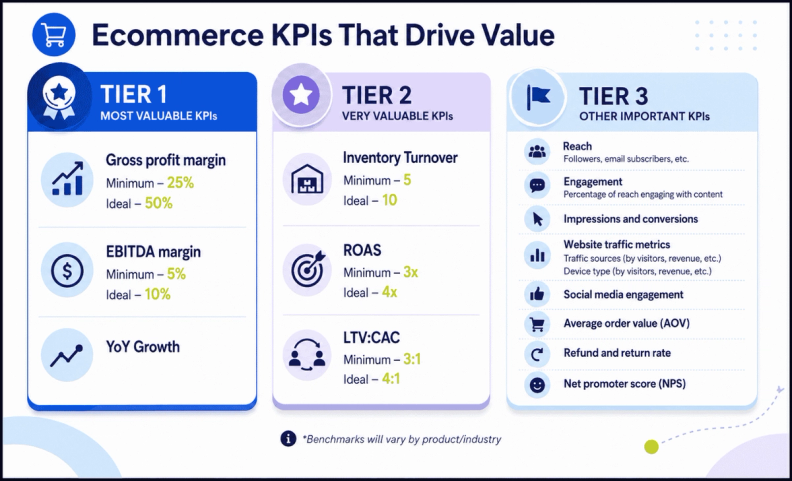
You can also download our most recent Ecommerce KPIs Report based on our own clients’ financials (anonymized, of course!).
Benchmarks will differ by category and industry, and there may be metrics not on this list that are also important to your business. You should identify which ones are most important for the success & sale of your business, and start tracking them. From there, you can optimize them to make your business as strong and successful as possible.
These are some of the most important topics to pay attention when you're preparing to exit your ecommerce business. If you're getting closer to an actual sale timeline, our guide on maximizing your ecommerce business's sale price walks through the tactical, financial-metric-level checklist to work through in the 12-18 months before you list.
Frequently asked questions
When should I start preparing my ecommerce business for an eventual exit?
As early as possible, even if you have no plans to sell soon. Waiting until you're ready to list often means you don't have time to fix things that would have added real value.
What does "ownership alignment" mean for an exit plan?
It means every owner and executive decision-maker agrees early on the exit timeline, the vision for the company before and after the exit, how involved ownership will stay post-exit, and how equity and decision-making are structured.
What legal and organizational issues do buyers look for?
Buyers look for solid contracts with employees and vendors, protections for intellectual property and other assets, and clearly defined roles across the team. Gaps here are common deal-breakers.
Why are "reliable financials" harder for ecommerce businesses specifically?
Ecommerce accounting has quirks that don't show up in other industries: recording actual sales instead of bank deposits, accounting for constantly shifting inventory, and treating sales tax as a liability rather than an expense. Getting these wrong can distort your valuation.
Which KPIs should I be tracking before an exit?
The right KPIs vary by category and industry, but buyers will want to see the ones that matter most for your specific business tracked and trending in the right direction, not just reported.
Start building toward your best exit, whenever it comes
Whether you're planning to exit next year or a decade from now, ownership alignment, legal structure, reliable financials, and the right KPIs are worth getting right today. LedgerGurus specializes in ecommerce accounting, and we can help make sure your financials are one less thing standing between you and a strong valuation whenever you're ready.
