

Shipping can account for up to 25% of an ecommerce company's costs, and that pressure keeps building: prices keep rising, international shipping isn't cheap, and customers expect free or low-cost delivery no matter what it costs you. Cutting shipping costs is one of the most direct ways to protect your margins and free up money to reinvest in growth. Here's where to look.
Negotiate rates: Benchmarking vs. cost-modeling
There are two main approaches to negotiating shipping rates and discounts: benchmarking and cost-modeling.
Benchmarking
Most shippers focus on two things when trying to get favorable rates and discounts
- The dollar amount
- The volume being shipped
This is called “Benchmarking”.
Benchmarking is the simpler, more common approach: shippers compare their rates and shipping volume against similar companies, in the same industry or a similar product category, and use those comparisons to negotiate similar discounts.
It's an easy way to get a general sense of what the market is doing, but the comparisons aren't always accurate. Two companies can look similar on paper and still have very different shipping profiles, which means benchmarking can lead you to negotiate for either less or more than a carrier can actually offer, and it tends to skip over important details buried in the agreement's fine print.
Cost-modeling (our recommended approach)
Cost-modeling looks at the carrier's actual costs and your specific shipment characteristics, rather than comparing yourself to other companies. It takes more work, but it builds a better, more accurate relationship between you and your carrier because it's grounded in your real shipping profile rather than a rough comparison.
A few things that affect a carrier's cost, and therefore your negotiating leverage:
- Delivery density: Shipments to spread-out, "out of the way" addresses cost carriers more than shipments concentrated in a dense area, since dense routes can be split across multiple deliveries in one trip.
- Air feed costs: If a shipment needs a domestic flight before its international leg, it usually costs more, since domestic flights tend to already be full, sometimes requiring the carrier to add a second plane or borrow cargo space. Somewhat counterintuitively, it's often the domestic leg driving the extra cost, not the international one.
- The agreement's fine print, especially the ground minimum per shipment. Both UPS and FedEx set a minimum package charge equal to their "Zone 2, 1 lb. package" rate. If most of your packages fall in the 1-15 lb. range, negotiating a steeper discount percentage may not actually save you anything, since your rate can't drop below that minimum, regardless of the discount. Know your weight mix before you negotiate, so you're not chasing a discount that won't apply.
Choose the right carrier for your delivery area
If your customers are concentrated in one region, a regional carrier can often beat a national one on price and delivery speed for that area. It's worth comparing rates for your specific delivery footprint rather than defaulting to whichever national carrier you've always used.
Watch for additional carrier fees
Carriers charge extra for things like delivery signatures, Saturday delivery, and fuel surcharges. Review which of these you actually need. If Saturday delivery isn't essential for your customers, for example, scheduling shipments to avoid it is an easy way to skip that fee entirely.
Use third-party shipping insurance
Carriers typically charge more for their own shipping insurance than third-party providers do. Third-party providers can often be up to 50% less than carrier rates.
Cut packaging costs
Once your carrier relationship is dialed in, packaging is the next easiest place to find real savings.
- Reuse packaging: If you receive inventory or supplies in good boxes, bubble wrap, or packing paper, reuse it for outgoing orders instead of buying new materials. It's a direct cost cut and a nice bonus for sustainability.
- Look for carrier discounts: If you ship USPS Priority Mail or Priority Mail Express, purchasing postage through Express1 gets you a discount regardless of your shipping volume. UPS offers free shipping supplies through its website, and DHL Express will send free supplies on request.
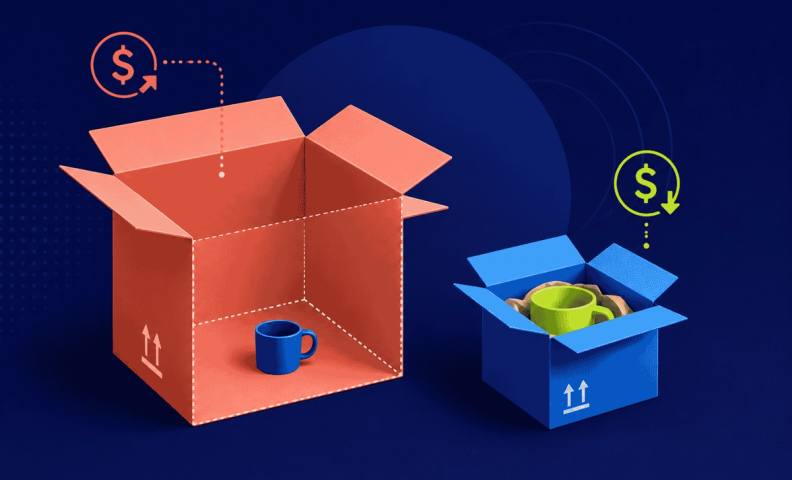
- Right-size your packaging: Carriers often charge based on "dimensional weight," meaning the box's height, length, and width relative to its actual weight, not just the weight itself. Using packaging that actually fits your product, instead of oversized boxes, can meaningfully cut this fee.
Use a shipping platform
A shipping platform saves both time and money, especially for ecommerce businesses. Tools like ShipStation integrate with platforms like Shopify, Amazon, and WooCommerce, so orders upload automatically when a customer checks out (you can also add orders manually). When you're ready to ship, you just enter the shipment details and print the label.
Consider outsourcing your shipping
Managing fulfillment in-house takes real time, and for your top-selling products especially, outsourcing can improve the customer experience while keeping costs down. Fulfillment partners like Amazon's multi-channel FBA can lower costs and speed up delivery.
Shipping consultants are another option worth exploring, they can often unlock volume discounts you wouldn't have access to on your own.
Audit your shipments for refunds
Carriers owe you a refund when shipments arrive late. If you don't have the bandwidth to track this yourself, services like Share a Refund audit your shipments for you and take a cut of whatever they recover.
Final thoughts
Understanding how to reduce shipping costs creates room to reinvest in growing your business. Focus on negotiating through cost-modeling rather than benchmarking, stay alert to avoidable fees, be intentional about your packaging, and consider partners who can help make shipping faster, easier, and more cost-effective. It's time to ship smart.
Frequently asked questions
Should I negotiate shipping rates using benchmarking or cost-modeling?
Cost-modeling. It's more work upfront, but it's based on your actual shipment characteristics and the carrier's real costs, rather than a rough comparison to similar companies, which leads to more accurate rates and a better long-term carrier relationship.
What is dimensional weight, and why does it matter for packaging?
Dimensional weight is a pricing method carriers use based on a package's size (height, length, and width) relative to its actual weight, not just the weight alone. Oversized packaging can trigger these fees even for a lightweight item, so right-sizing your boxes is one of the easiest ways to cut shipping costs.
Is it cheaper to use a carrier's shipping insurance or third-party insurance?
Third-party insurance is typically cheaper than a carrier's own insurance. Rates vary, so it's worth comparing current pricing, but third-party insurers have historically undercut carrier rates meaningfully.
When does it make sense to outsource fulfillment instead of handling it in-house?
It's especially worth considering for your top-selling products, where order volume is high enough that in-house fulfillment becomes a time drain. Outsourcing to a partner like Amazon's multi-channel FBA can lower costs and improve delivery speed at the same time.
What should I do if my shipments consistently arrive late?
Most carriers owe you a refund for late deliveries. If tracking this yourself isn't realistic, third-party auditing services can monitor your shipments and recover refunds for you, typically for a cut of what they collect.
See exactly where your shipping dollars are going
Shipping is one of the biggest line items in ecommerce, and it's also one of the easiest to lose track of. LedgerGurus can help you get clear, accurate visibility into your true shipping and fulfillment costs, so you know exactly where to negotiate, cut, or optimize.
