

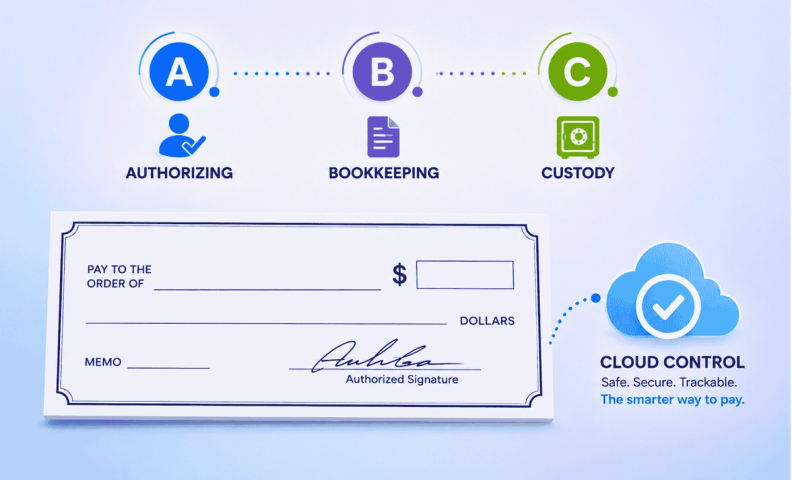
One of the biggest pains that handcuff owners of a growing business to their desk is handling bill payment. Don't believe me? Ask a business owner who understands the embezzlement risks they face and has grown large enough for bill payment to become a real pain point.
Common business bill payment issues
When a business first launches, bill payment is often a non-issue. You've got a few things on auto-pay and a check or two you cut here and there, no big deal. You're lured into a false sense of security, because that changes as your business grows.
Let’s fast forward a couple years. Another text from your bookkeeper asking you to come in and sign some checks, the last thing you want to do before leaving for vacation in the morning. You could wait until you're back, but there's that one check that really needs to go out before you leave. So, you drive in and sign the check. Then you're on vacation and some vendor calls about a late payment, and you're scrambling to fix it from your phone. Eventually, you get tired of it and start leaving a couple of signed, blank checks in a drawer just in case.
Risk of embezzlement
Now you've set yourself up for embezzlement, and you may not realize how likely that actually is. Want to know how many clients we pick up because their previous in-house bookkeeper embezzled from them? It's a startlingly large percentage, and in almost every case, it happened in conjunction with business bill payment. For a closer look at how this actually plays out, see our podcast episode on ecommerce accounts payable fraud.
Most business owners we know start with good controls around bill payment. They approve, sign, and distribute checks themselves. When a credit card payment is needed, they make it directly instead of handing card info to an employee. But this gets inconvenient fast, and once the frustration sets in, they start looking for shortcuts that quietly open the door to fraud. The only two options they see are:
- Staying highly involved in the bill payment process, with a lot of inconvenience.
- Handing it off to someone they trust completely and creating shortcuts along the way. This is where embezzlement becomes real, and it's worth remembering that everyone who's ever been embezzled from trusted that person completely to begin with.
A typical scenario for business bill payment
We often see a bookkeeper handling everything related to paying bills: a box of checks in their office, a signature stamp in their desk drawer, and full bank rights with no one else authorizing payments. Does this sound familiar? You can probably already see the problem here.
Business bill payment solution
The good news: In today's world of cloud accounting, there's a real solution to bill payment purgatory. Before we get to it, let's put the problem in the context of the ABC's of segregation of duties.
The ABC’s of segregation of duties
To maintain good internal controls around your business's cash, if anyone besides the owner touches bill payment, different people need to handle each part of the process:
- Authorizing: The signing of checks and approval of all payments
- Bookkeeping: Recording the bill payment transactions in your accounting software
- Custody: The possession of blank checks
In the typical scenario above, the bookkeeper had authorizing (signing and initiating checks), bookkeeping (letting them cover their own tracks), and custody (the checks themselves) all at once. That's a textbook setup for embezzlement, and small businesses see more of it than larger ones, mostly because they simply don't have the staff to separate these roles. Most small businesses are lucky to have one person on their accounting staff, let alone three.
Here's the good part: you can cover all three roles without adding a single person to your accounting staff. The process is clean enough that you can outsource your business bill payment entirely and still keep perfect control.
The solution
We don't own any of the apps we're about to describe, so this isn't a commercial for them. Just picture this:
While vacationing in Cabo, you get a notification: bills are ready to approve. You pull up the app, see each one queued with its PDF, amount, and vendor info attached. You review, approve what looks right, and flag anything that doesn't for your accountant to check. Approved bills go out by ACH or a check the app prepares and sends.
You only had to approve the payment. Nothing gets paid without that approval, so you never lose control of the process, you just get to do it from anywhere, in a couple of minutes.
Now picture a complete history of every bill you've paid, with the original PDFs attached, and visibility into whether your vendor actually received payment, all with almost no effort on your part. Your accounting software updates automatically with everything. One person, an internal bookkeeper or an outsourced team like ours, can manage the whole thing without you giving up a single control. Your ABC's stay covered:
- Authorizing is still you.
- Bookkeeping updates automatically (your bookkeeper can oversee accuracy).
- Custody stops being a concern entirely. There are no blank checks to hold.
We wish LedgerGurus were the magic-pill solution for bill payment. We can be part of it, but the real fix lives in the software. Our favorite tool for this is Bill.com (watch our full review). Once you've got the right tool in place, our guide on streamlining your accounts payable processes is a good next step for tightening up the rest of your controls.
Frequently asked questions
Why is leaving signed blank checks in a drawer risky?
A signed blank check hands over both authorizing and custody at once, which is exactly the setup that makes embezzlement easy. It removes the review step that would normally catch a payment that shouldn’t go out. Business owners usually land here after getting worn down by the hassle of signing checks one at a time.
What are the ABC’s of segregation of duties?
Authorizing, Bookkeeping, and Custody: the signing and approval of payments, the recording of transactions, and the possession of blank checks. Good internal controls mean different people handle each part. When one person holds all three, like a bookkeeper with checks, a stamp, and sole bank access, there’s nothing stopping them from covering their own tracks.
Can one person manage bill payment without creating a fraud risk?
Yes, with cloud-based bill payment tools. The owner still does the authorizing by approving each bill from an app, the bookkeeping updates automatically, and no one needs physical custody of blank checks. That covers all three roles without requiring three separate staff members.
How does cloud-based bill payment actually work?
Bills come into an app with the PDF, amount, and vendor details attached for the owner to review and approve. Once approved, payment goes out by ACH transfer or a check the app prepares and sends. Nothing gets paid without that approval, and the accounting software updates automatically with the activity.
What tool does LedgerGurus recommend for business bill payment?
Bill.com is our favorite for this. It's part of a broader case for outsourcing your business bill payment while keeping full control over what gets approved.
How we can help
Bill payment shouldn't cost you your controls or your sanity. Whether you set up Bill.com yourself or want it done for you, LedgerGurus can implement clean bill payment processes that keep your ABC's covered (authorizing, bookkeeping, and custody) without chaining you to a desk or trusting the whole process to one person. Let us build the system so you can approve payments from your phone and never think about blank checks again.
