

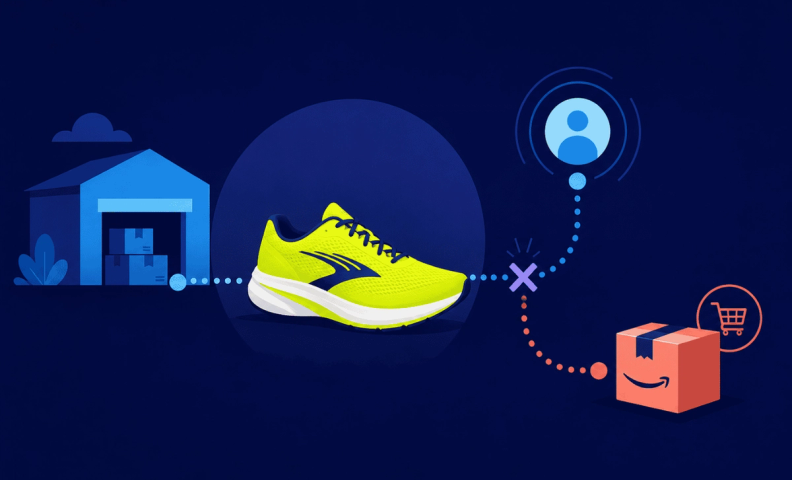
Ecommerce fulfillment and sales performance go hand-in-hand. You're probably thinking, "no duh." But let's take a step back with a real example of what happens when fulfillment breaks down, and the financial impact that follows.
Shoes and ecommerce
I am a runner and every so often will run a marathon. In training for and running marathons, shoe purchases go up to 3-4 pairs a year. Most serious runners become very committed to a brand and model of shoes. They buy them repeatedly because injuries happen, so don't break what's working. For years I stuck with one brand until they changed my favorite shoe, so I switched to a different one and never looked back (side note, I still love the old brand's apparel).
A few years ago, I realized that I was buying the same shoe every time until the next version came out. My purchase process was going to the running store, throwing them on, realizing nothing changed, and buying them. Lots of time driving, putting on a shoe that hadn't changed, and buying through inefficient point-of-sales systems. Sorry local running stores, but it's so much easier to buy online where my shoes show up 2 days later. I still buy from a store when the next version comes out because that's when things can go bad, but ecommerce is so much easier otherwise.
Searching for the perfect pair
Last month, I realized I was going to need another pair of shoes for an upcoming marathon, so I wanted to make it count. I wanted a good color, something that gave me a boost during those 26.2 grueling miles, and the selection at running stores or on marketplaces was limited.
What about giving some love to Brooks and buying direct? I could pick my favorite color and who doesn't do ecommerce well these days? Fluorescent yellow was the clear choice and I ordered, with some surprise that it would be 10-14 days before I received my shoes. While disappointed in the timeline, I had time before I needed to retire my current pair of shoes, so I was alright waiting.
I checked their website every few days on the order status with no updates, but I thought I would get an email or update when it shipped. Then I received this message 11 days later:
“Hi Stephen, it's with a heavy heart that we have to tell you that we cannot complete your order. We have moved our distribution center to a brand new facility to help us provide better and faster service to customers like you. We have seen unexpected delays to our customers' orders as we adjust to this transition. Call it growing pains. When we went to ship your order, we discovered that we do not have the inventory and we are not able to complete your order at this time. We are not proud about the unexpected detours we have had to take, but we would like to take the right path to attempt to make it right with you. We would like to offer you a 25% discount for your next purchase.”
I was disappointed. How does it take 11 days to figure out the product is not available? Better yet, the exact shoe was still available on their website? I should have ordered again just to get another 25% discount.
Poor ecommerce fulfillment means brick and mortar
My quest turned to the local running store, hoping they would have better color selection than usual. Sadly, they not only didn't have that color, they had no shoes from this brand in my size. This was due to fulfillment problems from the brand to retail stores over the previous few months. I wasn't mad at my local store, and still wasn't mad at the brand itself, but it was surprising that a company of their size could end up in such a mess.
Amazon to the rescue
Luckily, shoe loyalty is deep. So, while in my car in the running store’s parking lot, I went to Amazon and ordered a different-colored pair from my phone. Lost were the direct profits to the brand and the modest margins to my local store, while some retailer smart enough to do Fulfillment by Amazon (FBA) and be Prime Eligible won my business instead. This is one small example, but I want to peel back the layers and explore the relationship between ecommerce fulfillment and sales.
Ecommerce fulfillment woes
After finishing my purchase, I thought: How does a well-established, well-funded athletic brand end up this bad at ecommerce? Digging deeper, I saw plenty of other people online noting similar fulfillment problems with the same brand.
Perhaps it was tariff troubles that led to a manufacturing shift to a new country. That's understandable, yet it still doesn't explain the long fulfillment times and poor inventory management. Perhaps the delays trace back to that manufacturing switch. But that doesn't explain why their inventory and ecommerce systems were out of sync in the first place. Every customer wants to accurately order a product and get it quickly.
Sales impacts
I got lucky. My purchasing challenges didn't stop me from eventually buying the shoes, but the same experience could easily have pushed a more casual shopper to a competitor entirely. That's one lost sale. Multiply that across enough product categories, and plenty of those choices go elsewhere for good.
At minimum, fulfillment issues like this prolong purchase timelines and push customers toward less profitable channels than a brand's own direct site. That's fewer sales, less profit, or both.
Lessons for ecommerce fulfillment
It's an obvious point, but worth stating plainly: good ecommerce fulfillment equals sales and profits. In this case, poor inventory management hurt both the brand's direct and retail channels at once. Whether the root cause was tariffs, a manufacturing switch, or something else internally, the outcome was the same for the customer.
Understanding your supply chain, your inventory, and your sales demand is critical for hitting sales targets and keeping customers happy. Not every company has the built-in brand loyalty that running shoes do, so this is worth thinking about seriously as you grow your own ecommerce sales.
For more information, read How to Prevent Overselling: 14 Tips to Stop Losing Sales to Stockouts.
Frequently asked questions
How does poor ecommerce fulfillment affect sales?
A single fulfillment failure, an order that can't be completed or ships late, can push even a loyal customer to buy from a competitor, a marketplace, or a different retailer instead, costing you the sale now and potentially in the future.
What usually causes ecommerce fulfillment failures?
Poor inventory visibility, not knowing what you actually have in stock, is often the real root cause, more than shipping delays themselves.
Can a fulfillment failure cost me a sale even if my customers are loyal?
Yes. Brand loyalty buys you some grace, but it isn't unlimited. A loyal customer might still buy from you eventually, but a fulfillment breakdown pushes even them toward a competitor or a marketplace in the moment, and a less loyal customer may not come back at all.
How does a manufacturing or supply chain shift lead to fulfillment problems?
Changes like shifting production to a new country can create short-term disruptions in lead times and inventory accuracy. That's not an excuse for poor fulfillment, but it's often the root cause behind a sudden drop in a previously reliable brand's performance.
What should ecommerce sellers actually do to avoid this?
Keep a clear, accurate, real-time view of your inventory across every channel you sell on. Most fulfillment failures trace back to a business not actually knowing what it has in stock, not to shipping carriers or bad luck.
Don’t let poor visibility cost you sales
Brooks lost a sale not because of bad products, but because they didn't know what was actually in stock. LedgerGurus' inventory accounting and consulting services can help make sure your inventory data is accurate and in sync with your ecommerce systems, so you're never the company sending that "we can't complete your order" email.
