

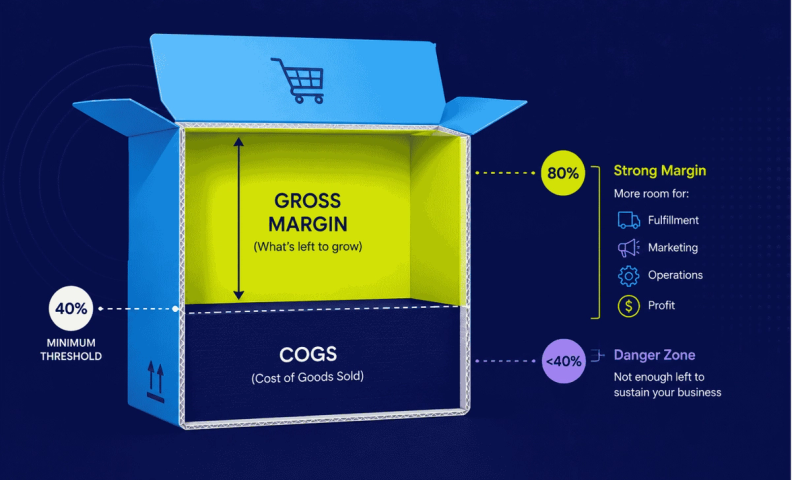
What counts as a good gross margin in ecommerce? Every brand selling online should be asking this question because, in the world of ecommerce, gross margins can make or break your business. Whether you're a growing brand or an established business, understanding your gross margin is the first step to boosting profitability and staying competitive.
You can also watch our video: Ecommerce Gross Margin: What's a Good Range and How to Improve It.
What is gross margin?
Gross margin is the percentage of your sales revenue left over after covering the costs of making and stocking your products. In other words, it's what remains once the direct expenses, called Cost of Goods Sold (COGS), are covered.
So, what's included in COGS? They are the costs of producing a product and getting it to your warehouse ready to be sold. This includes the costs of:
- Manufacturing your product
- Packaging it up
- Inbound shipping to your warehouse
- Tariffs
- Any other fees required to get the product from the factory to your warehouse
Essentially, COGS covers every direct cost involved in making your product available to customers. For more information, read How to Calculate Cost of Goods Sold for Ecommerce Sellers.
An accountant's nerdy, technical definition of COGS
A common mistake sellers make is treating all variable sales costs as part of cost of goods sold. This would include things like:
- Fulfillment costs
- Merchant fees
- Advertising
But technically, this is not correct according to Generally Accepted Accounting Principles (GAAP). Adhering to GAAP can be important because investors, lenders and potential buyers usually expect to see accounting in this format.
GAAP guidelines for COGS
According to GAAP, only the direct costs associated with producing or buying products should be included in COGS.
Here's what that usually covers:
- Raw materials: For manufacturers, this means the cost of materials used to make the finished goods.
- Labor costs: This includes wages for employees directly involved in production, like factory workers. For retailers or ecommerce businesses, this might also include fees for assembling or packaging products.
- Manufacturing overhead: These are indirect costs directly related to production, like factory rent, utilities, and equipment depreciation. These costs are assigned to products based on accounting methods like absorption costing.
- Purchased products for resale: For retailers and ecommerce businesses that buy products to resell, the purchase price of those products is included in COGS. This is typical for ecommerce sellers who buy inventory to resell on platforms like Amazon or Shopify.
- Freight-in (Inbound shipping): This covers the costs of shipping materials and products to a warehouse or store. For ecommerce, it includes the cost to bring products from suppliers to your warehouse.
- Customs and import duties: If you're importing goods, any tariffs, customs duties, or import fees paid to bring inventory into the country are part of COGS, as they are necessary to get your products ready for sale.
Exclusions from COGS under GAAP
According to GAAP, indirect costs (those not directly tied to making your products) should not be included in COGS. Instead, they're classified as operating expenses. Here are some common expenses that GAAP excludes from COGS:
- Selling expenses: Costs like advertising, marketing, and distribution fees (think Amazon's referral and advertising fees) fall under selling expenses, not COGS.
- Fulfillment costs: For ecommerce, expenses for fulfilling orders – like shipping products to customers or warehousing finished goods – are treated as operating expenses, not COGS.
- Administrative and overhead expenses: Office rent, salaries of administrative personnel, and utilities unrelated to production are considered general operating expenses, not COGS.
- Outbound shipping costs: Costs to ship products to customers are classified as delivery or fulfillment expenses, not COGS, so they go under operating expenses.
- Storage costs (if not production-related): While storing raw materials used in production might count in COGS, storing finished goods or inventory before it's sold is generally recorded as an operating expense.
What is a good gross margin for ecommerce?
We've reviewed hundreds of ecommerce businesses, listened to countless podcasts, and read way too many blog articles to come up with a recommended benchmark. Generally, for ecommerce and consumer products businesses selling online, a good gross margin falls between 40 to 80%. This range depends on your manufacturing costs, product type, and business model. At a minimum, aim for a 40% gross margin. Here's why:
- You'll probably need about 10-15% of sales for fulfillment costs.
- Expect around 3% of sales for credit card merchant fees.
- Advertising costs can vary wildly. For efficient advertising, spending 20% of sales is excellent, while 33% of sales is still good.
What's left over after these costs is your contribution margin, the portion of each sale remaining after variable costs like fulfillment, merchant fees, and advertising. Your contribution margin goes towards covering operating expenses like payroll, software, non-advertising marketing expenses, rent, etc. What's left over after operating expenses is (hopefully!) your profit.
What is the minimum gross margin for ecommerce?
If your gross margin is around 40%, you won't have much room to spend on advertising since fulfillment and operating expenses will eat up most of what's left. Brands with lower gross margins are usually those that buy products to resell rather than selling their own branded products.
For resellers, heavy competition often drives down prices, which squeezes your margin. Customers tend to find these products through search, so having strong SEO can help you bring in sales without relying too heavily on paid advertising.
The implications of a low gross margin may include:
- Marketing constraints: There is little leftover to spend on marketing
- Operating constraints: There is little leftover for payroll, rent, software, etc.
- Difficulty in achieving profitability: Your profit margin will never be greater than your contribution margin which will never be greater than your gross margin.
- Unable to get affordable lending: Many lower cost private lenders want to see at least 40% gross margin.
What is the maximum gross margin for ecommerce? If you are selling your own brand, you can potentially see margins of 80% or higher, though this often depends on your product category.
For example, Ecommerce Tips highlighted 22 Products with High Profit Margins that can have impressive markups. However, these examples only consider the product cost, not the full landed cost, which includes inbound shipping, tariffs, and other fees. Unique products also have an edge when it comes to pricing power, which can lead to higher gross margins.
Branded products are another story. The brand itself adds value, turning a physical product into something more. The right combination of logo, design, communication, and customer experiences can make a product feel special, even beyond its features. With branded or unique products, you'll often need those higher gross margins to support the extra advertising spend required to get in front of customers and build awareness.
Gross margin benchmarks for ecommerce
Looking for ways to benchmark your gross margin? Here are a few helpful resources:
- AMP Ecommerce Benchmarks: This is a handy interactive tool where you can benchmark your business based on things like product type, category, selling model and customer type.
- Retalon's Gross Margin Return on Inventory Investment: This metric shows how much gross margin you're making for every dollar you invest in inventory. You can read more about it in 10 Most Important Ecommerce KPIs to Measure in 2024.
- Our own LedgerGurus benchmarks report based on our own clients’ numbers
Gross margins for Amazon sellers
Gross margins for a product are generally similar, no matter where it's sold. However, selling on Amazon can affect your margin in a few ways:
- Price: Amazon's Buy Box competition encourages the lowest possible prices, which can push your selling price down compared to your Shopify store. A lower price with the same landed product costs means a lower gross margin.
- Inbound shipping fees: Any costs to get a product to the warehouse are considered part of COGS. Some key fees here include:
- Import fees, like taxes and duties
- Inbound fees, including Amazon's new Inbound Placement fee
- Manufacturing and production fees
The actual list of fees can be exhaustive. Here is a good article on them: Amazon Seller Fees & Transactions: A Comprehensive List.
There are plenty of other Amazon fees to consider as well. According to GAAP, these fees aren't part of COGS, but are counted as expenses for fulfillment, advertising, or payment processing fees. Accounting for all of these can be a huge pain, which is why tools like A2X exist to help simplify things and make it easier to get this right.
How to boost your ecommerce gross margins
Here are a few strategies to help you improve your gross margins:
- Optimize pricing: Regularly review your pricing to find that sweet spot where you're maximizing revenue without losing too many sales. It's not just about raising prices; it's about setting a price that will truly maximize your profits.
- Negotiate with manufacturers: Better pricing from your supplier often comes with either switching suppliers or placing larger orders. As your business grows, so does your ability to negotiate better rates, which means better gross margins.
- Product quality improvements: Investing in higher-quality materials or better production methods can boost the perceived value of your product, which often leads to higher prices and improved margins.
- Branding: As we discussed earlier, a strong brand can add value beyond just the product itself, allowing for higher margins.
Each of these strategies has its own set of considerations, so take the time to weigh your options.
Optimize pricing
Here are some effective ways to fine-tune your pricing:
- Regular price reviews: Keep an eye on competitor pricing, demand trends, and what your customers are willing to pay. Adjusting based on these factors can help you stay competitive and profitable.
- Dynamic pricing: Adjust prices in real time based on market factors like time of day, day of the week, or seasonal trends.
- Price testing: Experiment with different price points to find the balance between sales volume and profitability. For example, try premium pricing for high-value items or bundle low-margin products with high-margin ones to increase overall margins.
- Pricing psychology: Use techniques like charm pricing ($9.99 instead of $10), product bundling, or creating a sense of scarcity. These strategies encourage purchases without actual discounts, enhancing perceived value and helping maintain margins.
Negotiate with manufacturers
Here are some ways to reduce manufacturing costs:
- Bulk order discounts: As your business grows, use your purchasing power to negotiate discounts on bulk orders. Larger order volumes typically lead to lower unit costs, which can directly improve your gross margins.
- Explore alternative suppliers: Look into other suppliers who might offer better rates. You might also consider sourcing from countries with lower production costs or favorable trade agreements to cut costs even further.
Product quality improvements
Here are some ways to boost quality and, in turn, increase your margins:
- Invest in quality improvements: When you improve a product's quality, customers are often willing to pay a bit more, which helps your margins. This might mean using better materials, enhancing durability, or adding functionality that increases value without driving up costs too much.
- Customer experience: Elements like great customer service, appealing packaging, and strong after-sales support add to the perceived value. When customers feel they're getting more than just a product, it's easier to keep prices (and margins) higher.
- Highlight unique selling points: Emphasize the qualities that set your product apart, like extra durability or unique features competitors don't have. Marketing these standout qualities can make your product more appealing and support a premium price.
Branding
Here are a few ways branding can boost your pricing power:
- Build key elements: Focus on branding essentials like storytelling, consistent visuals, and clear brand values to create a distinct identity that stands out.
- Niche audience: Cater to a specific audience that values what makes your brand unique. Niche audiences are often willing to pay a bit more for specialized products, which can lead to better margins.
- Partner with influencers: Influencers can help communicate your brand's value to potential customers, boosting brand perception and supporting higher prices without needing to rely heavily on traditional ads.
Why a strong gross margin is vital for a healthy ecommerce business
As you can see, there is a lot that goes into calculating and improving gross margins. For ecommerce businesses, healthy gross margins aren't just nice to have. They're essential for long-term success. Without strong gross margins, it's tough to cover expenses, let alone make a profit.
Improving them can feel challenging, but with the right insights and strategies, it's absolutely doable.
Frequently asked questions
What's the difference between gross margin and contribution margin?
Gross margin is revenue minus COGS (the direct cost of producing and getting a product to your warehouse). Contribution margin goes further, subtracting fulfillment, merchant fees, and advertising too, since those variable costs also come out before you reach profit.
Does fulfillment count as COGS?
No. Under GAAP, fulfillment costs, along with advertising and outbound shipping, are operating expenses, not COGS. Only costs required to get a product made and into your warehouse (raw materials, inbound freight, tariffs, production labor) belong in COGS.
What's the minimum gross margin an ecommerce business needs?
Aim for at least 40%. Below that, fulfillment (roughly 10-15% of sales) and merchant fees (about 3%) eat up most of what's left, leaving little room for advertising or operating expenses, and many lenders want to see at least 40% gross margin before extending affordable financing.
Why is gross margin usually lower for resellers than for branded products?
Resellers face heavier price competition since customers can easily comparison shop, which drives margins down. Branded and unique products carry pricing power that resellers don't have, which is why margins for branded ecommerce products can reach 80% or higher.
Does selling on Amazon affect gross margin differently than selling on your own website?
The product's underlying margin doesn't change based on where it's sold, but Amazon's Buy Box competition often pushes prices (and therefore margin) lower, and Amazon-specific inbound fees like the Inbound Placement fee can add to COGS in ways a direct website sale wouldn't.
Do you need some help boosting your gross margin?
At LedgerGurus, we specialize in helping ecommerce businesses understand and optimize their COGS, so they can get good gross margins.
Our team can give you a clear, accurate picture of where your business stands and where you can make improvements to boost profitability.
As a matter of fact, we consider analysis and financial planning to be so important that we've put together a dashboard for our customers to show all this information quickly and clearly.
In one place, we can show you all your most important ratios, as well as historical data to compare to and see if they are trending up or down.
Let us handle the numbers, so you can focus on growing your brand.
