

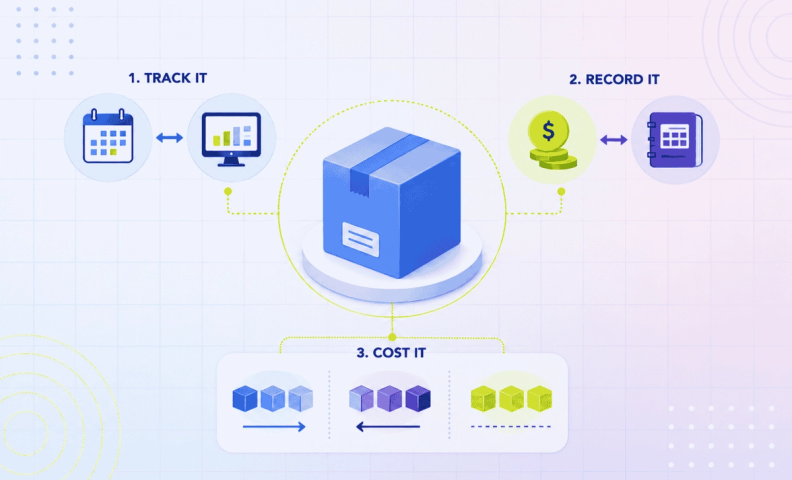
When you're running an ecommerce store, you need to know exactly what you have in stock, how much it's worth, and how quickly it sells. That's the essence of inventory accounting, and good inventory accounting helps you make smarter buying, pricing, and selling decisions, spot trends and discrepancies before they become problems, and manage cash flow with real numbers instead of guesswork.
The 3 decisions behind good inventory accounting
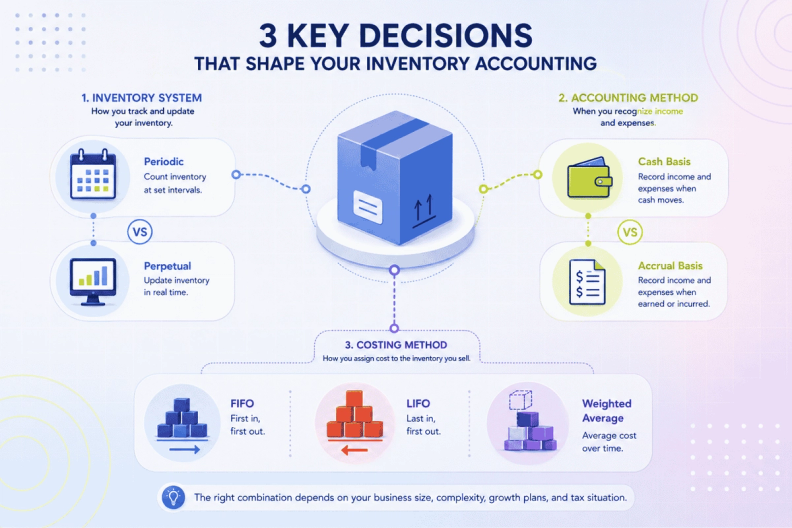
We have yet to meet a business owner who jumped into their business excited by the prospect of accounting for their inventory. (If you did, hats off to you!) In practice, you're forced into it by three questions that every ecommerce business has to answer:
- How do you track and update your inventory levels? (Your accounting system: Periodic or perpetual)
- When should you recognize and record revenue and expenses? (Your accounting method: Cash or accrual)
- How do you assign costs to your inventory items? (Your costing method: FIFO, LIFO, or weighted average)
Before diving into these three decisions, if you're not sure what counts as inventory in the first place, or how it works if you manufacture your own products, start with Inventory Basics for Ecommerce Sellers.
Vocabulary worth knowing first
A few terms come up constantly in inventory accounting. Two of them, COGS and inventory turnover, connect directly to the decisions ahead, so it's worth understanding them before you dig in.
Cost of Goods Sold (COGS) is the total cost of producing or purchasing the goods your business sells in a given period. It includes direct production costs (materials, labor, manufacturing overhead) as well as landed costs like shipping, customs and duties, insurance, and handling and storage fees. COGS directly impacts your gross profit, so calculating it accurately lets you set pricing that actually protects profitability.
Inventory turnover measures how often your inventory sells and gets replaced over a given period. A high turnover rate signals strong sales and efficient inventory use; a low rate can signal overstocking or weak sales.
For a full breakdown of how to calculate and improve it, see How to Calculate & Optimize Inventory Turnover for Ecommerce Sellers.
A few more worth knowing at a glance:
- Beginning inventory: The value of stock on hand at the start of an accounting period.
- Ending inventory: The value of stock on hand at the end of a period, i.e., what remains unsold.
- Inventory shrinkage: The gap between what your books say you have and what you actually have, usually from theft, damage, misplacement, or clerical error.
- Inventory write-off: The formal recognition that a portion of your inventory has lost its value and can no longer be sold.
With that vocabulary in hand, let's get into the three decisions.
Decision 1: Periodic vs. perpetual inventory systems
This decision answers: how do you want to track and update your inventory levels?
The periodic inventory system counts inventory at specific intervals, monthly, quarterly, or annually, by physically tallying stock on hand. It's simpler and cheaper to implement, making it a good fit for smaller businesses with less complex inventory. The tradeoff: since it only captures data at discrete points in time, it can lead to less accurate tracking and discrepancies between counts.
The perpetual inventory system continuously updates inventory records in real time as sales and purchases happen, using technology like barcode scanners and inventory management software (such as Finale or Cin7) to automatically adjust levels. It's more accurate and up to date, which helps with reordering decisions and reduces stockout risk, but it's also more expensive and complex to set up. For larger businesses with extensive inventory, the benefits of real-time tracking usually outweigh the cost. Watch our video on how an IMS delivers real-time sales insights.
Choosing between them: consider your business size and complexity, your budget (perpetual costs more upfront but often saves money long-term through better control), your inventory turnover (high-turnover businesses usually need perpetual's real-time accuracy), how well the system integrates with your existing tech stack, and your growth plans. If you're evaluating whether an IMS makes sense for you, see Is an Inventory Management System Right for You? A Practical Guide to Fit, Cost, and Selection.
Decision 2: Cash basis vs. accrual basis accounting
This decision answers: when should you recognize and record revenue and expenses?
Cash basis accounting records revenue and expenses only when cash actually changes hands. It's simple and popular with small businesses, and it gives a clear picture of cash flow, but it doesn't always reflect your true financial position, since it ignores receivables and payables until cash moves.
Accrual basis accounting records revenue and expenses when they're earned or incurred, regardless of when cash changes hands. It's more complex and requires more sophisticated bookkeeping, but it gives a more accurate, comprehensive view of profitability by matching income with the expenses that generated it. It's generally preferred by larger businesses and required for GAAP compliance.
The key question to ask yourself: for inventory specifically, do you record its cost when you buy it, or when you sell it? You don't have to fully commit to one method forever, many businesses transition from cash to accrual as they grow. For more detail, read Cash vs. Accrual for Inventory: The Accounting Mistake That Wrecks Your Margins and From Cash to Accrual: A Stage-by-Stage Guide as Your Ecommerce Business Grows
Decision 3: FIFO, LIFO, or weighted average costing
This decision answers: how do you assign costs to your inventory items?
FIFO (First-In, First-Out) treats your oldest inventory as sold first, using those older costs to calculate COGS. It usually aligns with how inventory physically moves, and results in lower COGS (and higher profits and taxes) when prices are rising. During inflation, though, it may not reflect current costs, which can distort profitability.
LIFO (Last-In, First-Out) does the opposite, using your most recently purchased costs for COGS. It typically results in higher COGS during rising prices, which lowers taxable income, and it matches current costs to current revenue more accurately. The tradeoffs: it can leave outdated values on your balance sheet, and it isn't permitted under IFRS, limiting its use for international companies.
Weighted average costing (WAC) averages the cost of all inventory items to calculate COGS, smoothing out price fluctuations and simplifying accounting. The tradeoff is precision. It may not reflect current market prices, especially during periods of significant price change.
Choosing between them: assess your business size, industry norms, and financial goals; weigh implementation complexity against tax implications; and revisit your choice periodically as your business or the market changes. For a deeper comparison, read FIFO vs. LIFO vs. Average Cost: How Each Inventory Costing Method Changes Your Numbers.
Inventory accounting best practices
However you land on the three decisions above, these practices help keep your inventory accounting reliable:
- Regular audits and reconciliations: Conduct periodic physical counts to identify discrepancies like theft or damage. See Inventory Basics for Ecommerce Sellers for a full breakdown of audit cadence and process.
- Use inventory management software when you're ready, to automate tracking and reduce errors.
- Use the costing method that fits your business, based on your model and financial goals.
- Monitor inventory turnover ratios to catch overstocking or weak sales early. (See also: Why Inventory Optimization Is Critical.)
- Train your team on inventory processes and accurate data entry.
- Review and update your processes regularly as your business and market conditions change.
Frequently asked questions
What's the difference between a periodic and perpetual inventory system?
A periodic system counts inventory at set intervals (monthly, quarterly, annually) and is simpler and cheaper, good for smaller businesses. A perpetual system updates inventory in real time using technology like barcode scanners and inventory management software, giving more accurate, up-to-date data, but at higher cost and complexity.
Should I use cash basis or accrual basis accounting for my inventory?
Cash basis is simpler and gives a clear picture of cash flow, but doesn't reflect your true financial position since it ignores receivables and payables. Accrual basis is more complex but gives a more accurate view of profitability, and it's what most larger businesses and GAAP compliance require.
What's the difference between FIFO, LIFO, and weighted average costing?
FIFO uses your oldest inventory costs first, usually meaning lower COGS and higher profits (and taxes) when prices rise. LIFO uses your newest costs first, usually the opposite effect, and it isn't allowed under IFRS. Weighted average smooths out price fluctuations using an average cost per unit, but it can be less precise during major price swings.
Can I switch between inventory accounting systems or methods as my business grows?
Yes, many businesses transition, for example from cash to accrual, or periodic to perpetual, as they scale and their needs change. There's no requirement to fully commit to one approach forever.
What is inventory shrinkage, and why does it matter?
Shrinkage is the difference between what your books say you have and what you actually have on hand, usually from theft, damage, misplacement, or clerical error. High shrinkage often points to bigger operational issues like weak security or poor internal controls.
How do I know which costing method is right for my business?
Assess your business size, industry norms, and financial goals; consider how complex each method is to implement and its tax implications; and revisit your choice periodically as your business or market conditions change.
Get your inventory accounting systems set up right
Choosing the right tracking system, accounting method, and costing approach isn't a one-time decision, it shapes your financial statements, your taxes, and how well you can actually run your business as you scale.
LedgerGurus specializes in ecommerce accounting, and we can help you choose and implement the right systems and methods for where your business is today, and where it's headed.
