

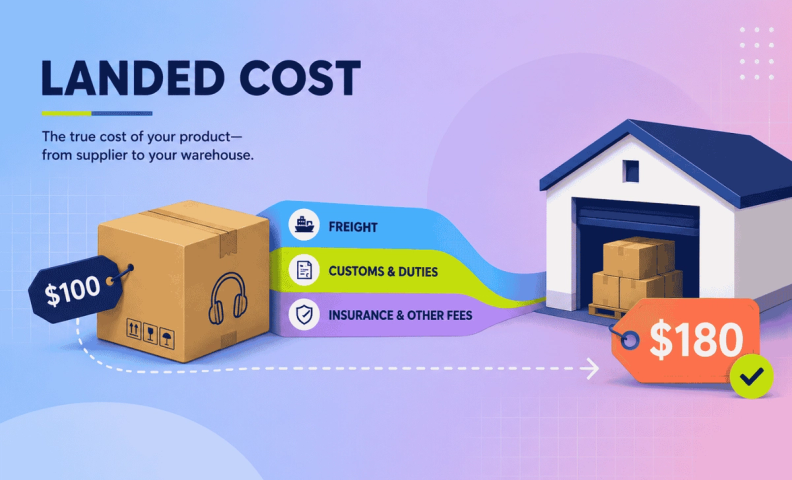
Are you tired of unexpected costs eating into your profits? Understanding landed cost is essential for ecommerce businesses to manage expenses and make informed decisions.
\In this blog post, we'll explore the components of landed cost, methods for calculating it, and strategies to reduce these costs, ultimately improving your bottom line.
What is landed cost, and what does it include?
Landed cost is the total cost of getting a product from its source to your location, not just the invoice price. It includes:
- Product cost
- Shipping charges
- Customs duties
- Insurance
- Overhead expenses incurred along the way
Tracking these separately is something we talk about a lot as an ecommerce accounting firm, because it's what lets you do accurate expense tracking and profit margin analysis.
"Gross margin is the single most important metric for an ecommerce business." - Stephen Brown, COO, LedgerGurus
Gross profit margin is the single most important metric in an ecommerce business, and it's super important to have what you need to calculate an accurate COGS, since landed cost is the foundation that number is built on.
To illustrate how each component adds up, we'll follow a shipment for a fictional company called Electra's Electronics, from their supplier in China to their warehouse in the US.
Product cost
Product cost includes raw materials, manufacturing fees, and labor, also called buy cost or production cost.
Electra's Electronics orders 100 units of an electronic gadget from a supplier in China at $100 each, for a total of $10,000. That's the buy cost, and the starting point of the total landed cost.
To lower this cost, you can source more competitively priced suppliers, buy in greater volume for a discount, or build stronger vendor relationships. Controlling product cost matters because it directly affects your margins and your ability to price confidently.
Shipping costs
Shipping costs vary by carrier, weight, and distance, and include handling fees and freight charges.
Electra's Electronics' shipping starts when the gadgets are trucked to the nearest port in China ($500), shipped internationally by boat to the US ($2,000), then trucked from the US port to their 3PL warehouse ($1,000). That's $3,500 in shipping costs to get the product to their warehouse. (Shipping the product onward to the end customer after it sells is a separate cost, not part of landed cost.)
Shipping costs can be reduced by negotiating better terms with carriers or partnering with a 3PL, who often have existing relationships with shipping lines that get you better rates than you could negotiate alone.
Customs fees
Customs fees, tariffs, and taxes on international shipments can meaningfully impact your total landed cost.
Electra's Electronics is charged $1,000 in customs fees at the origin port in China, and $3,000 at the destination port in the US, $4,000 total.
Staying current on regulations around harbor charges and duties and partnering with a 3PL that has strategically located fulfillment centers, can help reduce customs costs and transportation distances at the same time.
Insurance costs
Shipping insurance protects your goods in transit and depends on factors like shipment value and shipping method.
Electra's Electronics purchases shipping insurance for this order at a cost of $300.
Comparing self-insurance against cargo coverage, and choosing the option that fits your specific shipment, protects you against damaged or lost goods while keeping this cost as low as it reasonably can be.
We have a great video about how to calculate COGS accurately to create a product cost formula.
Calculating landed cost: Methods and best practices
There are a few ways to calculate landed cost, each with tradeoffs.
Method 1: Using spreadsheets
Spreadsheets work well for calculating landed cost, especially early on, but they take time and carry real risk of error. Get clear on which cost components you're including, use accurate data, and check your formulas regularly.
If you're managing inventory in Excel or Google Sheets, our free Inventory and COGS template includes a product cost catalog section built specifically for landed cost calculations, alongside quantity reconciliation, COGS computation, and physical inventory valuation.
As your business grows more complex, spreadsheets eventually stop being enough, and specialized inventory management software becomes the better option for accuracy and speed.
Method 2: Software Tools
Inventory management systems calculate landed cost automatically, improving both accuracy and speed. Finale Inventory, Cin7 Core, and Katana are a few leading inventory management software solutions. Once you're ready to implement one, avoid these common implementation mistakes that can undercut the accuracy you're trying to gain.
When comparing tools, weigh features, ease of use, and integration with your existing systems. For more, read The Top 10 Benefits of an Inventory Management Software.
Landed cost formula and worked example
The landed cost formula adds up product cost, shipping, customs, insurance, and overhead to give you the true cost of a product landed at your warehouse.
Here's every cost Electra's Electronics incurred on this shipment:
- Product cost: $10,000 (100 units at $100 each)
- Shipping: $3,500 ($500 to port + $2,000 international + $1,000 to warehouse)
- Customs, tariffs, and duties: $4,000 ($1,000 origin + $3,000 destination)
- Insurance: $300
- Overhead (receiving and handling): $200
Total landed cost: $18,000, or $180 per unit ($18,000 ÷ 100 units)
Electra's Electronics thought they were paying $100 a unit. Their real cost is $180, 80% higher. That's the number that should actually drive their pricing and sourcing decisions, if they're purchasing the same SKU at different landed costs over time, this is also where inventory costing methods like FIFO, LIFO, and weighted average come in, to decide which cost applies to which unit sold.
One more way to cut landed costs: shipment consolidation
Each component above has its own way to bring costs down, sourcing cheaper suppliers, negotiating shipping rates, staying ahead of customs regulations, comparing insurance options. But there's one lever that can reduce several of these categories at once: consolidating shipments.
Combining smaller, more frequent orders into larger, less frequent ones spreads your fixed shipping and customs costs (port fees, documentation, per-shipment charges) across more units, lowering your per-unit cost in more than one category simultaneously. It won't fix a bad supplier rate or a high insurance premium on its own, but it's worth evaluating alongside the component-specific fixes above, especially if you're currently shipping in small, frequent batches.
Frequently asked questions
How do I calculate landed cost?
To calculate landed cost per unit, add up your product cost, shipping costs, customs fees and duties, insurance, and any other overhead, then divide by your total number of units. Using our Electra's Electronics example above: $10,000 (product) + $3,500 (shipping) + $4,000 (customs and duties) + $300 (insurance) + $200 (overhead) = $18,000 total, divided by 100 units = $180 per unit in landed cost.
Who pays for landed cost?
The total cost for a shipment to your warehouse is covered by the retailer. This price, known as landed cost, consists of all components.
What is the difference between standard cost and landed cost?
Standard cost includes the cost of materials, labor, and overhead, but does not account for freight and other expenses incurred with landing the product. In contrast, landed cost takes into account these additional costs to give a total cost of a product or shipment when it arrives at the buyer's doorstep.
Does landed cost include cogs?
The landed cost includes all direct costs necessary for the manufacture or purchase of a product, as well as extra shipping and inventory storage fees. All of this feeds into calculating COGS.
What are the key components of landed cost?
In order to determine the total cost, all aspects of landed costs need to be factored in. This includes product costs, shipping expenses, customs duties and charges insurance expenditures as well as overhead charges.
Get your landed cost (and your margins) right
It is only possible to make wise decisions for an ecommerce business by understanding landed cost and its components. Strategies like optimizing supply chain, bargaining better deals, and utilizing technology can help reduce these costs significantly. This will give a competitive edge in the market while boosting profitability.
A crucial piece is putting all the pieces of landed cost and cost of goods sold together. You need to know what your actual costs are, so you know if you are profitable. This can be tricky since there are so many pieces involved. Landed cost touches your pricing, your sourcing decisions, and your true gross margin, get it wrong, and every one of those decisions is built on shaky numbers.
LedgerGurus has a team experienced in inventory and COGS accounting, and we can help you calculate landed cost accurately and turn it into pricing and sourcing decisions you can actually trust.
