

You just got a new PO from a major retailer. Congratulations! The opportunity to create and sell more products is exciting for any CPG brand. But are your operating systems up to the task? Juggling multiple-point applications, calculating landed costs and COGs, and finding reliable funding make purchasing and managing inventory extraordinarily complicated. Worst of all, inefficiencies can cost your business time and money.
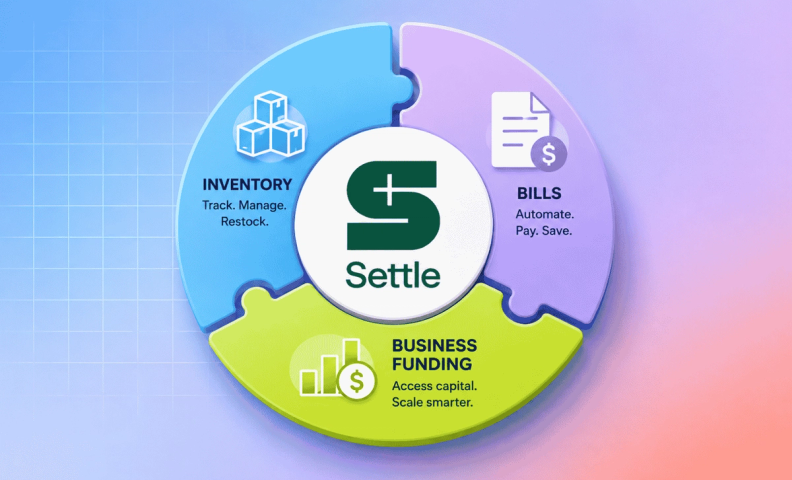
Settle, a trusted LedgerGurus partner, is a platform designed to meet the challenges of evolving CPG brands. Our suite of products, from inventory management to capital solutions, helps ecommerce owners make smarter decisions as they scale. In our recent webinar, “Inventory, Bills, and Business Funding: The Ecommerce Growth Trifecta with Settle,” Stephen Brown, COO of LedgerGurus, and Peter Potsos, Head of Accounting Partnerships at Settle, explore the challenges ecommerce businesses face as they grow, and how Settle's unified tech stack can support.
If you couldn't attend, here's a summary of what we covered:
Managing and ordering inventory
Does your inventory live across multiple open tabs and systems? Many ecommerce owners toggle between touchpoints to order, track, and restock inventory. But when inventory management gets out of hand, your bottom line feels the effects: unexpected stockouts and PO delays can seriously impact profit margins.
An all-in-one solution
Get a hold of your inventory with Settle's universal hub. A “rosetta stone of SKUs”, our universal product catalog stores information on your finished goods, raw materials, BOMs, and all the variations that make up your product. SKUs can be uploaded manually or synced from Shopify, Walmart, Amazon, and WMS's.
With your inventory under control, it's time to cut your POs. Settle translates purchase orders from major retailers into orders for your vendors, with details on which and how many materials are needed to complete each order. From there, the hub allows you to create and track work orders, inventory transfers, and receipts on those transfers from 3PLS.
Once your inventory arrives, Settle connects with your sales channels to track real-time movement. Ecommerce owners can identify sales trends and keep popular inventory in stock with daily updates. Use a separate POS? You can upload purchase orders to Settle and sync them with your WMS.
Simplified reporting
Traditional methods of tracking inventory landed costs and COGS are time-consuming. Data exists across multiple platforms that don't communicate with each other, resulting in additional work for ecommerce owners and accounting teams.
Settle simplifies the process with AI-powered end-of-month reports. These reports pull data from across the universal catalog, such as:
- What was your inventory at the beginning of the month?
- What's been received?
- What have you used to assemble or manufacture?
- What's been transferred and sold?
Using this data, the end-of-month report calculates your COGS and landed costs by SKU and location. Our reports also include write-offs and the valuation of your existing inventory.
Paying and tracking bills
Bills aren't just a record of your expenses. When collected and properly analyzed, they offer valuable insights into your business's performance. Unorganized payment systems and data impede you and your accounting team's ability to understand cash flow, COGs, and profit margins.
Stronger financial insights
Settle syncs with your accounting software to improve communication between you and your accountants and create more accurate, immediate forecasting:
- Make payments to vendors directly through Settle and sync the details to your existing accounting software.
- Connect with online accounting software like Quickbooks to feed bills into Settle.
- Send bills to a dedicated inbox that connects directly to Settle, which will read and upload each line item.
With all this information at your fingertips, calculating landed costs has never been easier. Extra fees like tariffs or set-up charges can also be pulled or estimated from existing data for additional visibility into future spending and cash flow.
Automated payment workflows
Manual payments are more than a hassle. In our webinar, Stephen shared an example of a LedgerGurus client who paid all their bills by check multiple times a week. According to Stephen, each check took 30 minutes for their accounting team to process.
Stop cutting checks and start scaling smarter. Settle's AP Automation tool lowers accounting time and simplifies the payment process. Ecommerce owners who use Settle's integrated payments platform:
- Reduce transaction fees with consolidated payments.
- Save money on overseas inventory purchases ($1500 to $2000 per hundred thousand dollars) with our competitive conversion rates.
- Discover an average of $270,000 in vendor credits annually with automated three-way matching.
Does your bill payment process feel too complicated to automate? Settle allows for customized workflows catered to your team and approval process. You can trigger approvals for certain transactions according to:
- Amounts
- Category
- Class
- Location
- Vendor
These rules can even be stacked on each other for workflows with changing variables, streamlining communication and eliminating potential oversights.
Finding reliable funding
Finding the capital to purchase inventory and scale is one of the biggest hurdles you might face as a CPG brand. The right solution can make a difference: Businesses with access to simple, non-dilutive capital can grow 385%.
Enter Settle's Working Capital solution. Simply make a request, and our underwriting team will examine your inventory, bank, Quickbooks, and other relevant data to decide whether or not they can extend you a line of credit. You can request a minimum of $50,000 with monthly rates ranging from 1 – 2% interest.
Settle users find that the transparent capital and preferred payment terms allow them to scale faster than other funding options. For example, a merchant cash advance (MCA) might seem simple, but it can increase your APY and the rate you pay back your loan. With Settle, you can extend your loan to 180 days, pay a fixed rate, or amortize over time.
Frequently asked questions
What does Settle's universal product catalog actually track?
It stores your finished goods, raw materials, bills of materials (BOMs), and product variations in one place, essentially a single source of truth for your SKUs. You can upload data manually or sync it from Shopify, Walmart, Amazon, or your WMS.
How does Settle calculate COGS and landed costs?
Settle pulls data from across its universal catalog, beginning inventory, what's received, what's used in assembly or manufacturing, and what's sold or transferred, then calculates COGS and landed costs by SKU and location automatically, including write-offs and current inventory valuation.
How much can businesses actually save using Settle's AP automation?
Settle users have discovered an average of $270,000 in vendor credits annually through automated three-way matching, plus $1,500 to $2,000 in savings per $100,000 on overseas inventory purchases through competitive conversion rates.
How does Settle's Working Capital funding work?
You submit a request, and Settle's underwriting team reviews your inventory, bank, QuickBooks, and other data to determine if they can extend a line of credit. Minimum funding starts at $50,000, with monthly interest rates of 1-2%, and it's non-dilutive, meaning you don't give up equity to access it.
How is Settle's funding different from a merchant cash advance (MCA)?
An MCA can look simple upfront but often comes with a higher APY and repayment rate. Settle offers more transparent terms, you can extend a loan to 180 days, pay a fixed rate, or amortize over time.
Can Settle's approval workflows be customized to my team's process?
Yes. You can trigger approvals based on amount, category, class, location, or vendor, and these rules can be stacked together to handle more complex, multi-variable workflows.
Ready to scale smarter with Settle?
Settle brings inventory, bill pay, and funding into one platform, and LedgerGurus can help you get it set up and connected to your accounting.
