

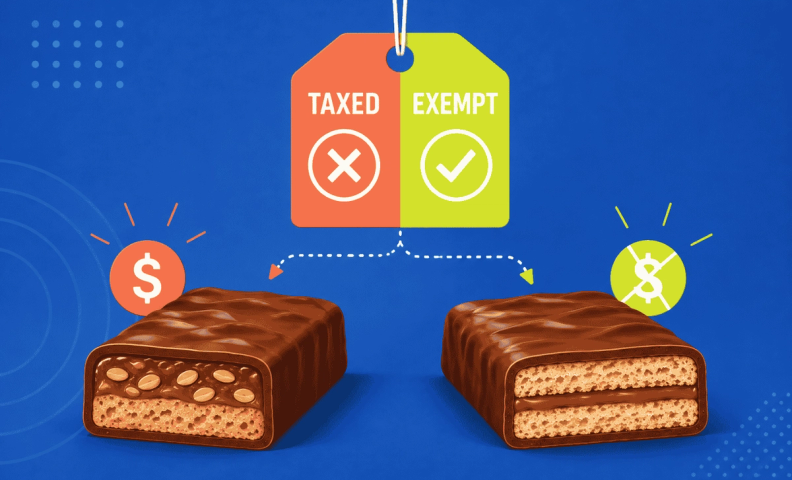
Let's talk about candy. We all know what candy is when we see it. It's hard to debate whether something is candy or not when you walk down the grocery store's aisle. But it's a completely different story to define candy when it comes to sales tax. Why? Because, depending on what kind of candy it is, it can be taxed at full rate, reduced rate or not taxed at all!
Why are certain items taxed differently?
Let's take a step back and talk about tax policies and why there are tax exemptions on certain items. Tax policies are used to encourage or discourage behaviors, for example, sin tax for cigarettes and alcohol. Another unpopular sin tax is tax on sugar, and that's why soda and candy are often taxable.
But another key function of tax policy is to create social equality. Thus comes a reduced tax rate or 0% tax rate for food. Food, especially raw food, is essential and necessary for human life. Therefore, a good number of states decided not to impose tax on such a commodity. Like prescribed medication, we simply can't live without them. So, food is tax free in certain states.
Why is candy taxable?
As mentioned above, candy is usually taxable because policy makers want to discourage the consumption of sugar. But here's the interesting part: A lot of states explicitly say candy is not food, therefore subject to tax, but if the candy has flour as an ingredient, then it's not candy anymore. Mind blowing, right?
Here's an example: Minnesota specifically tax exempts food and food ingredients. Food and food ingredients are defined as “substances, whether in liquid, concentrated, solid, frozen, dried, or dehydrated form, that are sold for ingestion or chewing by humans and are consumed for their taste or nutritional value.”
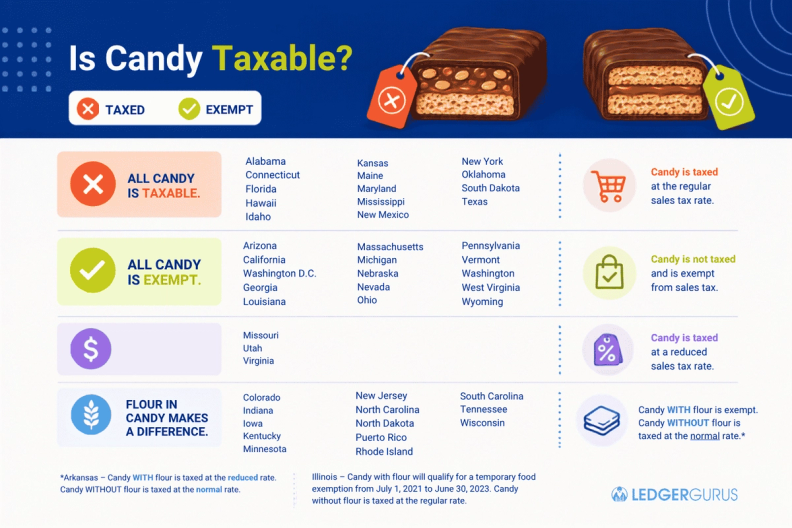
Candy is excluded from Minnesota's exemption for food and food ingredients and is subject to tax. However, preparations containing flour are specifically excluded from Minnesota's definition of candy.A Minnesota regulation notes that preparations containing flour include white, whole wheat, rice, corn, or brown flour, as long as the label lists “flour” as one of the ingredients. Candy with flour is therefore considered to be “food and food ingredients” by Minnesota and is exempt from tax. So, if you buy a Twix bar in Minnesota, you don't pay sales tax, versus if you buy a Snickers bar, you have to pay sales tax.
And Minnesota is not alone. Here's a list of all the states' treatment of candy in case next time you are at the grocery store you want to be more informed of exactly what items you are paying sales tax for.
Candy is just one example of how specific product classification affects taxability, see The Where, Who, and What of Sales Taxability for Online Sellers for the broader framework.
Observations on candy's taxability
We have two more interesting observations about candy's taxability. First, taxability is not the same for all the Streamlined Sales Tax states. The 24 SST states may agree on the definition of candy versus food, but they made their own decision on how to tax candy and food. Second, if the candy is in spray, squeeze and/or powdered form, they are almost always exempt because taxable candy items must be in the form of bars, drops or pieces.
Frequently asked questions
Why is candy taxed when most groceries aren't?
States often tax candy specifically to discourage sugar consumption, similar to how they tax cigarettes and alcohol, even in states that otherwise exempt food from sales tax.
Why does adding flour make candy tax-exempt in some states?
Many states, including Minnesota, define "candy" narrowly enough that a product containing flour, like a Twix bar, legally counts as food rather than candy, and food is often tax-exempt where candy isn't.
Are all Streamlined Sales Tax states consistent on candy taxability?
No. SST states generally agree on the definition of candy versus food, but each state still makes its own decision about whether to actually tax candy or exempt it.
Is candy in spray, squeeze, or powdered form taxed the same as candy bars?
Usually not. Most states only tax candy in solid forms like bars, drops, or pieces, non-solid forms like sprays and powders are often exempt.
How do I know if my specific product is taxable in a given state?
Check that state's specific definitions and rules, since even similar-sounding products can be classified differently state to state. If you're unsure, a sales tax expert can help you confirm taxability before you get it wrong at scale.
Getting taxability right is trickier than it looks
If Twix versus Snickers can trip up an entire state's tax code, imagine what's hiding in your own product catalog. Figuring out exact taxability, product by product, state by state, is one of the easiest places for ecommerce sellers to get sales tax wrong. However much help you need, we've got an option:
- Not sure where you stand? Take our free Sales Tax Risk Assessment, 20 quick questions, about five minutes, for a personalized read on your exposure.
- Have a specific question? Schedule a sales tax consultation with one of our experts.
- Ready to hand it off? Explore our sales tax services and let our team handle it for you.
