

You've started an ecommerce business and you're selling on Amazon, Shopify, or a similar sales channel. You're focused on ordering and managing inventory, shipping, and driving traffic to your website.
In the back of your mind, you know you'll need to do some accounting for your business, but that's straightforward, right?
You figure your college accounting class, a few Google searches, or eventually a bookkeeper should be enough to handle it. Then you make $100K in sales on Amazon, log into your bank account, and find only $70K actually deposited.
Where did the rest go? You dig in, only to discover that ecommerce accounting works nothing like what you learned in that one accounting class years ago.
The problem is that relying on general accounting knowledge assumes ecommerce accounting works the same way as accounting for any other business. It doesn't, and modeling your books after a typical business will give you an inaccurate picture that can seriously affect your success. So, what do you, or your bookkeeper, need to understand to get it right? This guide walks through it.
Why ecommerce accounting is different from other accounting?
A typical business sends invoices to clients and gets bills from vendors. As those are paid, the activity moves through the bank account, easy to track because it's all in one place.
Model your ecommerce accounting the same way, and you'll end up with an inaccurate picture of your business. That's because most of the activity in an ecommerce business doesn't happen in the bank account at all. It happens in your sales channels and payment processors, and what hits your bank account is only a summary.
That activity includes:
- Product sales
- Refunds & return fees
- Sales tax
- Advertising
- Selling fees
- Fulfillment & warehousing
- Service fees
- Shipping costs
And that's just a partial list. A typical accountant or bookkeeper who only tracks bank account activity misses all of it and the inaccuracies that creates can have a real impact on your business.
You'll also need to account for inventory, COGS, timing issues, and cash planning. To start, know what to look out for: download our 5 Ecommerce Bookkeeping Warning Signs guide. If you haven't started ecommerce-specific accounting yet, most of these will likely be off, but they're fixable, and you have to start somewhere.
What does an ecommerce accountant do?
Every industry has its own accounting nuances, and ecommerce is no exception. The first step to understanding them is knowing the difference between bookkeepers and ecommerce accountants, terms often used interchangeably that aren't the same thing.
- Bookkeepers: Reconcile bank accounts and code transactions in your general ledger.
- Ecommerce accountants: Dig into the sales channel data, inventory, COGS, and sales tax that determine your real profitability and cash flow.
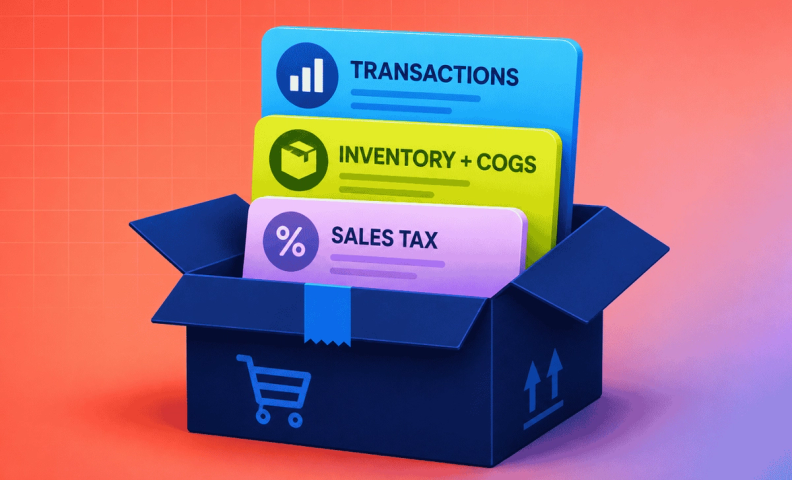
Many bookkeepers simply aren't aware of these ecommerce-specific issues, or struggle to navigate them. Our specialized ecommerce accountants see three areas that are crucial to getting accurate numbers you can actually build your business on:
- Finding accurate transactional data
- Understanding inventory and COGS in depth
- Managing sales tax for online sales
Find transactional data for accurate ecommerce accounting
Deposits into your bank account aren't an accurate revenue number, the way they might be for other businesses. Record them as-is, and you'll miss two things:
- Accurate income
- Accurate timing
Why income is inaccurate: The deposit hitting your bank account from a sales channel is a net deposit, meaning it already reflects sales, returns, sales tax, chargebacks, and customer-paid shipping netted together.
A good ecommerce accountant knows to dig into your sales channel's back-end reports instead because that's where the accurate numbers actually live. Tools like A2X can make pulling that data into your accounting software much easier.
Why timing is inaccurate: If Amazon deposits on January 5th, many of the underlying transactions happened in December, and those December sales should affect your prior year's numbers, not the new one. Over time, inaccurate timing distorts your forecasting and becomes a bigger and bigger problem as your business grows. A2X can help here too, our A2X/QBO Setup & Consulting Service sets this up correctly for you. Here's a video explaining it.
Get an in-depth understanding of inventory and cost of goods sold (COGS)
As an ecommerce business, you're inventory-based, so your inventory and COGS numbers are the most important ones to get right. You (or your accountant) need to understand:
- How to determine your COGS numbers and how they affect your business
- How to effectively manage inventory processes
- Accurate bookkeeping principles for inventory and COGS (a lot of bookkeepers get this wrong)
Determine your COGS numbers. COGS is one of the most important things an ecommerce business needs to get right, if your accountant doesn't understand this, it's time to find a new one. Inventory is typically your largest expense, and inaccurate COGS distorts your taxable income and profit margins, which affects decisions about pricing, order quantity, ad spend, hiring, and more.
Manage inventory processes. Inventory affects two sides of your business: the operational side (how much do I have, when do I reorder, how long will supply last) and the accounting side (COGS, ending inventory values, purchase orders). A good inventory management system can handle much of this complexity for you.
Handle inventory and COGS bookkeeping accurately. One of the most common mistakes we see is expensing inventory the moment it's purchased. This leaves out real data about your business. When you expense at purchase, your margins get skewed now and in the future, and you only get a fraction of the real story.
Instead, inventory should sit on your balance sheet as an asset until it's sold. This gives you three things: informed decisions based on real profit visibility, an accurate picture of remaining inventory as an asset, and margins you can actually plan around. For a deeper explanation, read Cash vs. Accrual Accounting for Inventory.
Manage sales tax for online sales
Sales tax can feel overwhelming. Every state has its own laws, and it's easy to feel set up to fail. It's rarely the biggest fire you're fighting on a given day, until it is.
We won't go into every detail here around nexus laws and states that are aggressively pursuing ecommerce businesses, but this isn't something to ignore. Collecting sales tax during the sale means your customer pays it. Not collecting when you should means you're the one holding the liability when a state comes looking.
We have a lot of resources on handling sales tax, the best place to start is our 10 Steps of Sales Tax Compliance Checklist.
An experienced ecommerce accountant can help you navigate sales tax compliance, determine which nexus thresholds you've crossed, and get you registered and remitting correctly across states. And remember, marketplace facilitators are legally required to collect and remit sales tax on your behalf, but only on marketplace sales. You’re responsible for everything else.
Choose the right ecommerce accountant for your business
Taming ecommerce accounting takes both the right tools and, at some point, a great ecommerce accounting specialist. You're already juggling everything else it takes to run the business, it makes sense to hand the books to someone who specializes in exactly this.
These are three things that trip up nearly every ecommerce seller, and by now you've seen why each one matters.
First, there's finding and reading your transactional data. Unlike a traditional business, your real numbers don't live in your bank account. They live scattered across your sales channels. That's why tools like A2X exist (we can set it up for you!), and why it's worth learning where this data actually hides in your sales channels' back-end reports (Shopify, Amazon). Ecommerce accountants deal with this daily, which is exactly why they're faster at pulling the full picture than a generalist would be.
Second, and closely related, is getting inventory and COGS right. These are the most important numbers in your business, and getting them wrong distorts everything downstream, margins, cash flow, even whether you're actually profitable.
Inventory management software handles most of this once it's set up and used correctly. If you're not sure where you currently stand, our free Inventory Reality Check will tell you.
Finally, there's sales tax, which only gets more complicated as you grow. Rules shift state to state, and knowing where you've crossed a nexus threshold is half the battle. This is where sales tax engines like AvaTax and Shopify Tax earn their keep.
It can also really help to get sales tax consultation with an ecommerce sales tax expert, and, again, an ecommerce-specialized accountant who already knows the landscape can make all the difference.
Take our free Sales Tax Risk Assessment if you're not sure how exposed you are.
Put those three together, accurate transactional data, disciplined inventory and COGS tracking, and proactive sales tax management, and you've got the foundation every ecommerce business actually needs.
Frequently asked questions
Why doesn't my bank deposit match what I actually sold?
Because deposits from sales channels like Amazon or Shopify are net deposits, not raw sales figures. They already have fees, refunds, chargebacks, sales tax, and shipping netted out before the money ever hits your bank account.
What's the difference between a bookkeeper and an ecommerce accountant?
A bookkeeper reconciles bank accounts and codes transactions in your general ledger. An ecommerce accountant goes further, digging into sales channel data, inventory, COGS, and sales tax to uncover your real profitability and cash flow, things a generalist bookkeeper often misses.
Why does inventory need special accounting treatment?
Because expensing inventory the moment you buy it (instead of when it sells) distorts your margins and hides the real story of your business. Inventory should sit on your balance sheet as an asset until it's actually sold.
Do I need to worry about sales tax if I only sell on marketplaces like Amazon?
Less so, marketplace facilitators are legally required to collect and remit sales tax on your behalf on those sales. But if you sell on your own site or other channels too, you're still responsible for those, and for knowing where you've crossed nexus thresholds.
What should I look for when choosing an ecommerce accountant?
Someone who specifically understands ecommerce nuances, sales channel data, inventory and COGS, and multi-state sales tax, not just general bookkeeping. A generalist accountant often doesn't know to look for these issues in the first place.
Get ecommerce-specialized accounting on your side
LedgerGurus is a cloud-based, ecommerce-specialized accounting firm. We relieve the stress and overwhelm our clients feel by freeing them from their accounting headaches, giving them solid, reliable numbers to build their businesses with.
Four things that may make us a great fit:
- Ecommerce specialized: We combine ecommerce-specialized accountants and bookkeepers with the processes and technology to grow alongside your business.
- Team of experts: You get an entire team, not just one accountant, with varied experience matched to your company's needs.
- Customizable experience: Choose our full line of services or select ala carte, we grow with you and help you actually understand the numbers we give you.
- 100% remote: We understand ecommerce because we work entirely remotely ourselves, giving you direct, timely answers through the technology that fits your business.
