

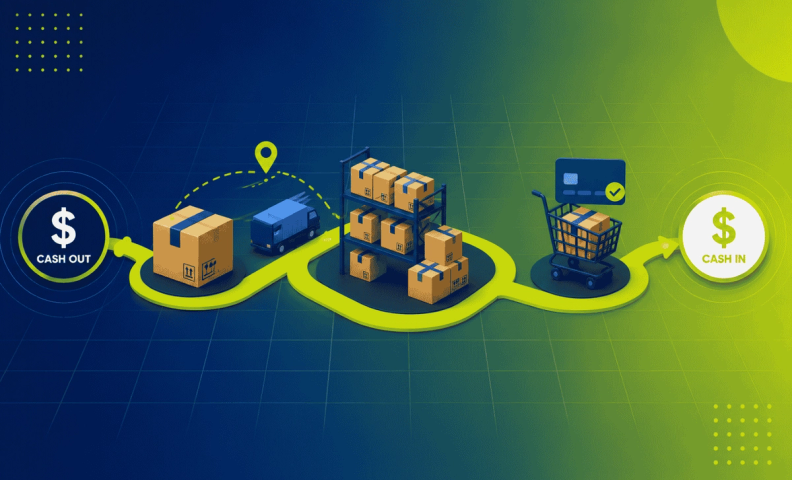
Most business owners can tell you whether they're profitable. Far fewer can tell you exactly how long their cash sits tied up in inventory before it comes back to them, and that gap is where cash flow problems quietly start.
Every inventory purchase moves through the same six-stage cycle, from the moment you place an order to the moment a customer's payment lands back in your account. This article walks through each of those stages, what stretches or shortens the lag between them, and two simple formulas for measuring it, so you always know where your cash actually is.
Understanding your inventory cycle
What does your inventory cycle actually look like? Most business owners can't answer that with any precision, and that gap is exactly where cash quietly gets tied up without anyone noticing.
Every dollar you spend on inventory sits idle from the moment you pay for it until the moment it sells. The longer that stretch lasts, the less cash you have on hand for payroll, marketing, or your next round of inventory. Understanding your inventory cycle means understanding exactly how long that stretch is, and where the time is actually going.
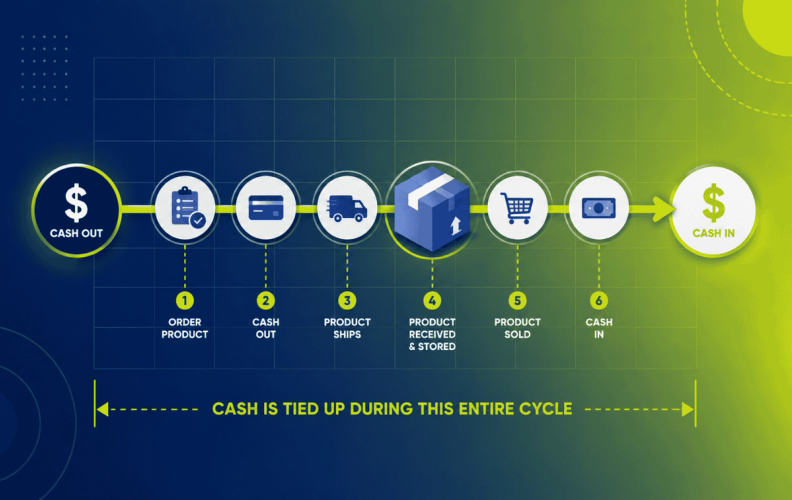
The 6 stages of your inventory cycle
Here's what that cycle looks like in practice:
- Order product: You place a purchase order, and depending on your supplier's terms, this may require prepaying for inventory before you have it in hand.
- Cash out: This is the moment cash actually leaves your business, whether that's a full payment or a deposit.
- Product ships: Goods are in transit. If you prepaid, this inventory is now sitting on a boat or plane instead of in your bank account.
- Product received and stored: Goods arrive and become inventory on your books. Cash is now fully committed and sitting on a shelf.
- Product sold: The sale happens, and the cost of that inventory becomes cost of goods sold.
- Cash in: Payment comes back to the business, closing the loop.
Every stage between step 2 and step 6 is cash sitting idle. The whole point of understanding this cycle is knowing exactly how long that stretch is for your business, and where the time is actually going, since that's what determines how much working capital you need just to keep operating.
For a deeper walkthrough of steps 1 and 4 specifically, read Your Road Map for Good Inventory Management, and for how step 5 gets recorded correctly, see Inventory Accounting Systems and Methods.
How outsourcing location affects your cash lag
The longest stretch in this cycle is almost always the gap between step 2 (cash out) and step 6 (cash in), and how you manufacture has a direct effect on how long that gap runs.
Manufacturing locally keeps steps 3 and 4 short, since goods aren't crossing oceans. Outsourcing to another country, China being the most common example, extends that lag considerably and raises the risk of items landing on back order, which stretches the cycle even further.
Manufacturing in-house is the other end of the spectrum. It's more operationally demanding, but it gives you direct control over steps 1 through 4, which means more control over exactly how long your cash stays tied up.
Measuring it: Inventory turnover and Days-in-inventory
Once you understand the stages, the next step is measuring how long cash actually spends stuck in them. Two formulas do this:
Inventory turnover = COGS / Average inventory
Inventory turnover shows whether you're carrying too much inventory relative to your sales. High turnover means goods are selling quickly and cash is moving back through the cycle fast. Low turnover means cash is sitting in stage 4 longer than it should. This ratio is only as good as your COGS accounting, so make sure that's accurate before you rely on it.
Days-in-inventory = 365 / Inventory turnover
This converts turnover into a number you can feel: the average number of days your cash sits tied up in inventory before it converts back to cash. A rising days-in-inventory number is an early warning that your cycle is stretching out, often before it shows up anywhere else in your financials.
Left unaddressed, a stretched-out cycle is exactly the kind of problem that leads to real trouble. There is a direct relationship between poor cash flow and business failure, and obsolete inventory quietly locking up cash is one of the most common ways that plays out.
Planning for seasonal inventory needs
Seasonality adds another layer to the cycle. Stocking up for Black Friday, Christmas, or other peak periods means paying for inventory well before you'll sell through it, which extends your cash-out-to-cash-in gap right when you need the most inventory on hand.
This gets more pronounced the further away your manufacturing is. If you're ordering overseas for Q4, that lead time compounds with the seasonal timing, and a large amount of cash goes out well before any of it comes back. Planning for that outlay in advance gives you time to line up financing on your terms, rather than scrambling for it mid-crisis.
For the fuller strategic picture: Negotiating better supplier terms, understanding the true cost of financing that cash gap, and where AI tools can and can't help, see Ecommerce Cash Flow: What's Really Holding Your Brand Back and How to Fix It.
What this means for your business
Knowing your inventory cycle means being able to answer a simple question: how long does it actually take you to go from cash out to cash in? Once you know that, you can tell whether you have enough reserves to comfortably cover the lag, or whether you're one slow season away from a real cash crunch.
From there, the levers are the ones covered above:
- Shortening the cycle by moving manufacturing closer to home or in-house.
- Tracking turnover and days-in-inventory so you catch a stretching cycle early.
- Planning seasonal cash outlays well ahead of time instead of reacting to them.
Frequently asked questions
What is an inventory cycle?
It's the path cash takes from going out to pay for product to coming back in once that product sells. In between, there are steps like shipping, receiving, and storing the product where cash is tied up but not yet recovered.
How does outsourcing manufacturing affect cash flow?
Outsourcing locally keeps the lag between cash out and cash in relatively short. Outsourcing overseas, to a country like China, can stretch that lag out considerably and increase the risk of items going on back order, both of which tie up cash for longer.
How do you calculate inventory turnover and days-in-inventory?
Inventory turnover equals COGS divided by average inventory, and it shows whether a company has too much inventory relative to its sales. Days-in-inventory equals 365 divided by inventory turnover, and it shows how many days of the year cash stays tied up in inventory rather than converting to sales.
Can poor inventory management actually lead to bankruptcy?
Research from the Financial Management Association International has found a direct relationship between cash flow problems and bankruptcy. Inventory that goes obsolete while sitting in the warehouse ties up cash a business can't sell its way out of, which is exactly the kind of problem that leads there.
How far in advance should a business plan for seasonal inventory needs?
Well before the season hits, especially for events like Black Friday, Christmas, and Memorial Day sales, and even further ahead if you're ordering overseas. Planning that cash outlay early gives you time to line up favorable financing instead of getting caught in a cash crisis.
Let's help you get your inventory under control
If your inventory cycle feels like a black box, our team of inventory specialists can help you map it out, choose the right inventory management tool, and get your COGS accounting clean enough to trust the numbers you're measuring.
