Margins are getting squeezed from every direction.
Tariffs are climbing. Fulfillment costs are brutal. Digital ads aren’t pulling their weight like they used to.
And for 7- and 8-figure ecommerce sellers, the stakes are higher than ever. You can’t just “ride it out” and hope things get better. Doing nothing means watching profits drain away. Doing the wrong things – like slashing the very areas that drive growth – can cripple your business.
That’s why you need cost cutting strategies that are smart, targeted, and data-driven. Not reactionary hacks. Not penny-pinching that costs you more later.
In this guide, we’ll walk through the exact steps to identify waste, protect your growth drivers, and make cuts that actually improve your profitability. You’ll get the answers to the most pressing questions ecommerce brands are asking right now, plus actionable steps you can take this month to boost your margins without killing your momentum.
We’ll cover:
- Why cost cutting strategies matter more than ever
- Strategy 1: Start with the numbers
- Strategy 2: Slash low-impact spend
- Strategy 3: Optimize before you cut deep
- Strategy 4: Rethink fixed expenses
- Strategy 5: Tackle your contribution margin
- Strategy 6: Capture overlooked savings
- Strategy 7: Optimize sourcing & supply chain
- Strategy 8: Introduce price increases the right way
- Where to start this month
Let’s get into it.

Key Takeaways
- Cutting costs in ecommerce is about making smart, targeted changes that protect and grow margins, not shrinking your business.
- Start by identifying low-impact expenses you can eliminate without affecting customer experience or revenue growth.
- Optimize existing operations (like packaging, shipping, and marketing) before making deeper cuts that could limit capacity.
- Rethink “fixed” expenses such as rent, payroll, and vendor contracts to uncover hidden savings opportunities.
- Strengthen your contribution margin by focusing on high-performing products and removing unprofitable SKUs.
- Small, overlooked adjustments, like raising free shipping thresholds or using bonded warehouses, can have a big impact on profitability.
- Diversifying sourcing and improving supply chain resilience helps reduce tariff exposure and long-term costs.
- Communicating price increases transparently can maintain customer trust while preserving profitability.
Why Cost Cutting Strategies Matter More Than Ever
“What’s the real impact of tariffs on ecommerce profits?”
It’s the question almost every ecommerce seller is asking.
Here’s the blunt truth: even a business with strong margins can see profits evaporate almost overnight. Run a 30% tariff increase through a $5M ecommerce brand with healthy numbers, and you can swing from solid profitability to break-even…or even a loss. To see your numbers for yourself, download our Tariff Impact Calculator.
 And tariffs are just the headline. Layer on:
- Rising freight and packaging costs
- Higher labor and payroll expenses
- Digital advertising efficiency dropping post-iOS 14.5 changes
- Flat or sluggish consumer spending
The result? A perfect storm that’s forcing business owners to ask:
- Where can I cut costs without stalling growth?
- Which expenses are bloated?
- And what benchmarks should I be using to know if I’m overspending?
This is where a structured approach, grounded in real numbers, comes in. Before you start swinging the budget axe, you need a clear picture of where you stand. That’s step one.
Strategy 1: Start with the Numbers. Benchmark Before Cutting
“What should I benchmark my costs against?”
Without benchmarks, “cutting costs” is just guessing.
Here are industry standards for healthy ecommerce operations:
- Fulfillment: 10–15% of revenue
- Marketing: 20–33% of revenue for DTC brands, lower for resellers
- COGS: 20–30% of revenue for branded DTC products, up to 60% for resellers
- Payroll: 10–15% of revenue
- Net Operating Income: 10–20% of revenue is ideal, but in today’s climate 5% may be the new floor
These numbers aren’t just nice to know. They’re your first red flags.
- If fulfillment is creeping toward 20% or more, packaging, warehouse location, or shipping contracts might be draining your margin.
- If marketing is chewing up a third of your revenue without profitable returns, you’ve got a spend efficiency problem.
- If payroll is swelling beyond 15%, it might be time to revisit structure, roles, and outsourcing options.
Remember, these are JUST benchmarks.
The goal here isn’t to blindly match an “industry average.” It’s to use benchmarks as a reality check, spot problem areas fast, and focus your cost cutting strategies where they’ll have the biggest payoff. Your specific business circumstances may be different (e.g. you have a bulky product that has higher shipping costs).
Strategy 2: Slash Low-Impact Spend (Quick Wins First)
“Are there quick wins I can implement fast?”
Yes, and they’re often hiding in plain sight.
When margins are under pressure, the easiest savings don’t come from massive operational overhauls. They come from trimming expenses that quietly bleed your profit month after month without driving real growth.
Here’s where to look first:
Unused or Duplicate Software
It’s amazing how quickly a tech stack gets bloated, especially after busy seasons. Audit your tools quarterly and ask:
- Have we logged in during the last 30 days?
- Are two platforms doing 80% of the same job?
- Are we paying for premium features no one uses?
Cancel, consolidate, or downgrade. If you need it later, you can always re-subscribe.
Low-Performing Agency Retainers
If you’re paying for marketing, creative, or SEO retainers that aren’t delivering ROI, it’s time for a candid review. Ask:
- Which campaigns have generated measurable profit?
- Are we seeing clear, consistent reporting?
- Can parts of their scope be brought in-house or automated?
- How can AI add value without reducing quality?
Renegotiating scope or shifting to project-based work can free up thousands without cutting off access to expertise.
Meals, Travel, and “Lifestyle Perks”
It’s tempting to keep the nice-to-haves like catered lunches, frequent conference travel, or high-end swag. But ask yourself: Would my team rather have this perk or more job security?
- Cut back to essentials.
- Focus travel only on events that directly produce sales or high-value partnerships.
Tighten Spend Controls
Even after you make cuts, you need to prevent creep. Tools like Ramp, Brex, or Divvy let you:
- Assign virtual cards for specific expenses
- Set per-purchase or monthly limits
- Track spend by category in real-time
Visibility is your ally. Share budgets with team members who spend money, and report actual vs. budget monthly so there are no surprises.
Keep in mind that these are precision cuts, not just “penny-pinching” moves.
When you slash low-impact spend, you free up cash that can be reinvested into the areas that actually move the needle. And when we get to the later sections, we’ll talk about how to protect those growth drivers while making deeper, strategic cuts where it counts.
Strategy 3: Optimize Before You Cut Deep
“How can I cut costs without hurting growth?”
The answer: don’t cut first. Optimize first.
Some expenses look oversized on paper but are actually critical to keeping revenue flowing. The problem isn’t that they exist; it’s that they’re underperforming.
Before you slash, ask: Is this cost failing… or just poorly optimized?
Fulfillment: Shrink Costs Without Slowing Delivery
Benchmark: 10–15% of revenue
If you’re above that range, there’s opportunity to improve, without sacrificing speed or customer experience.
- Right-size packaging: Switch to smaller boxes, lighter materials, or bundle products to cut dimensional weight fees. Even a one-inch reduction can save thousands in annual shipping costs.
- Warehouse location: If most customers are on the East Coast and your 3PL is in California, you’re literally paying for distance. Moving closer to your customer base can cut both freight costs and delivery times.
- Renegotiate contracts: If your order volume has increased, or decreased, your rates should reflect it. Price shop and use competing quotes as leverage.
Marketing: Spend Smarter, Not Less
Benchmark: 20–33% of revenue for DTC, lower for resellers
Marketing is often the first place owners reach for the scissors…and the first place they regret cutting.
- Audit campaigns: Pause low-ROAS ads and double down on proven winners.
- Kill “spray and pray” spending: Brand awareness matters, but only if it actually translates to sales.
- Renegotiate retainers: Tighten scope to high-ROI activities or shift to performance-based agreements.
- Leverage AI: Creative testing, ad copy, and image generation can now be done faster and cheaper without sacrificing quality.
Software & Tools: Streamline the Stack
Tech costs can creep up as new tools get added for “one specific thing” that overlap with another platform.
- Run a quarterly stack audit: Identify duplicate features, unused add-ons, and outdated plans.
- Consolidate where possible: Sometimes one upgraded tool can replace three subscriptions.
- Downgrade to a lower tier: If you’re not using premium features regularly, don’t keep paying for them.
Optimizing is about running the engine more efficiently.
If quick wins are the low-hanging fruit, optimization is the pruning that makes your growth sustainable. It’s slower than simply cutting a budget line, but it protects revenue and often unlocks more savings over time.
Strategy 4: Rethink Fixed Expenses
“Which fixed expenses can I actually change?”
Many sellers assume fixed costs are… well, fixed. But that’s not always true. Rent, payroll, and vendor contracts might be hard to change overnight, but they’re far from untouchable. With the right approach, these line items can shrink AND free up significant cash.
Rent: Do You Really Need That Space?
Post-COVID, many ecommerce teams have learned they can operate just fine without a traditional office.
- Go remote: If you’re not doing in-house fulfillment or regular face-to-face customer interactions, consider going fully virtual. The savings on rent, utilities, and upkeep can be huge.
- Downsize: If you need some physical space, sublet unused square footage or move to a smaller facility.
- Flexible arrangements: Co-warehousing and shared workspaces for meetings can keep your footprint (and costs) small.
Payroll: Apply the 3 O’s
Labor is one of the biggest (and most sensitive) cost categories. The goal here isn’t layoffs. It’s making sure every dollar spent on payroll is delivering results.
- Optimize: Ensure every role is clear, measurable, and essential. Use frameworks like EOS (Entrepreneurial Operating System) to confirm you’ve got the right people in the right seats.
- Outsource: Fractional experts (e.g., marketing, legal, LedgerGurus for accounting) can deliver specialized results without full-time salaries.
- Offshore: Certain roles (like customer support, data entry, or routine admin work) can be handled by skilled global talent for a fraction of U.S. labor costs.
Even a 10% payroll efficiency gain can make a major difference in your bottom line.
Vendor & Contract Negotiations
It’s not just your 3PL that’s negotiable.
- Annual subscriptions: If you’ve been a long-term customer, ask for loyalty discounts.
- Service providers: Compare competitor quotes before renewal time and use them to secure better rates.
- Volume commitments: If you can guarantee a certain spend, providers are often willing to lock in lower rates.
Mindset Shift: Fixed Doesn’t Mean Permanent
Treat your fixed expenses as recurring investments, not immovable obligations. If a cost isn’t delivering clear value, it should be on the table for rethinking, renegotiating, or replacing.
This is where many ecommerce brands find the single biggest line-item savings. And unlike cutting marketing or fulfillment, trimming these costs doesn’t always risk revenue.
Strategy 5: Tackle Your Contribution Margin
“What if my product margins are already too thin?”
If your contribution margin (the profit left after covering the direct costs of a sale) is unhealthy, no amount of software cuts or rent savings will save the business.
Contribution margin includes:
- Cost of Goods Sold (COGS): Materials, manufacturing, inbound freight
- Fulfillment costs: Warehousing, packaging, outbound shipping
- Advertising costs: What it takes to acquire the customer
- Merchant fees: Payment processor cuts, though these are smaller and more fixed
When this number is too low, you’re essentially scaling losses. The good news? Small improvements here can create massive bottom-line gains.
For more info on contribution margin, watch Ecommerce Contribution Margin Explained.
Analyze Your Product-Level Margins
- Identify your top sellers and high-revenue SKUs.
- Calculate the real contribution margin for each (after COGS, fulfillment, and advertising).
- Flag products where rising tariffs, shipping, or ad spend are eating away at profitability.
Apply Strategic Fixes
Raise Prices…Smartly
If your competitors already have higher prices, you have room to move. Communicate price increases transparently (we’ll cover how later) to maintain trust.
Adjust Bundles and Order Minimums
Encourage higher Average Order Value (AOV) by bundling complementary products or increasing your free shipping threshold. This spreads fixed fulfillment costs over more revenue.
Eliminate or Replace Unprofitable SKUs
If a product can’t hit your margin targets, even after optimization, it may be better to discontinue it and focus on higher-margin offerings.
Redesign Products for Cost Efficiency
Small tweaks like using lighter materials, reducing dimensions, or simplifying assembly can lower both COGS and shipping costs.
Bonus: if you frame these changes as sustainability improvements, customers may see it as added value.
Renegotiate Supplier Terms
Even a 3–5% improvement in unit cost on your best sellers can make a dramatic difference to your profit line.
Focus on Incremental Gains
You don’t need to overhaul your entire catalog at once. Start with the top 20% of products generating the majority of your revenue. Small margin gains here ripple through the business faster and bigger than in low-volume products.
Contribution margin is where the battle for profitability is won or lost.
Get this right, and every other cost cutting strategy you implement works harder because the foundation is solid.
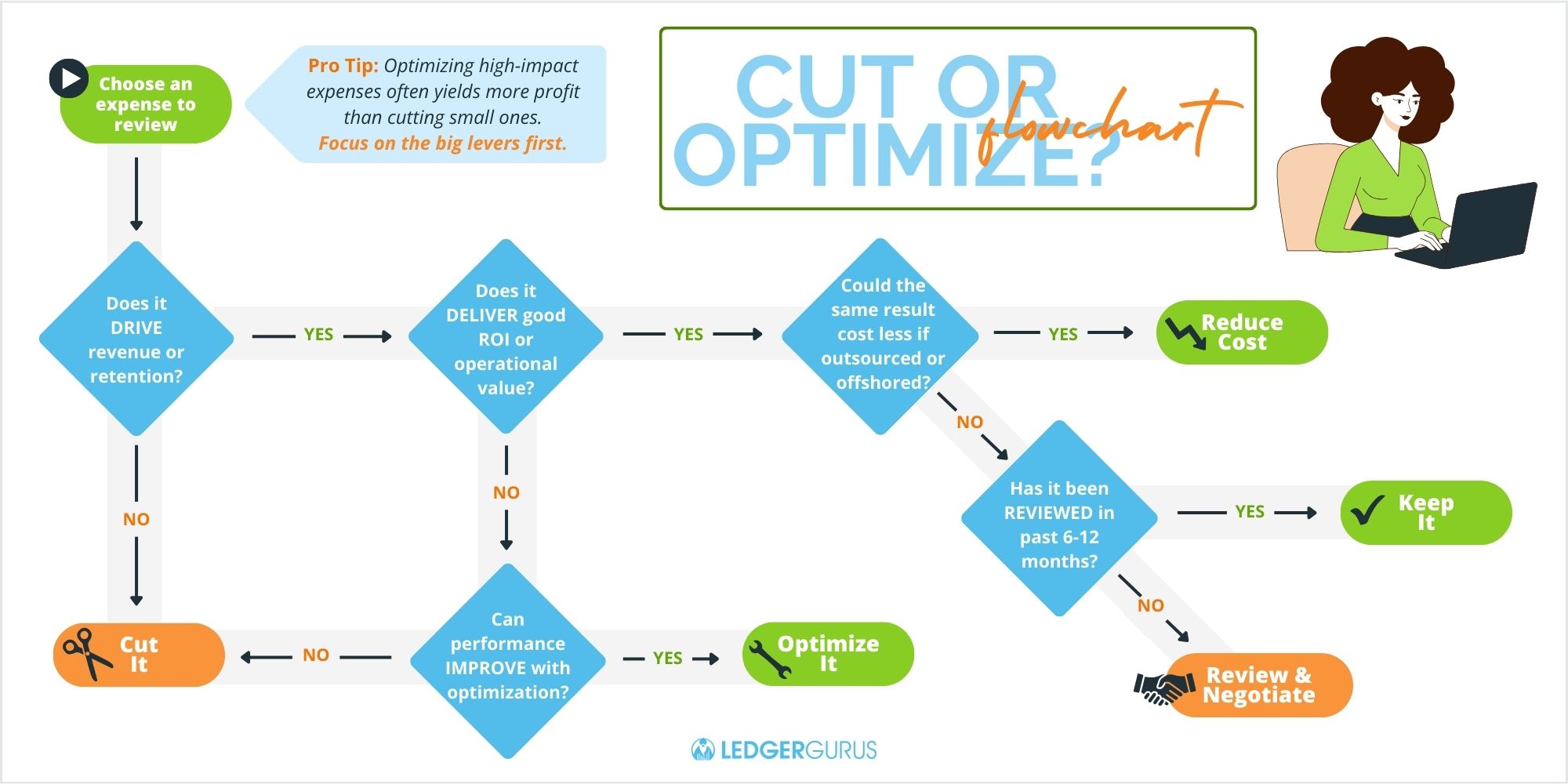
This graphic gives a really easy-to-follow series of questions to ask yourself to put the first 5 strategies into play.
Strategy 6: Three Often-Overlooked Cost Reduction Strategies
Sometimes the most powerful savings aren’t in massive overhauls. They’re in smart, targeted tweaks that fly under the radar.
These moves can boost profitability quickly, with minimal disruption to your day-to-day operations.
#1: Raise Your Free Shipping Threshold
If you’re offering free shipping on orders over $35, consider bumping it to $45 or $50.
Most customers won’t think twice about adding another item to hit the new threshold.
This small adjustment:
- Increases Average Order Value (AOV)
- Spreads fulfillment costs across a larger purchase
- Offsets rising shipping rates
Even a $5–$10 increase can make a noticeable difference to your margins.
#2: Simplify Your Packaging
Fancy packaging is great for unboxing videos, but not if it’s costing you dimensional weight surcharges or expensive materials.
- Switch to right-sized boxes and lighter fillers.
- Consider multi-use packaging that works for multiple SKUs to reduce ordering complexity and bulk-buy costs.
- If you’re a premium brand, balance the unboxing experience with cost efficiency. You can still “wow” customers without overbuilding your packaging.
#3: Use a Bonded Warehouse
If you import goods (especially from tariff-heavy regions like China), a bonded warehouse can be a strategic game changer.
Goods can be stored for up to five years without paying duties until they leave for domestic sale.
This lets you time your imports strategically, delaying tariff payments or avoiding them entirely if you re-export the goods.
Be aware: bonded warehouse space is in high demand right now, so plan ahead.
These strategies are about making surgical changes that have a ripple effect on profitability, not doing a total operational overhaul. And the best part? You can implement most of them in weeks, not months.
Strategy 7: Optimize Sourcing & Supply Chain
“Can I diversify my sourcing to avoid tariff impact?”
For many ecommerce sellers, tariffs are a structural cost change, not just a temporary annoyance. And while bonded warehouses can help you delay or time your duty payments, the bigger play is to rethink where and how you source your products.
Diversify Your Manufacturing Footprint
If all your products come from one country, especially one with high or unstable tariffs, you’re vulnerable. Consider:
- Shifting some production to lower-tariff countries like Vietnam, Mexico, or India.
- Splitting production across multiple countries to reduce disruption risk.
- Reshoring or nearshoring certain SKUs to shorten lead times and improve supply chain agility.
Tip: Diversification doesn’t have to be all-or-nothing. Start with a portion of your product line to test quality, lead times, and cost differences before making larger moves.
Negotiate with Existing Manufacturers
You may not need to move production to get relief.
Use tariff changes, lower global demand, or volume growth as leverage in price negotiations.
Explore changing materials or product design to lower costs without changing the core value to the customer.
Ask suppliers about delivery duty paid (DDP) arrangements so they carry the tariff burden.
Build a Tariff-Resilient Inventory Strategy
Bonded warehouses can store imported goods for years without triggering tariffs until they’re sold domestically.
Stagger imports to avoid overpaying during high-tariff periods.
Use air freight strategically, especially during seasonal surges or when ocean freight costs spike.
Watch for Supply Chain Bottlenecks
When tariff conditions shift, everyone rushes to import (or delay importing) at the same time. That’s when freight capacity dries up and costs soar.
Keep tabs on global shipping trends and port congestion reports.
Build in buffer inventory for your best sellers so you’re not forced into expensive emergency freight.
Why This Matters
Sourcing and supply chain moves aren’t quick fixes because they take months or years to fully implement. But for high-revenue sellers, a diversified, flexible supply chain is the difference between absorbing cost shocks and being blindsided by them.
A few smart adjustments today can protect you from margin-killing surprises for years to come.
Strategy 8: Introduce Price Increases the Right Way
“Should I raise prices, and how do I tell customers?”
Sometimes, even the best cost cutting strategies can’t offset every hit to your margins, especially when tariffs, freight hikes, or supplier costs stack up. In those cases, raising prices may be unavoidable.
The key is doing it strategically and transparently.
Be Transparent and Direct
Customers are far more understanding when they know why prices are going up.
- Explain the cause: Link the increase to specific, external factors (e.g., “Due to significant increases in shipping and materials costs…”).
- Show the balance: If you’re absorbing part of the increase, say so (e.g., “Our costs have risen 20%, but we’re only increasing prices by 5%”).
- Use plain language: Avoid corporate jargon. Speak the way you would in a conversation.
Communicate Early
Announcing a price increase before it happens does two things:
- Gives customers a chance to stock up at the old price (which can drive a short-term sales boost).
- Avoids the shock factor of prices jumping overnight with no explanation.
Choose the Right Channels
- Email: Reach your most loyal, engaged audience first.
- Website banners: Make the update visible at checkout or on key product pages.
- Social media: Use it to humanize the message and answer questions directly.
Highlight the Value, Not Just the Price
Price changes are easier to accept when they’re framed in terms of value.
- Emphasize product quality, durability, sustainability, or unique features.
- Remind customers of the benefits they get beyond the product itself, like fast shipping, exceptional customer service, or a hassle-free return policy.
Use It as a Loyalty Opportunity
Turn a tough message into a goodwill moment:
- Offer early access or a discount window for existing customers before the increase takes effect.
- Bundle the announcement with a small thank-you gift, loyalty points boost, or free shipping offer.
Bottom line: Customers know prices rise over time, especially in today’s economy. What they won’t tolerate is feeling blindsided or undervalued. By communicating clearly, respectfully, and with empathy, you can raise prices and strengthen customer loyalty at the same time.
Quick-Start Checklist: Where to Start This Month
Cutting costs strategically isn’t about gutting your business. It’s about removing what’s not working, fine-tuning what is, and protecting the margins that keep you growing.
Here’s your quick-start checklist to get moving this month:
Step 1: Run Your Numbers
- Compare your key costs against industry benchmarks (fulfillment, marketing, COGS, payroll, net operating income).
- Identify any categories outside the healthy range. These are your first targets.
Step 2: Slash Low-Impact Spend
- Audit your tech stack for unused or duplicate tools.
- Trim low-ROI marketing and agency costs.
- Tighten controls on meals, travel, and discretionary perks.
Step 3: Optimize Before Cutting Deep
- Right-size packaging and renegotiate 3PL or shipping contracts.
- Audit marketing for performance, shift spend to winners, and explore AI tools to lower costs.
- Consolidate or downgrade underused software.
Step 4: Rethink “Fixed” Costs
- Evaluate rent and space needs. Consider downsizing or going remote.
- Apply the 3 O’s to payroll: Optimize, Outsource, Offshore.
- Negotiate with vendors before renewals.
Step 5: Strengthen Your Contribution Margin
- Focus on your top sellers. Raise prices strategically, adjust bundles, and redesign for cost efficiency.
- Eliminate unprofitable SKUs and renegotiate supplier terms.
Step 6: Implement Overlooked Wins
- Raise free shipping thresholds.
- Simplify packaging to cut dimensional weight fees.
- Use bonded warehouses to delay or reduce tariff costs.
Step 7: Plan Long-Term Supply Chain Resilience
- Diversify sourcing across countries to reduce tariff risk.
- Stage imports strategically to avoid bottlenecks and freight spikes.
Step 8: Communicate Price Changes With Transparency
- Announce changes early and explain the “why.”
- Reinforce the value customers receive.
- Turn the moment into a loyalty-building opportunity.
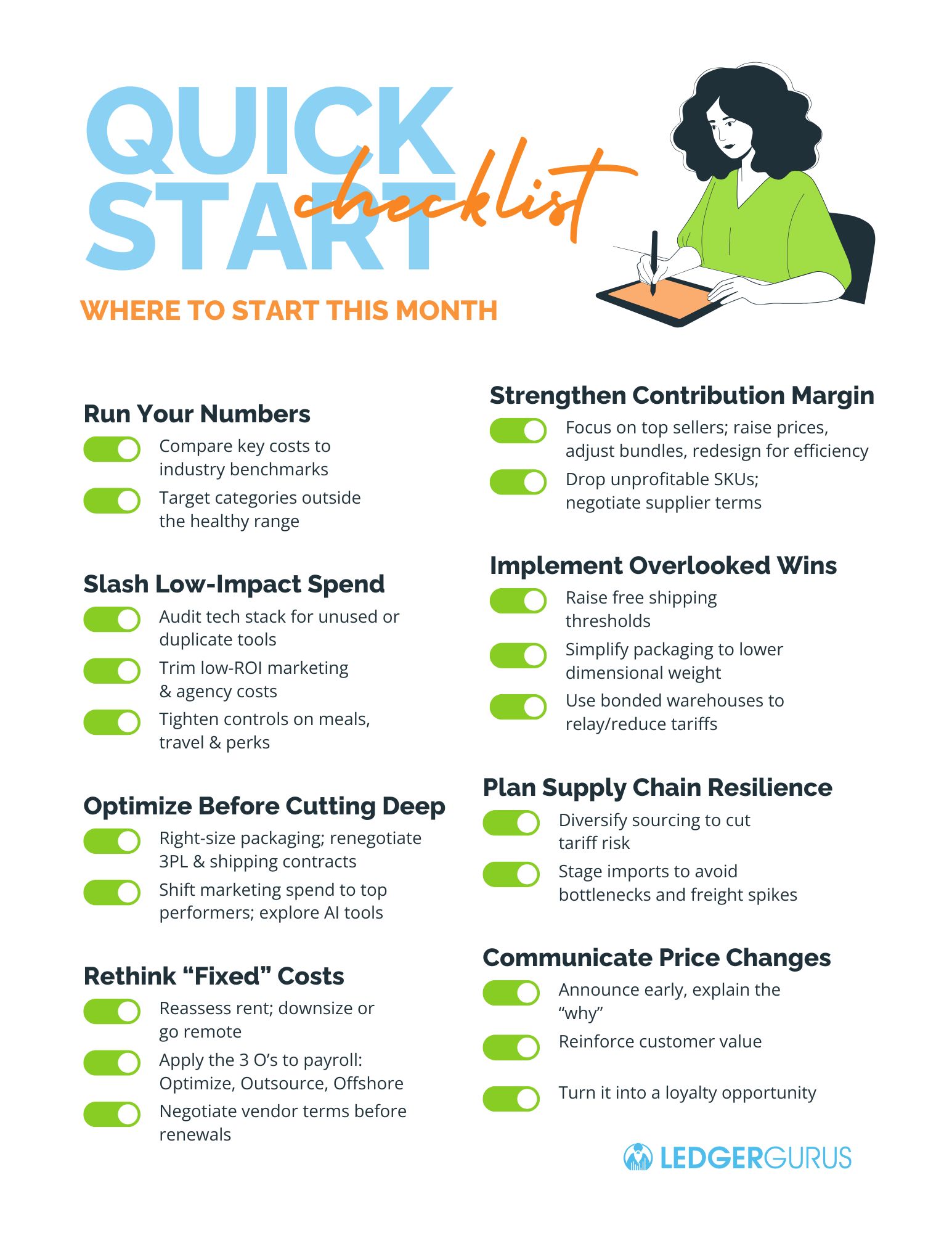 Click here to download as a PDF.
Your Next Step
Your next step really is determined by what your goals and circumstances are. Are you trying to do this yourself? Do you need expert help? Here are some options:
Option 1: Download our Cost Cutting Quick Wins Checklist. This guide goes deeper on the first 4 strategies, and includes lots of questions you can ask yourself to help reach the outcome you’re looking for → better profits.
Option 2: Book a 1-hour Cost Cutting Consultation today to help you:
- Understand the true drivers behind your costs and margins.
- Identify your highest-impact opportunities for savings.
- Build a strategic plan to cut costs without cutting growth
Option 3: Let the experts help you. The fastest way to make these strategies work is to know exactly what your numbers are telling you, so you can make changes with confidence. And to do that you, need accurate, reliable numbers. At LedgerGurus, our Ecommerce Accounting Services give you exactly that – numbers you can count on to make your most important decisions with.
Whether you want a full ecommerce accounting services, an out-sourced CFO partnership or a one-time deep dive into your financials, we’ll help you find the clarity and cash flow you need to scale profitably.