

This financial health check breaks down the five numbers you need to track to see exactly where your business stands and what to do next. Our first step for businesses navigating a downturn, or trying to stay ahead of one, is to do a business financial health check. This article covers what we do.
Assess your starting point
The first thing you need to do is identify where you are financially, right now.
First, let's remind ourselves that profitability = sustainability. During good economic times, it becomes easy to justify not operating profitably. You may be investing in growth and looking at the cash in your bank account. This is okay and good in certain circumstances. But any business that is not profitable long-term is not sustainable. Your cash may easily disappear over time if you are not operating profitably. (We are talking about bottom line, net profits.)
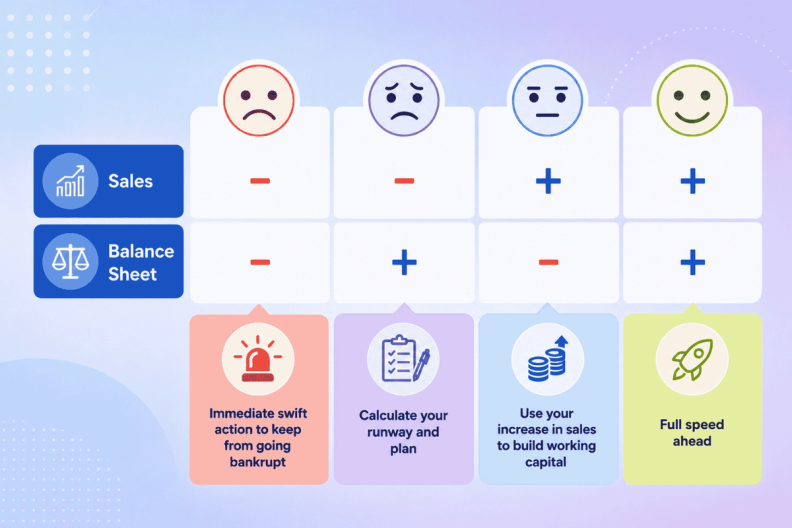
When disruptions happen, you may need to change your mindset significantly. Instead of focusing on investing, adjusting to a profitability mindset may need to happen. You should look at two factors when deciding what to do:
- Sales (Are sales up or down?)
- Balance sheet health (Your reserves. Inventory, bank account balances, accounts receivable, etc.)
Assess whether your sales are moving up or down. Then, do you feel comfortable with the reserves you show on your balance sheet? We'll dive into each of these factors next.
Track your sales trend
When looking at sales, you need to measure what matters. It's not about the amount of sales, but the trend. When looking at your sales trend, we suggest looking at year-over-year for comparable periods. The time period you look at should be at least seven days and no more than 30 days.
For example, you could compare your sales from the last two weeks to the same two-week window a year ago. You will then be able to see your current sales trend. When gathering your data, there are basically two ways to do so:
- Accounting system/CRM: This is typically for invoice-based companies. Invoices are usually done through an accounting system or CRM. The pros are that it can be very accurate. The cons are that it depends on timely updates, which can be difficult for these types of companies.
- Sales system/payment processor: This is for businesses with a point of sale, such as retail. The pros are that data collected is fast and accurate. The cons are that you may need to look at multiple sales channels and payment processors to gather your data.
Check your balance sheet health
A lot of business owners think about their accounting for tax purposes. But your financial data can be a powerful tool for decision-making if it is accurate and timely. Before looking at your balance sheet health, you'll want to make sure the data is up-to-date and accurate. This is why quality accounting is so important, especially when you're making big decisions about your business's survival.
You will want to look at two areas on your balance sheet:
- Liquidity
- Asset management
Liquidity
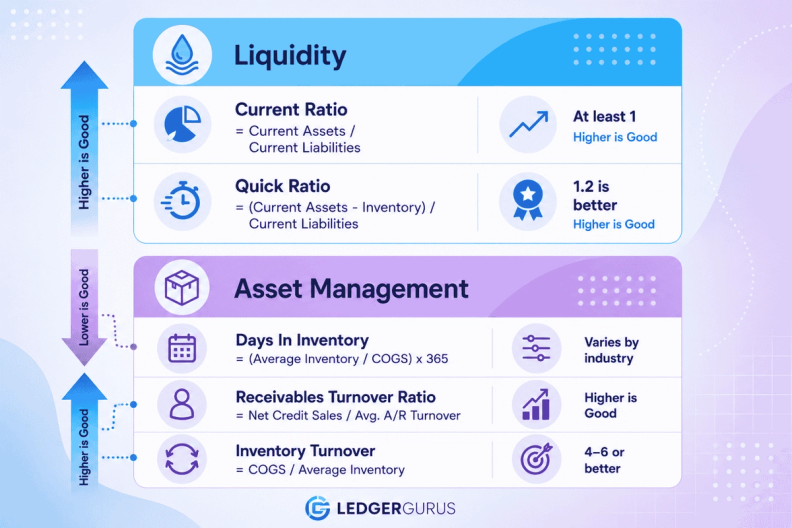
Liquidity is basically how likely you are to go bankrupt. Can you convert assets to cash quickly? View the table below for Quick Ratio and Current Ratio formulas.
Asset management
How well are you managing and converting your assets into something of worth? View the table below for Days in Inventory, Receivables Turnover Ratio, and Inventory Turnover Ratios. You can see what you want each of these numbers to be. Once you calculate these important ratios, you can determine if your ratios are poor, average, or good in general and for your industry. This will help you determine your balance sheet health.
Calculate your operating runway
The next thing you want to assess is how long you can survive on your reserves and current expenses. This is called operating runway. It will tell you how much time you have left to make necessary adjustments before looking at bankruptcy. You'll want to take this step if your sales are declining and you have poor balance sheet health. It will help determine what to do next.
Here is the calculation for operating runway:
Working capital (Current Assets – Current Liabilities)/Monthly Net Income or Loss
If you have a net loss, the number you'll see from this calculation will tell you how many months you have before running out of money, if everything stays consistent. This can happen fast if you are not careful! So, how can you extend your runway? You have two options:
- Increase your cash reserves
- Cut expenses
If you need help increasing cash reserves, start by tightening up your cash flow forecasting. Our guide on cash flow management for small businesses walks through practical ways to build up your reserves.
When cutting expenses, you can look at fixed COGS that you have power to reduce. You can also look at your overhead expenses.
Confirm your cash availability
Cash is king. Cash availability becomes an issue when you have sales coming in but can't fulfill because of a lack of cash. For example, a product company getting orders but not having the inventory or cash to purchase new inventory. You want to be able to free this bottleneck.
The measurement here is Operating Cash Flow Ratio:
Operating Cash Flow Ratio = Net Cash Flow from Operations/Current Liabilities
You want this ratio to be at least 1. 1 would mean you have enough cash to support current operations, but you would struggle to support growth. The higher, the better.
Common cash flow issues include the following:
- Slow Accounts Receivable collections
- Long inventory purchase cycle
- High days in inventory (This isn't an issue for selling, but can be an issue for covering operating expenses.)
- Paying bills too quickly
- Excessive debt payments
Frequently asked questions
What is a business financial health check?
It's a five-part check covering self-assessment, sales trends, balance sheet health, operating runway, and cash availability, to establish exactly where your business stands financially and what to prioritize next.
How do I measure whether my sales trend is actually up or down?
Compare year-over-year sales for the same window of at least 7 and no more than 30 days, rather than looking at a raw sales total. This shows you the trend, not just a snapshot.
What is operating runway and how do I calculate it?
Operating runway tells you how many months you can survive on your current reserves and expenses. Calculate it as Working Capital (Current Assets minus Current Liabilities) divided by your monthly net income or loss.
What's a good Operating Cash Flow Ratio?
You want a ratio of at least 1, meaning your operations generate enough cash to cover current liabilities. The higher above 1, the more room you have to support growth as well.
What should I do if my runway is short?
You have two levers: increase your cash reserves or cut expenses. On the expense side, look first at fixed COGS you have power to reduce, then your overhead.
Get a clear read on where you actually stand
Everything we've covered here, sales trends, balance sheet health, runway, and cash flow, depends on having clean, accurate, and timely books behind it. Running these numbers is only half the battle, acting on them is the other half.
LedgerGurus specializes in ecommerce accounting, from monthly bookkeeping to the kind of financial analysis that turns "I think we're okay" into "I know exactly where we stand." If your books aren't in shape enough to run this health check with confidence, or you'd rather have an expert run the numbers with you, that's exactly what we do.
