

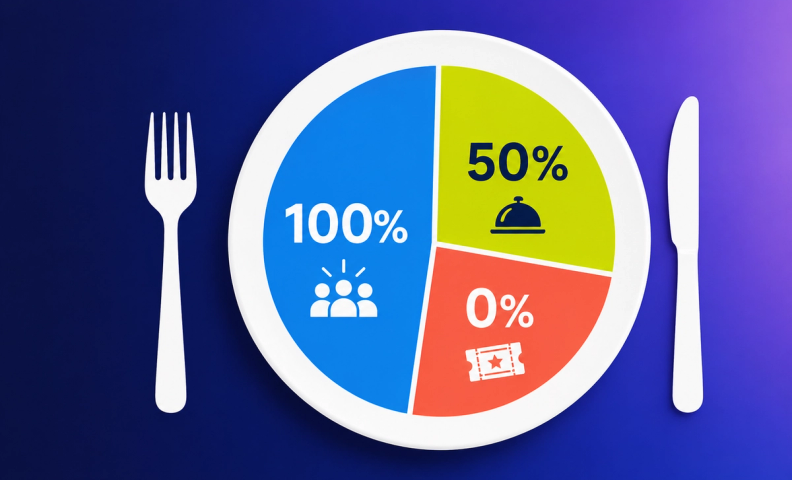
Meals and entertainment deductions are one of those gray areas that can leave business owners scratching their heads, and 2026 just made it more complicated. What's fully deductible, what's partially deductible, and what's off the table completely now depends not just on the purpose of the expense, but on rules that changed at the start of this year.
The IRS has clarified these rules several times since the Tax Cuts and Jobs Act of 2017 (see 26 U.S. Code § 274), most recently through the One Big Beautiful Bill Act, signed into law in July 2025 (see Public Law 119-21). The OBBBA added a new provision, IRC Section 274(o), that eliminates the deduction entirely for two categories of meals that used to qualify for the 50% deduction. If you haven't updated how you're categorizing meals since January 1, 2026, this is worth a close look.
In this article, we'll break down what's deductible, what's not, and what specifically changed this year.
Meals and entertainment deductions
Deductions come down to what is the purpose of the meal or event and who benefits from it.
In the past, it was common to use wining, dining and entertaining as a way to woo clients, writing off box seats or a round of golf along the way. The Tax Cuts and Jobs Act (TCJA) of 2018 changed that. One of the biggest shifts was that deductions are no longer allowed for entertainment expenses at all, with narrow exceptions for certain employee events.
In 2021, Congress passed a temporary tax incentive, the Consolidated Appropriations Act (CAA), that increased the deduction for restaurant business meals to 100% through the end of 2022. That break was temporary, meant to support the restaurant industry during COVID, and it expired as planned. Since 2023, most business meals have been back to the standard 50% deduction.
Then, in July 2025, Congress passed the One Big Beautiful Bill Act, which added IRC Section 274(o). Effective for expenses paid or incurred after December 31, 2025, this section eliminates the deduction entirely for two categories that had previously been 50% deductible: meals provided for the convenience of the employer (think food during in-office meetings or meals meant to keep employees working through a shift), and food provided through an employer-operated eating facility (think office snacks, breakroom coffee, and subsidized cafeterias).
What is considered a tax-deductible expense?
There is still plenty of room for fun with deductions. You just have to be careful about what you're doing so you can take them. Here's a quick overview:
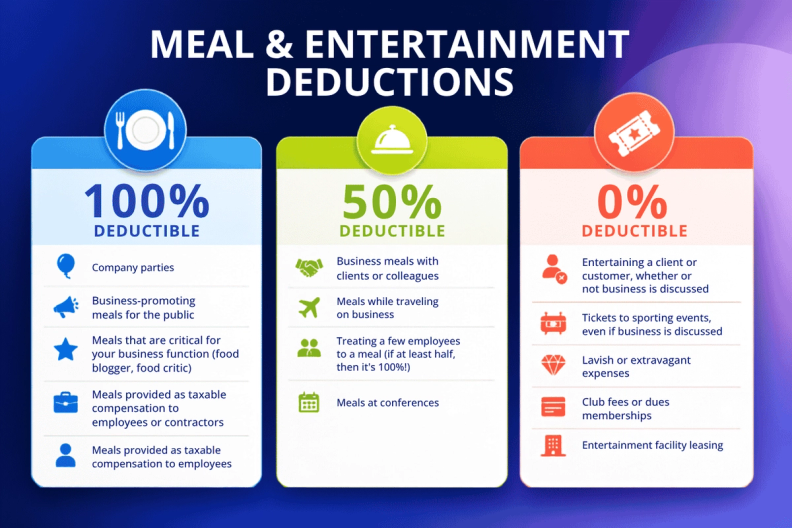
100% deductible
Here are some examples of 100% deductible meals and entertainment expenses:
- The company holiday party or summer picnic (You can still have tax-deductible fun with your employees!)
- Business-promoting meals provided to the public, such as an open house.
- Meals provided as taxable compensation to employees or independent contractors, included on a W-2 or 1099
- Business meals that are a critical part of your business function (ex. if you're a food critic or food blogger)
- Meals sold to a client or a customer
50% deductible
Here are some examples of 50% deductible meals and entertainment expenses:
- Business meals with clients or colleagues
- Meals while traveling on business
- Meals at conferences
- Treating a few employees to a meal (Note: If it's at least half of all employees, this can instead qualify as a 100% deductible recreational or social event)
No longer deductible as of 2026
These two categories were 50% deductible from 2018 through 2025, but IRC Section 274(o), added by the OBBBA, eliminated the deduction entirely starting January 1, 2026:
- Meals provided to an employee at work to keep them on-site, such as food for an in-office meeting or a meal during a late shift (this is the "convenience of the employer" category under the law)
- Office snacks, breakroom coffee, and other food provided through a company-run eating facility or subsidized cafeteria
The value of these meals is still excludable from the employee's taxable income, but the business can no longer deduct the cost. If your books are still coding these as 50% deductible, it's worth updating your chart of accounts to separate them out.
What expenses are NOT deductible?
These have been nondeductible since the TCJA in 2018 and are unaffected by the 2026 change:
- Entertaining a client or customer, whether or not business is discussed
- Tickets to sporting events, even if business is discussed
- Lavish or extravagant expenses
- Club fees or membership dues
- Entertainment facility leasing
This may change a few things about how you do business. Instead of doing business in a box at an NBA game, you may be better off to wine and dine your clients and customers because it'll be 50% deductible instead of 0% deductible. Or the food at the entertainment event can still be deductible if it is billed separately from the entertainment itself.
Make sure that you are reviewing meals and entertainment expenses regularly to be sure you are applying the right deduction, especially with two new nondeductible categories in play this year.
What entertainment expenses ARE deductible?
Some employee entertainment costs can still be deducted:
- Employee holiday party expenses
- Expenses for employee award or incentive trips
- Entertainment that is included in employees’ wages, and are reflected on their W2s (though there are some exceptions for highly compensated employees)
Criteria for meals and entertainment deductions
In order to deduct business meals, you must be self-employed or operating a business. Employees on W2s no longer qualify for business meals deductions.
The meal expense must be ordinary and necessary in carrying on your business, meaning it cannot be lavish or extravagant.
You, as the business owner, or your employee must be present with at least one other party present (ex. a client or colleague). This does not apply while you or your employees are traveling for business or attending conferences.
What are the IRS requirements for meal receipts?
You must keep a proper record of the meal:
- The amount (delivery fees, taxes, and tips can be included)
- The time and place of the meal
- The business purpose of the expense
- The business relationship between the taxpayer and the individuals being fed.
You can review the IRS guidance yourself, if you'd like, or read the underlying statute at 26 U.S. Code § 274.
Frequently asked questions
Are business meals 100% or 50% deductible?
It depends on the purpose. Most business meals, like client meals, travel meals, and food for in-office meetings, are 50% deductible. Meals tied to specific circumstances, like company parties, open-house events, or meals provided as taxable compensation, can be 100% deductible.
What changed with meals and entertainment deductions in 2026?
The One Big Beautiful Bill Act added IRC Section 274(o), which eliminates the deduction entirely, starting January 1, 2026, for meals provided to keep employees on-site (like food for an in-office meeting) and for food provided through an employer-run eating facility, such as office snacks or a subsidized cafeteria. Both were previously 50% deductible.
Are office snacks still deductible?
No, not as of 2026. Office snacks and breakroom food were 50% deductible through 2025, but IRC Section 274(o) eliminated that deduction starting this year. Employees still don't pay tax on the value of the snacks, but the business can no longer deduct the cost.
Is entertainment, like sporting event tickets, still deductible?
No. Since the Tax Cuts and Jobs Act, entertainment expenses like sporting event tickets, club memberships, and entertainment facility leasing are not deductible at all, even if business is discussed. This hasn't changed with the 2026 update.
Can I still deduct food at an entertainment event?
Yes, but only if the food is billed separately from the entertainment itself. If the meal cost isn't broken out, the whole expense loses its deduction.
What documentation do I need to back up a meal deduction?
You need to keep a record of the amount (including delivery fees, taxes, and tips), the time and place, the business purpose, and the business relationship between you and the people at the meal.
Can W-2 employees deduct their own business meals?
No. Only self-employed individuals or business owners can deduct business meal expenses; employees on a W-2 no longer qualify.
How LedgerGurus can help
Getting your meals and entertainment expenses categorized correctly is only half the job, especially now that a miscategorized snack budget or meeting-meal line item can mean claiming a deduction that no longer exists. LedgerGurus can handle both sides: keeping your ecommerce books accurate throughout the year and preparing your income tax filing, so nothing gets lost in a handoff between bookkeeper and tax preparer, and nothing gets claimed under outdated rules.
