

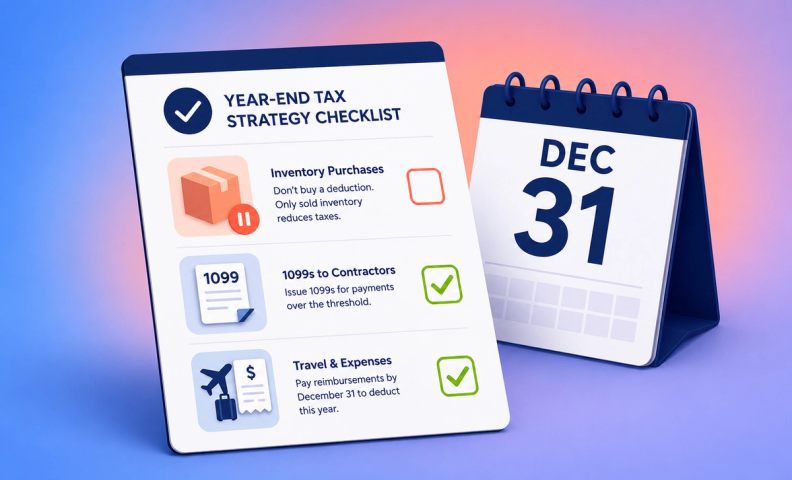
Here are the tax moves worth making before year-end, some with hard December 31st deadlines, others you'll want to have in place before your accountant starts your return. We're leading with the one that costs ecommerce sellers the most, because it's also the one most sellers get wrong.
Focus #1: Time your year-end inventory purchases correctly
This is the single most common tax mistake we see ecommerce sellers make in Q4.
To reduce their tax burden before year-end, sellers often stock up on inventory in November and December, assuming that purchase is a deduction. It isn't, at least not yet.
Inventory hits your balance sheet when you buy it, and only moves to your P&L as Cost of Goods Sold once you actually sell it. Buy $50,000 of inventory in December to "save on taxes," and if it's still sitting in your warehouse on December 31st, it hasn't reduced your tax bill at all. You've just spent cash and tied it up in a warehouse.
The same logic applies to capitalized equipment, vehicles, machinery, and similar big purchases. Those hit the balance sheet first, then flow to the P&L through depreciation over several years, not all at once. A big year-end equipment purchase doesn't hand you a proportional tax break the way sellers often expect.
If you want a real year-end deduction, look at genuine expenses instead: bonuses, travel, office supplies, things that actually hit your P&L in the period you pay them. We've seen sellers deplete cash hoping to lower their taxes, only to find out it did nothing. Don't make that mistake.
Focus #2: Send 1099s to contractors, affiliates, and freelancers
The reporting threshold jumped from $600 to $2,000 starting with 2026 payments, under the One Big Beautiful Bill Act, so fewer of your smaller vendors will need a form this year than in years past.
That said, ecommerce sellers still have more 1099 vendors than most businesses: affiliate partners, influencers, freelance photographers and designers, virtual assistants, dropship partners. If you paid any of them more than $2,000 this year, they need a 1099.
One thing that hasn't changed: All of that income is still taxable for them whether or not a 1099 gets issued, so it's worth confirming your own records independently of the threshold.
Amazon sellers specifically should also check their Amazon 1099 against their actual financial statement activity. The numbers don't always match what you'd expect, and it's worth understanding why before you file.
For the broader distinction between contractors and employees, see why understanding W-2 vs. 1099 is important for small business owners. For the full rundown on this year's tax law changes, see our podcast episode, Ecommerce Tax Strategy: The Big Beautiful Bill Just Changed the Game.
Focus #3: Deduct travel expenses for sourcing trips and trade shows
If you're on cash-basis accounting, travel reimbursements need to be paid out by December 31st to deduct them on this year's return. That includes sourcing trips to visit suppliers, trade show travel, flights, and prepaid hotels.
Get expense reports in from employees and owners before year-end. It keeps reimbursements from bleeding into the new year, gets people their money back faster, and starts your books clean for January instead of chasing down old reports in February.
Focus #4: Recognize prepaid software subscriptions correctly
If you're on accrual-based accounting and haven't been recognizing prepaid expenses, annual Shopify plans, inventory management software, ad platform subscriptions, A2X, you'll end the year with an inflated sense of profitability in whichever month you paid for them, and an understated one everywhere else.
Prepaid expenses need to move from your balance sheet to your P&L over the period they actually cover, ideally spread monthly rather than dumped all at once. Now's a good time to go back and fix any of these you've been recording as a lump sum instead.
Focus #5: Clean up dead accounts receivable
Less universal for pure B2C sellers (most retail ecommerce gets paid upfront by card), but real for anyone doing wholesale or extending net terms to retail partners. If a receivable is older than 90 days, and especially past 180, ask honestly whether you're actually going to collect it.
Send it to collections, write it off, or both. Carrying it on your books indefinitely creates a false financial position that compounds over time, and it's exactly the kind of thing that looks bad if you're ever raising capital or preparing for a sale.
A couple of quick tips
Update employee addresses. W-2s go out in January, so make sure they're going to the right place. If your payroll system distributes W-2s electronically, have employees sign a consent form and skip the postage entirely.
Bonuses. If you're cash-basis, bonuses need to be paid by December 31st to deduct them this year. On accrual, you get more flexibility. Bonuses can be accrued and paid out up to 2½ months into the new year, as long as they were earned in the prior year. See the IRS's own guidance if you want the technical read.
Frequently asked questions
Does buying inventory in December actually lower my tax bill?
Not by itself. Inventory sits on your balance sheet until it sells. Only then does it become deductible Cost of Goods Sold. A big December inventory purchase that's still on your shelves December 31st hasn't reduced your tax burden at all.
Who do I need to send a 1099 to as an ecommerce seller?
Anyone you paid more than $2,000 this year who isn't an employee (raised from $600 starting with 2026 payments under the One Big Beautiful Bill Act), which for most ecommerce sellers still includes affiliates, influencers, freelance designers or photographers, VAs, and dropship partners. All of that income remains taxable for them regardless of whether a 1099 is actually issued.
Can I deduct a sourcing trip or trade show as a business expense?
Yes, travel for supplier visits, trade shows, and similar business purposes is deductible. If you're cash-basis, just make sure reimbursements are actually paid out by December 31st to count for this year.
What happens if I don't write off dead accounts receivable?
You're carrying a false financial position. Receivables you're never actually going to collect overstate your assets, and that gap compounds the longer it sits on your books. This is especially relevant if you're seeking financing or preparing to sell.
Do bonus and travel reimbursement deadlines really matter if I'm on accrual accounting?
They matter less strictly. Accrual accounting gives you roughly 2½ months of flexibility to actually pay out bonuses that were earned in the prior year. Cash-basis accounting has no such grace period. The payment itself has to happen by December 31st.
Let us build your ecommerce tax strategy with you
A little year-end planning goes a long way toward starting the new year with clean books and a lower tax bill, especially the inventory timing mistake above, which we see cost sellers real money every Q4.
If you're an ecommerce company looking for a sales-tax-specific version of this checklist, download ours here.
We can also help you with your ecommerce accounting to make sure that everything’s ready for tax season.
