

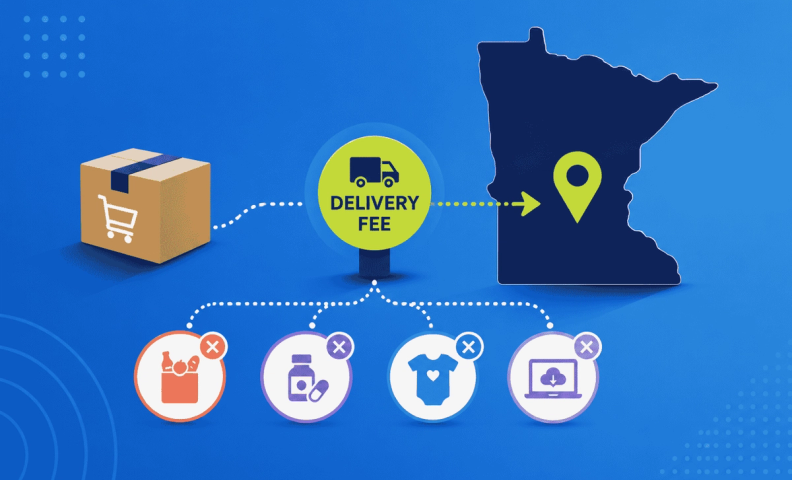
As of July 1, 2024, a new $.50 Retail Delivery Fee was imposed on retail deliveries in Minnesota. The fee is part of the state's efforts to increase revenue, following the lead of Colorado, which has already implemented a similar fee.
What is the Minnesota retail delivery fee?
As of July 1, 2024, the Minnesota Retail Delivery Fee has a new charge that applies to deliveries made within the state. The fee is part of the state's efforts to increase revenue to cover the wear and tear on infrastructure from all those delivery trucks hitting the roads. By labeling it a fee instead of a tax, the legislature can put it in place without having it be put to a vote by the general populous. If this sounds familiar, it's because Colorado already has a similar fee.
What you need to know about the Minnesota retail delivery fee
You might be thinking, ‘not another tax,’ but this fee might not even apply to you. Ask yourself if your business meets these criteria. If not, then you don't need to worry about it.
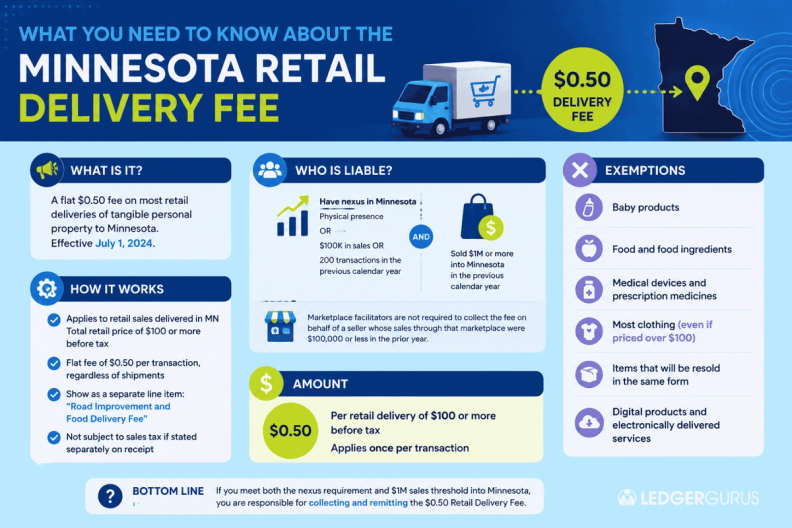
- The fee is only required from sellers who are selling $1M or more into the state of Minnesota each year, as determined by the previous year's sales.
- The fee applies to most retail sales of tangible personal property that are:
- Delivered in Minnesota
- Subject to Minnesota sales tax
- Have a retail price of $100 or more before state and local sales and use tax has been applied
- It is a flat rate of $0.50 per transaction on retail sales over $100, regardless of the number of shipments made.
How does the Minnesota retail delivery fee work?
The Retail Delivery Fee applies to all retail deliveries of tangible personal property with a retail price of $100 or more.
Also, the Retail Delivery Fee:
- Applies once per transaction, regardless of the number of shipments made.
- Should be shown as a separate line item on the receipt as “Road Improvement and Food Delivery Fee.”
- Is not subject to sales tax if stated separately on the invoice or receipt.
Please note: Most clothing is exempt from Minnesota sales tax, but clothing items priced at $100 or more will be subject to this fee.
Other types of products are exempt, so keep reading to find out what they are.
Which retailers are liable for the Minnesota retail delivery fee?
If you are a retailer or marketplace facilitator, you are liable for this fee if you meet both of these qualifications:
- You have nexus in Minnesota. This means that you've either got a physical presence in Minnesota and/or you have passed the economic nexus threshold of $100K in gross sales OR 200 transactions into the state in the past calendar year.
AND
- You sold $1M or more into Minnesota the previous year.
Note: The small business exemption threshold for the Retail Delivery Fee is far higher than the economic threshold for sales tax ($100K). Don't get them confused. Not sure where you stand on either one? Take our free Sales Tax Risk Assessment for a personalized read on your exposure.
Marketplace facilitators get a separate carve-out here: they don't have to collect the fee on behalf of a seller whose sales through that specific marketplace were $100,000 or less in the prior year, a distinct, lower threshold that applies only to the marketplace's collection obligation, not the seller's own liability. If you sell through a marketplace and your own site, you could still owe the fee on your direct sales even while the marketplace is exempt from collecting it on your marketplace sales.
Another thing to note is that you can choose to pay the fee yourself instead of adding it to the checkout process. This has been an issue with the Colorado Retail Delivery Fee because the software that retailers use often does not allow an extra line item to be added.
Want to avoid all kinds of sales tax woes for your business? Get the 10 steps you need to take to protect your business and be sales tax compliant with our free guide: Sales Tax Compliance Checklist. It also has a chart with all of the economic thresholds by state, along with other pertinent registration information.
Are there any exemptions to the Minnesota retail delivery fee?
Yes. Certain items are exempt, even if the transactions meets or exceeds the $100 threshold:
- Drugs, medical devices, accessories, and supplies
- Certain baby products (breast pumps, baby bottles and nipples, baby swings, baby wipes, bottle sterilizers, car seats and bases, changing tables and pads, cribs and bassinets, infant eating utensils, infant syringes, pacifiers, strollers, teething rings)
- Food, food ingredients, or prepared food
- Items delivered electronically
- Utilities delivered through wires or pipes
- Items purchased for resale
- Fuel products and construction materials
There are also some other types of transactions. The fee does not apply to:
- Deliveries to a sales tax-exempt purchaser
- Deliveries from food and beverage establishments
How does the Minnesota retail delivery fee compare to the Colorado retail delivery fee?
There are a couple of key differences:
- Minnesota's RDF is $0.50, a flat rate that hasn't changed since 2024, while Colorado's adjusts annually and is currently $0.31 (as of July 2026).
- Minnesota's is on retail transactions over $100 while Colorado's applies to any retail transaction with at least 1 item of taxable, tangible personal property.
- Minnesota's sales threshold for sellers is $1M in a calendar year, while Colorado's is $500K.
Colorado and Minnesota aren't likely to stay alone for long, more than ten other states have introduced or debated similar delivery fee legislation as of 2026.
Read our guide to Colorado's Retail Delivery Fee.
Frequently asked questions
What is Minnesota's current Retail Delivery Fee rate?
$0.50 per qualifying transaction, unchanged since the fee took effect July 1, 2024.
Who has to collect Minnesota's Retail Delivery Fee?
Retailers or marketplace facilitators with Minnesota nexus who sold $1M or more into Minnesota in the prior year. This threshold is separate from, and much higher than the $100K/200-transaction sales tax nexus threshold, don't confuse the two.
Do marketplace facilitators have to collect the fee on behalf of every seller?
Not necessarily. Marketplace facilitators don't need to collect the fee for sellers whose sales through that marketplace were $100,000 or less in the prior year, a separate, lower carve-out that applies only to the marketplace side, not the seller's own liability.
What items are exempt from the fee?
Drugs, medical devices, certain baby products, food, electronically delivered items, utilities, and resale items are always exempt. As of mid-2025, fuel products and road construction materials were added to the exemption list too.
How is Minnesota's fee different from Colorado's?
Minnesota's fee is $0.50 (vs. Colorado's current $0.31), applies only to transactions over $100 (vs. Colorado's any taxable item), and kicks in at $1M in sales (vs. Colorado's $500K).
Is Minnesota likely to be the last state to add a fee like this?
No. More than ten other states have introduced or debated similar delivery fee legislation as of 2026, so this is becoming a broader trend rather than a two-state anomaly.
Get Ahead of Minnesota's (and Every Other State's) Delivery Fee Rules
Minnesota and Colorado aren't likely to be the only states charging a retail delivery fee for long, and getting the thresholds, exemptions, and marketplace carve-outs right takes real attention. If you want your specific questions answered, schedule a consultation with one of our sales tax experts. If you'd rather hand the whole thing off, our sales tax team manages this, and everything else sales tax, for ecommerce sellers every day.
Get help with your Minnesota sales tax and delivery fee compliance →
