

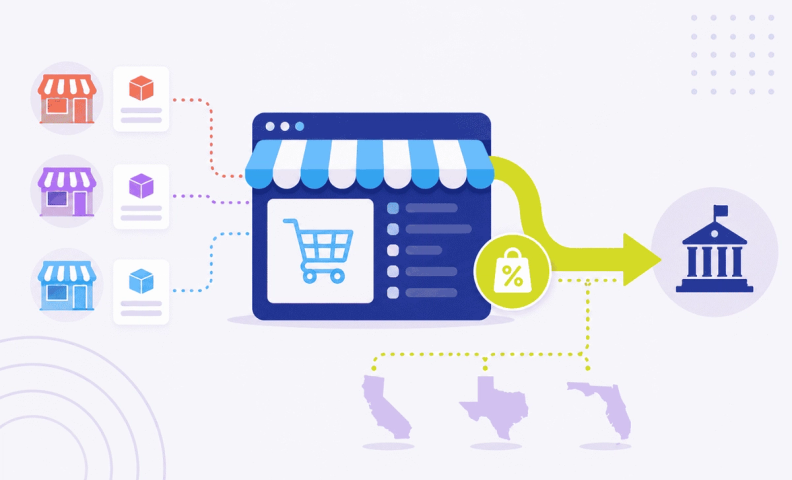
We've recently had more and more clients launching their own marketplaces. If you are a marketplace facilitator, you probably have a lot of questions surrounding sales tax. That's not surprising since internet sales tax is complicated. Furthermore, handling it as a marketplace facilitator can be confusing. But we are here to help!
For a closer look at exactly where your marketplace has nexus, watch Where Does a Marketplace Facilitator Have Sales Tax Nexus?
What are marketplace facilitator laws?
During the last few years, every state with sales tax laws has enacted marketplace facilitator laws. These laws place the liability for registering, collecting, and remitting sales tax on you as the marketplace facilitator, not on your sellers. It's much easier for states to deal with one entity (the marketplace facilitator) than with many, many thousands of entities (all the sellers on your marketplace).
Where do marketplace facilitators collect sales tax?
So, where do you need to manage sales tax as a marketplace facilitator? (For a quick primer, watch What online sellers NEED to know about sales tax nexus.)
Physical presence creates nexus
First, you should start with any state where you have physical presence. Physical presence includes:
- Where you have owners/employees
- Where your business entity is registered
- Where your inventory is stored, and so on.
In these states, you as the marketplace facilitator are legally obligated to register, collect, and remit sales tax for all sales being shipped to that state on your marketplace.
Economic nexus
Second, marketplace facilitators need to watch their sales volume in each state. If you have a high volume of sales into a state, you may be liable for sales tax. A general rule of thumb used to be 200 transactions or $100K in revenue for the current or previous calendar year, but more and more states are dropping the 200 transactions threshold. Also, many states have different dollar thresholds, so be aware of that. This rule is called economic nexus, and states have differing thresholds and requirements.
Download our Sales Tax Compliance Checklist for a complete and up-to-date list of all the economic thresholds by state, as well as all the steps you need to follow to be sales tax compliant.
Be aware of state thresholds and watch carefully as you approach them so you know when to register for a sales tax permit. Not sure where your marketplace actually stands? Take our free Sales Tax Risk Assessment, 20 quick questions, about five minutes, for a personalized read on your exposure.
If you discover you've already crossed a threshold without registering, don't panic, a Voluntary Disclosure Agreement can often limit your look-back period and reduce penalties, but only if you act before the state contacts you first. It is important to note that the physical presence of your sellers does not need to be factored in. If you have a seller operating in California, this does not mean you have a physical presence there. (Unless your marketplace actually has employees there, or some other physical presence.)
Do sellers on a marketplace need to collect sales tax?
If your marketplace does not have physical presence or meet the economic threshold in a state, you do not need to worry about sales tax in that state. Instead, the obligation moves to your sellers. If a seller has physical presence or meets the economic threshold in that state (due to sales on other platforms plus on the marketplace), the seller is liable for sales tax.
Note: This really only applies to smaller marketplaces, since larger marketplaces usually hit the thresholds so early in the year that marketplace facilitator laws come into play almost immediately.
For the fuller picture of how sales tax works beyond marketplace facilitator rules, see our complete ecommerce sales tax guide.
Frequently asked questions
What is a marketplace facilitator, and does it include my platform?
A marketplace facilitator is a business that lists third-party sellers' products and handles some part of the sale, like payment processing. If you operate a marketplace where multiple sellers list products and you process payments, you likely qualify, regardless of your platform's size.
Do I have to collect sales tax in every state where my sellers have nexus?
No. Your obligation as a marketplace facilitator is based on your own physical and economic nexus, not your sellers'. A seller having nexus in a state doesn't automatically create nexus for your marketplace there.
What's the typical economic nexus threshold for marketplace facilitators?
Many states use $100K in sales, and some historically paired that with a 200-transaction count, but thresholds vary by state, and a growing number of states have dropped the transaction-count test entirely, leaving only the dollar threshold. Always check the specific state's current rules.
If my marketplace doesn't meet a state's threshold, who's responsible for sales tax there?
The obligation shifts back to individual sellers, if they have physical or economic nexus in that state on their own, factoring in sales from all their channels, not just your marketplace.
Does it matter if my sellers have inventory stored in a state I don't have nexus in?
Not for your marketplace's own nexus determination. Your physical presence is based on your own employees, registered business entity, and inventory, not where your sellers happen to operate or store goods.
What happens as my marketplace grows and starts hitting more state thresholds?
You'll need to register, collect, and remit in each new state as you cross its threshold. Larger marketplaces typically hit most state thresholds early, which is why marketplace facilitator obligations tend to apply broadly once you scale past a certain size.
Let us handle your marketplace's sales tax
Marketplace facilitator compliance means tracking your own nexus across every state, registering at the right time, and collecting and remitting correctly, all while you're focused on growing your platform. Our sales tax team specializes in exactly this. We'll handle registration, collection, and remittance so you don't have to.
