

Ecommerce sales tax is genuinely intimidating, enough that many small- to medium-sized businesses put it off entirely (we don't blame you). But avoiding it can threaten your business's survival. One of the hardest parts to understand is sales tax nexus. Once you've got a handle on it, the rest of sales tax compliance gets a lot more manageable. You're in the right place.
What is sales tax nexus?
Like most things tax related, this term seems complicated at first glance but is actually fairly straightforward. In short, ‘Nexus’ is a term used to describe when a business has a strong enough connection with a given state or local government to be obligated to collect and file sales tax in that state. It's a simple enough concept. However, the devil is in the details.
Main types of sales tax nexus affecting ecommerce sellers
Previous to the South Dakota v. Wayfair ruling (June 2018), states could only tax ecommerce businesses based on old nexus laws (and a few less common laws). It used to be that the only basis used to determine whether a business had tax obligations in a state was if it had a physical presence there. Now there are other factors to consider:
- Physical presence
- Economic nexus
- Click-through nexus
- Affiliate nexus
The first two (physical presence and economic nexus) are the main ones that ecommerce sellers have to deal with. The other two (click-through and affiliate) are really only applicable in certain circumstances. Read below for descriptions of each type.
Physical presence
Physical presence can be in the form of locations, employees, warehouses, etc. An easy way to think of it is PEOPLE & PROPERTY. If you have people (employees, contractors, traveling salespeople, etc.) or property (warehouses, buildings, inventory, etc.) in a state, you have physical presence there.
Good questions to ask yourself are:
People
- Where is my company located?
- Where are my employees?
- Where are my salespeople?
Property
- Do I have any company-owned equipment or vehicles?
- Where are my offices and warehouses?
- Where is my inventory?
Please note that whether you store your inventory in your own warehouse or in a 3PL, if you own that inventory it is creating physical nexus for you.
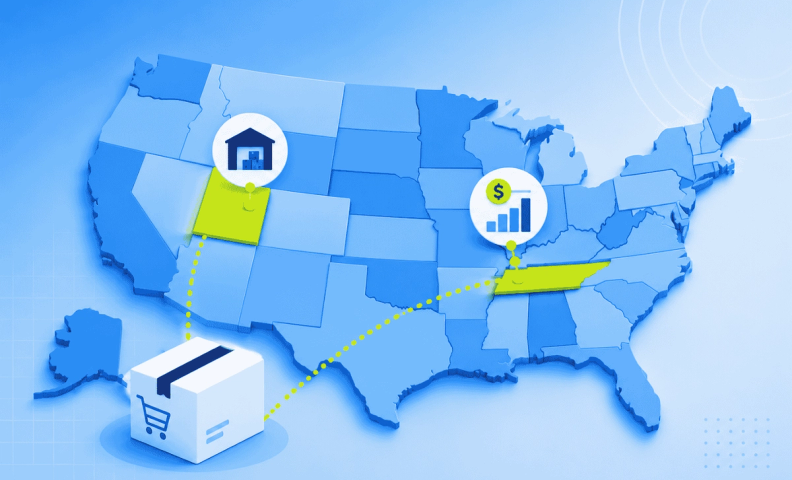
For example: If your business is located in Georgia, you have a physical presence there. You need to register and start collecting sales tax. If your business is located in Georgia and your inventory is in a warehouse in Tennessee, you have a physical presence in Tennessee, as well. That means you'll need to register for sales tax permits in BOTH Georgia and Tennessee, and start collecting and remitting sales tax on your sales into those states.
Economic nexus
The South Dakota v. Wayfair ruling made it so states can also tax businesses based on “economic activity.” Economic activity refers to the amount of gross sales annually and/or the number of transactions that a business has within a state. When you reach a certain threshold of sales and/or transactions within a state, your business is said to have economic nexus. You are then required to collect and remit sales tax to that state.
Some states have either sales OR # of transactions thresholds, while others require BOTH to pass the threshold. Historically, many states set this at 200 transactions OR $100,000 in revenue, but that's shifting. Indiana, North Carolina, and Wyoming dropped their transaction-count requirement in 2024, Alaska followed in 2025, and Illinois eliminated its own transaction threshold as of January 2026. More states are expected to follow this trend toward dollar-only thresholds, so don't assume the 200-transaction number still applies everywhere.
NOTE: You are NOT responsible for sales tax BEFORE you pass the threshold. So, don't make the common mistake of setting up your sales channels to collect in every state as soon as you start. Besides, it is ILLEGAL to collect sales tax if you don't have a sales tax permit.
For a complete list of economic thresholds by state, download our Sales Tax Compliance Checklist guide. Besides the 10 steps, there is a chart in the appendix with all the thresholds.
Click-through nexus
A seller meets sales threshold in a state from the activities of an in-state referral agent. The seller must be making commission payments for any sales that come about because of the website or marketing of the referral agent.
Affiliate nexus
A remote retailer can have affiliate nexus when he/she holds substantial interest in, or is owned by, an in-state retailer that sells the same or similar line of products under the same or similar name.
Criteria to determine where you have sales tax nexus
To determine whether you have sales tax nexus with a specific state, you need to answer the following questions:
- Do I have any physical locations/operations within the state?
- Do I make enough sales to surpass the state's sales tax threshold?
If you answered yes to either of these questions, you'll probably have to register and file a return. Not sure how to answer them? Take our free Sales Tax Risk Assessment, 20 quick questions, about five minutes, for a personalized read on where you likely have nexus.
Your ecommerce platform of choice will usually provide information about your number of transactions, how much money they're generating, and where they're taking place. Here are some resources for how to read your reports to get this information:
- How to Read Your Shopify Sales Tax Report (and Turn It into a Nexus Check)
- Understanding Your Amazon Sales Tax Report [A Compliance Guide for Sellers]
Economic nexus thresholds by state
Each state sets their own laws on economic nexus thresholds. For example, South Dakota expects sales tax to be collected by your business when you have annual sales in their state of more than $100K OR more than 200 annual transactions. California expects you to collect when you pass $500K in annual sales, but doesn't specific how many transactions.
Another “fun” fact is that sales tax laws change fairly often. It used to be that not all states that have state sales tax laws also had economic nexus laws. That is no longer the case. All states with state sales tax laws also have economic nexus laws. So, the question becomes, does your business have significant sales volumes in any of these states? If so, refer to our free sales tax guide for thresholds and other important info in those states. This is a great starting point for navigating the world of ecommerce sales tax and especially economic nexus.
Important Note: This guide is for informational purposes. Laws continue to change, and laws other than economic nexus may also require you to pay sales tax, including old nexus laws, click-through nexus laws, and affiliate nexus laws. Always contact the state if any questions remain.
How sales tax responsibility changes on different sales channels
The states you're selling in aren't the only factor to think about. Your ecommerce platform of choice is also important. Sites like Amazon or eBay are what's known as “marketplace facilitators.” They make sales, transactions, and often fulfillment possible. Many states have marketplace facilitator laws that ‘force’ these companies to collect sales tax on behalf of their sellers.
Amazon (and other marketplaces)
If you sell exclusively on Amazon, you usually won't have to worry about collecting sales tax yourself. The company now does this on behalf of their sellers in every state with a fulfillment center. For more guidance on what you need to do about sales tax as an Amazon seller, watch Do Amazon Sellers Need to Worry About Sales Tax?
Shopify
If you're wondering how to determine sales tax nexus for Shopify stores, the process is much like that described above. You'll need to know how many transactions you're making and/or how much revenue these transactions generate. The specifics, again, come down to each state.
If you're using Shopify's fulfillment network, the same principle applies as with Amazon FBA: wherever Shopify physically stores your inventory, you likely have physical nexus. Shopify's fulfillment center locations shift and expand over time, so check your SFN account or Shopify's fulfillment network page directly to see where your inventory currently sits, and treat each of those states as a probable nexus trigger.
If you know you're liable for sales tax in a given state, you'll need to add that state as a tax region in your Shopify admin and turn on collection there. Then decide whether shipping charges should be taxed too, since that varies by state and can be set as an override. Shopify updates the exact menu layout for this periodically, so rather than walk through button-by-button steps that can go stale, we'd point you to Shopify Sales Tax Setup: What to Get Right Before You Touch Your Settings for what you need for the setup process, or Shopify's own tax settings documentation for the most up-to-date screens.
Non-marketplace sales
If you're not selling on a common ecommerce platform, your situation may be a little trickier to navigate. You'll need to keep good records of the following:
- How many sales you're making
- How much money these sales have made
- Where these sales are generated
- Any physical locations you have in the United States
Once you've reached a state's threshold, it's your responsibility to start collecting sales tax on future sales and file returns where applicable.
Risks of delaying compliance
It may seem like a good idea to save money and time by putting off sales tax filings, but it is NOT smart to do this. States are becoming increasingly aggressive towards online sellers and sales tax audits are becoming more common. They are also starting to send out pre-audit questionnaires, to both registered and unregistered businesses, to see who is not being compliant.
For more information and to learn how to protect your business, read Sales Tax Audits Guide: What's Triggering Them and What Sellers Need to Know. If you've got a significant sales tax exposure, you may want to consider a Voluntary Disclosure Agreement (VDA) to reduce your liability and prevent an audit.
Resources available to help you comply with sales tax nexus laws
Our Sales Tax Compliance Checklist is a super valuable and free resource. It is intended to help you understand all the steps necessary for sales tax compliance. And, as an added bonus, there's a chart at the end with all the economic nexus thresholds by state, as well as links for more information.
Still scratching your head about how sales tax applies to your specific situation? We're happy to help. You can schedule a sales tax consultation with our sales tax experts. They are happy to answer your questions.
Frequently asked questions
If I'm drop shipping, do I have nexus where my supplier is located?
No. Your drop shipper owns the product, not you, so their location doesn't create physical presence for your business. For more detail, read Sales Tax for Dropshippers in the US: Who Pays and How to Save.
Am I responsible for sales tax as soon as I start selling into a state?
No. Without physical presence in a state, you have no sales tax obligation until after you cross that state's economic nexus threshold.
Should I start collecting sales tax in every state right from the start?
No. You're not responsible for sales tax until you actually have nexus in a state, and it's illegal to collect sales tax without a permit.
What's the difference between economic nexus and physical nexus?
Physical nexus comes from having people or property (employees, offices, inventory) in a state. Economic nexus comes from crossing a state's sales or transaction threshold, regardless of physical presence.
Does storing inventory in a 3PL or Amazon FBA warehouse create nexus?
Yes, if you own that inventory, physical nexus applies wherever it's stored, even in a third-party warehouse you don't operate yourself.
What happens if I ignore economic nexus in a state?
You risk audits, back taxes, penalties, and interest, and states are increasingly proactive about identifying non-compliant sellers through data sharing and pre-audit questionnaires.
Do click-through and affiliate nexus apply to most ecommerce sellers?
Not usually. These are narrower, less common nexus triggers tied to referral commissions or shared ownership with an in-state retailer, most sellers only need to worry about physical and economic nexus.
Stop guessing where you have nexus
Sales tax nexus gets more complicated every year as states pass new laws. If you're ready to hand this off entirely, our sales tax team can give you the peace of mind of knowing you're compliant, without you having to do the work.
