

As of this writing in Oct 2026, Shopify’s automated filing program is currently closed to new enrollments. There have been no changes to Shopify Tax, and it is still open to everyone.
In the complex world of online sales, merchants often find themselves grappling with the overwhelming task of managing sales tax. Calculating the correct amount to collect and ensuring timely remittance can be a major headache. At LedgerGurus, we understand the struggles that ecommerce sellers face when it comes to sales tax. That's why we've conducted an extensive comparison of some of the top sales tax software solutions available today. Join us as we explore how these tools can alleviate the challenges and bring clarity to your sales tax obligations.
What makes sales tax so complicated for ecommerce sellers?
- Every state has different sales tax regulations.
- Each state's regulations are subject to change at any time.
- Many states require a breakdown by county, city, and/or special jurisdiction.
It can be difficult to manually manage sales tax as a small business because every state has the freedom to regulate sales tax differently. Individual states determine their own:
- Tax rate
- Filing frequency
- Eligible merchandise
- Taxable services and products
See exactly how this complexity plays out in states like California, Illinois, Colorado, and New York.
Each facet of sales tax calculations and collections is also subject to change at the state's discretion, meaning you can be in compliance one month, but find that you're not in the following month. If you're not seeking out the information to stay informed, you could miss out on new exemptions, whether temporary or permanent. For an example of temporary exemptions, read about sales tax holidays.
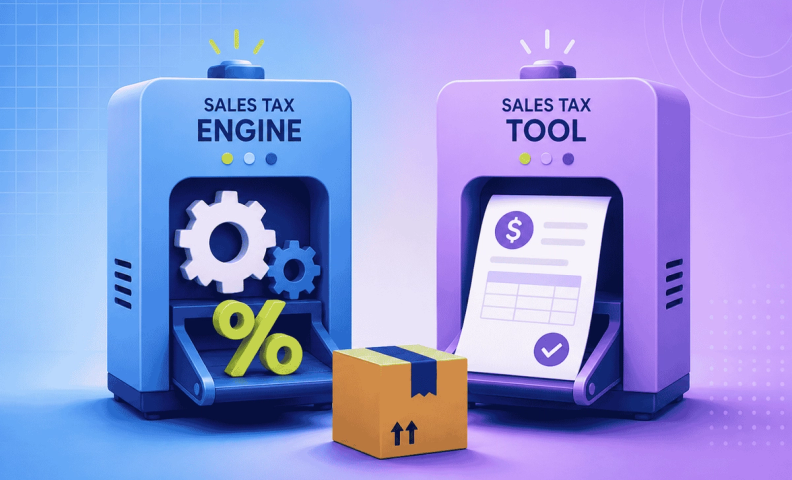
Sales tax engine vs sales tax filing tool: What's the difference?
To navigate the labyrinthine world of sales tax, ecommerce sellers require effective tools that can automate calculations, streamline reporting, and ensure accurate remittance. These tools come in the form of sales tax software solutions, offering two key components:
- Tax calculation engine
- Filing tool
These are two different things.
What is a sales tax engine?
Sales tax engines serve as the backbone of accurate tax calculations, simplifying the checkout process. They leverage up-to-date databases to determine the correct sales tax rate for each order, so you, as the seller, do not have to do it manually. For example, there are often special jurisdiction taxes that small businesses need to be aware of when selling online. Sales tax returns may require narrowing down what is owed based on these specific jurisdictions, meaning you have to track your sales to the exact purchase address.
This creates a tremendous number of variables that have to be researched, understood, and accounted for! A sales tax engine handles all these variables to help you manage everything accurately at checkout and avoid complications.
Marketplaces like Amazon already have built-in sales tax engines, while platforms like Shopify may provide in-house (though not free) engines or recommend external sales tax tools. If you want to see what that actually looks like on your end, we cover how to find and understand your Amazon sales tax report and your Shopify sales tax report in more detail.
For merchants selling on custom websites, there isn't always the option to build in a sales tax engine. That's when you need to purchase a software subscription with custom connections for your website to access the data it needs to accurately calculate sales tax in real-time.
What is sales tax filing software?
Sales tax filing software helps organize sales data, prepare returns, track filing deadlines, and submit returns based on the information flowing into the system. It can make the filing process more efficient, but it is important to understand that filing software is a tool, not a managed service.
Automated filings are only as accurate as the data and settings behind them. If an integration fails, a sales channel is missing, marketplace sales are classified incorrectly, or tax-exempt transactions are not handled properly, the software may prepare a return using incomplete or inaccurate information. Most filing platforms also require ongoing involvement from the business. Depending on the software and account setup, someone may still need to:
- Monitor integrations and confirm that all sales data imported correctly
- Compare imported data with sales channel reports
- Review returns for unusual amounts or discrepancies
- Make manual adjustments when the data is incorrect
- Approve returns before filing deadlines
- Confirm that payments and returns were successfully submitted
- Reconcile sales tax payable or clearing accounts
- Respond to notices and filing frequency changes
- Verify that all required state and local returns are included
This is the key difference between purchasing filing software and hiring a sales tax professional. Software provides the platform. A managed filing service provides the people, expertise, review, and accountability needed to operate it effectively.
How to choose what sales tax software you need
To determine what you need to help with ecommerce sales tax, LedgerGurus suggests asking the following question: Do you need a software that calculates tax OR a software that files tax returns? Addressing these two separate issues helps you decide which tool is best for your business.
Comparing your options: Avalara, TaxJar, Sovos, and Shopify Tax
When it comes to sales tax software, four names come up again and again: Avalara, TaxJar, Sovos, and, if you sell on Shopify, Shopify Tax. It's important to do your homework when doing a sales tax software comparison. You might have heard a lot about each of these sales tax programs. Each one might be right depending on who is asking. The question is, which one is the wisest option for your company?
Tax engine comparison
- Avalara: The most established option, with the deepest taxability and jurisdiction data, and the only one of the three that supports international filings. It was previously bundled into Shopify Plus for free; as of April 30, 2025, that changed, it's now a separate paid integration priced per transaction. Best suited to larger, more complex businesses.
- TaxJar: Generally the most affordable option for simple, lower-complexity sellers, though it raised prices significantly in 2026, and it doesn't support backfiling or home-rule jurisdiction filings (like in Colorado).
- Sovos: The most flexible of the three, supporting backfiling, editable returns, and remitting exactly what you collected rather than only what it calculates. Priced closer to Avalara's tier than TaxJar's, this isn't a budget step up from TaxJar, it's a different pricing tier entirely.
- Shopify Tax: A native option built directly into Shopify, only available if that's where you sell. Pricing is usage-based rather than subscription-based, and it now includes an optional automated filing add-on. If Shopify is your primary or only channel, this is worth weighing seriously before looking at the other three. For the full pricing tiers, feature breakdown, and how it stacks up against Avalara specifically, see our dedicated Shopify Tax vs. Avalara for Shopify comparison.
Sales tax software comparison wrap-up
The most important thing when making this decision is knowing your company's needs.
If you sell on a lot of channels, have tax exempt products, require backfiling, or want more flexibility, then it might be good to consider Sovos. Just know that Sovos operates at a similar price point to Avalara. This is the choice for complexity and flexibility, not for saving money over TaxJar.
If you only sell on a few channels, are just starting off, and don't have any of those extras to worry about, then the most cost-effective choice is TaxJar.
Avalara may not be the best choice for smaller ecommerce companies, but it does have high-quality performance and a very robust system, making it a good choice for larger companies.
If you sell exclusively or primarily on Shopify, don't skip past Shopify Tax just because it's not one of the traditional three, it's built into the platform you're already using, and for many Shopify sellers, it's the simplest path. See our full comparison against Avalara for Shopify before deciding.
If your sales channel doesn't already have a built-in sales tax engine, LedgerGurus highly recommends choosing a tool that has one. This makes the calculations easier, improves the customer's experience by making the checkout process smooth and hassle-free, and relieves you from having to do everything by hand. If your sales channel already takes care of the engine and all you need is the filing tool, it's still worth the money, time, and effort to set it up since it can calculate what is owed to each state, fill out the returns, and handle the filing process for you. Win-win!
Please note that using a sales tax engine and/or filing tool does not remove responsibility for sales tax compliance from the seller completely. Keep reading to see exactly where that responsibility still falls on you.
When software isn't enough
At LedgerGurus, we work with sales tax software rather than replacing it. We help clients select and use an appropriate tax engine, then provide the human oversight needed to manage their ongoing filing obligations. Our team reviews the information flowing into the filing system, identifies discrepancies, makes necessary adjustments, manages returns, and helps keep the business compliant.
That oversight matters because software alone tends to miss things: marketplace facilitator sales getting miscategorized, exempt sales handled incorrectly, home-rule jurisdictions like Colorado and Louisiana that most automated filing simply doesn't cover, B&O and other state-specific taxes falling outside the tool's scope entirely, backfiling and amended returns that most platforms don't support, registration gaps the software has no way to catch, and state notices that still need a person to read and respond to them.
For businesses considering automated filing, the real question is not simply, "Which software should we buy?" It is: “Does our team have the time and sales tax expertise to manage this process internally, or do we want professionals to manage it for us?” If it's the latter, that's exactly what we do.
Frequently asked questions
What's the difference between a sales tax engine and a sales tax filing tool?
A sales tax engine calculates the correct tax rate at checkout in real time. A filing tool takes your sales data afterward and handles preparing, filing, and remitting your returns to each state. Some software does both; some sellers only need one or the other.
Do I need sales tax software if my sales channel already calculates tax for me?
You may only need a filing tool in that case, not a full engine. Marketplaces like Amazon and platforms like Shopify often calculate tax automatically, but you're still responsible for filing and remitting it correctly.
Which sales tax software is best for a small, simple ecommerce business?
TaxJar tends to be the most cost-effective option for sellers on a few channels with no tax-exempt products or unusual complexity. It's less flexible than Sovos or Avalara, but that simplicity is exactly what keeps the cost down.
Is Shopify Tax one of the three main options, or something different?
It's a fourth option, but it's only available if you sell on Shopify. Unlike Avalara, TaxJar, and Sovos, which work across any sales channel, Shopify Tax is native to the platform. If Shopify is your primary channel, it's worth comparing directly against Avalara for Shopify before looking elsewhere.
Can I backfile past sales tax returns with any of these tools?
Sovos supports backfiling at the same filing fee as regular returns. TaxJar does not support backfiling at all, you can only file going forward from when you start using it.
Why would I choose Sovos or Avalara over TaxJar if they cost more?
Both offer more flexibility that TaxJar lacks: handling tax-exempt products, home-rule local jurisdiction filings (like Colorado’s), editable returns, and the ability to remit exactly what you collected rather than only what the software calculates.
Does using sales tax software mean I'm no longer responsible for compliance?
No. Software handles calculation and filing, but you're still ultimately responsible for staying compliant, catching errors, and making sure everything reconciles correctly.
Let us help you choose (and manage) the right software
Software handles calculation and filing, but it doesn't replace compliance responsibility, and getting the wrong tool for your complexity level can cost you more than the subscription fee. If you'd rather not sort through Avalara, TaxJar, Sovos, and Shopify Tax alone, or want us to manage the software and the compliance side together, that's exactly what we do.
