VIDEO TRANSCRIPT:
What if your inventory method is quietly draining your profits, and costing you thousands more in taxes than it should?
I’m talking about FIFO, LIFO, and Average Cost.
In this video, I’ll show you how each method impacts your bottom line. And at the end, I’ll give you a matrix that compares them all so you can decide which one is best for your business.
I’m Kelley with LedgerGurus. We’ve handled inventory accounting for hundreds of ecommerce brands, and this is one of the most common (and costly) mistakes we see.
I’ll walk you through the top three inventory costing methods, show you when to use each one, and help you avoid common pitfalls that could be hurting your margins.
What matters is which one fits how your business actually runs and what your financial goals are.
Average Cost
Let’s start with Average Cost. This method takes your total inventory cost and spreads it evenly across all units.
Say you run a print-on-demand shirt business. You buy 200 shirts at $12 each and 100 at $15 each. You don’t track which shirt sold first; you just want a clean, simple cost across your inventory.
So, if you average it, it’s $13 per shirt. Sell 75, and your COGS is $975 with $2,925 left in inventory. Average Cost works great here.
The pros of this method are:
- It’s easy to apply and automate
- It’s good for consistent pricing
- And it minimizes the risk of manipulation
The cons are:
- It doesn’t reflect actual price changes
- And it can cause mispricing when costs fluctuate
This method is best for high-volume sellers with similar SKUs, like t-shirts, accessories, or cosmetics.
FIFO
Next is FIFO (First In, First Out). This means you sell the oldest inventory first.
So, imagine you’re selling skincare products. You want to clear out older inventory before it expires, so naturally, you’re using the oldest batches first.
FIFO reflects this flow.
The pros are:
- It matches most natural inventory flow
- It often shows higher profits
- And it gives a nice, clean balance sheet
The cons are:
- A higher tax liability in times of inflation
- And it may overstate net income
This method is best for sellers with perishable goods or short product cycles, like food, beauty, seasonal items, or even apparel with fast style turnover.
To keep things tidy with our example, let’s say you’re running the same shirt business. FIFO says sell the oldest first, so 75 shirts from the $12 batch = $900 in cost of goods sold with $3000 left in inventory.
This method makes sense, but just know that when wholesale prices jump, your taxable income may increase more than you expect and may require some tax planning.
LIFO
Then there’s LIFO (Last In, First Out). With this method, you sell the newest inventory first. So, if you’re a large retailer selling consumer electronics or hardware, you’re constantly restocking and selling the latest batch.
Prices can rise regularly due to inflation and supply chain shifts.
The pros are:
- It reduces your taxable income when prices rise
- And it matches recent costs to current sales
The cons are:
- This method is not allowed outside the U.S.
- It can lead to a lower reported profit
- And it can distort inventory value
LIFO is best for large-scale retailers, wholesalers, or businesses with rising inventory costs and tax sensitivity—like auto parts or supplements.
So, if you switch to LIFO, you may lower your tax liability —but your books will also show lower profits.
So, we’re still running that shirt business. With LIFO, the newest ones go first, so 75 shirts from the $15 batch = $1,125 in cost of goods sold with $2,275 left in inventory.
Quick heads-up: If you’re thinking about changing your inventory costing method, be aware—it may require IRS approval.
We don’t handle income taxes at LedgerGurus, but we can help you understand how this change impacts your accounting and what steps to take with your tax preparer.
3 Mistakes Sellers Make
Let’s wrap with 3 big mistakes ecommerce sellers make with inventory costing:
- Using FIFO by default, even when it doesn’t match their business model
- Letting Average Cost run for years without adjusting for price changes
- Switching methods without understanding the financial or compliance impact
Are you still not sure which method fits your business?
Before we wrap up, here’s a quick scorecard to help you spot the best method for your business:
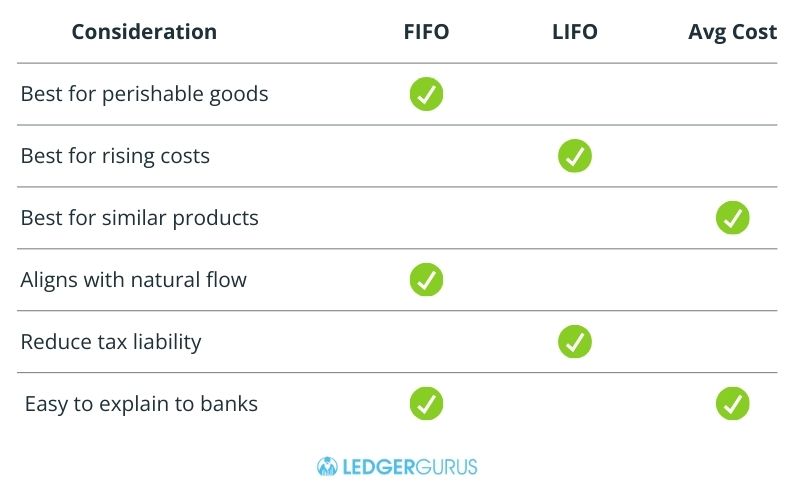 FIFO is great for perishable goods or seasonal products.
- It gives you a clean balance sheet and aligns with how inventory typically flows.
- LIFO is a strong fit if your costs are rising and you want to lower your taxable income
- But keep in mind, it’s U.S.-only and less intuitive.
- Average Cost is best for high-volume, interchangeable products.
- It’s simple to automate and works well when you don’t need price precision per unit.
Think about your products, your pricing, and your goals. The right method can tighten your margins and give you a clearer financial picture.
How to Get Help
And if you’re looking to stop guessing and start growing with confidence, we can help.
At LedgerGurus, we specialize in inventory consulting and ecommerce accounting built specifically for brands like yours.
Whether you’re trying to clean up your books, prep for an exit, or just make smarter decisions, our team can help you set up systems that scale.
We’ll walk you through how to get control of your inventory, align your costs with your strategy, and build a financial foundation for growth.
Thanks for watching.
Like and subscribe for more ecommerce accounting tips.
We’ll catch you in the next video!