Your P&L says you’re profitable. Orders are coming in. So why does cash always feel tight? If this sounds familiar, the answer is almost certainly hiding in your inventory.

It’s one of the most common frustrations we hear from ecommerce founders, and most of the time it has nothing to do with sales. As your business grows with more SKUs, more sales channels, more suppliers, and more warehouses, inventory stops being a simple list of products and becomes a complex system connecting purchasing, operations, and accounting. Every decision you make has a financial ripple effect, whether you realize it or not. And when that system has gaps, profit quietly disappears.
The short answer: An ecommerce business can show profit on a P&L and still feel cash poor when inventory costs are not being captured accurately. If landed costs like freight, duties, and tariffs are missing from your product cost calculations, your margins are inflated. If COGS is not being recorded correctly, your financials are overstating how much money you are actually making. The business feels tight because the real profit is lower than what the numbers show.
In this post, we cover:
- Why your product costs might be silently drifting
- The landed costs most brands forget to capture
- When spreadsheets stop working for inventory
- What happens when no one owns the numbers
- Why a monthly inventory reality check changes everything
- A 3-step fix to get back on track
- FAQs
- How to get help
Why Your Product Costs Might Be Silently Drifting
The problem: Inconsistent product cost updates cause profit margins to drift without any visible reason.
If your margins are swinging month to month and you can’t explain why, your first instinct might be to look at discounts, ad spend, or seasonality. But more often than not, the culprit is inventory. Specifically, costs that aren’t being tracked or updated in real time.
Think about everything that can change the cost of a product:
- Supplier price increases
- Tariff changes
- Duties
- Freight fluctuations
If those changes aren’t being reflected consistently in your inventory records, your margins will start to drift. From an operations standpoint, nothing feels like it has changed. But the disconnect between what’s physically happening with your inventory and what’s showing up in your financials is usually the first signal that something deeper needs attention.
The fix: Review and update product costs on a regular schedule, not just when something looks off.
The Landed Costs Most Brands Forget to Capture
The problem: Businesses that only count vendor purchase price as product cost are understating COGS and overstating profit.
When most people think about the cost of a product, they think about what they paid the vendor. But your true product cost includes everything it took to get that item to your warehouse and ready to sell. That list is longer than most businesses account for.
Landed costs include:
- Freight
- Duties
- Tariffs
- Insurance
- Packaging
All of it factors into your real cost of goods sold.
Here’s why it matters: if you think you’re running at 60% margins, but your actual landed costs push that number to 48%, you are operating on phantom profit. Phantom profit is money you believe you’re making but aren’t. When you’re making pricing decisions, forecasting cash flow, or evaluating which products are worth selling, phantom profit leads to costly mistakes.
Getting landed costs right isn’t always easy, especially when freight invoices arrive weeks after a purchase order has been processed. But capturing them accurately is one of the highest-impact changes you can make to your inventory accuracy and financial clarity.
The fix: Build a landed cost process that captures freight, duties, and all associated costs at the purchase order level, and allocate them to each product appropriately.
When Spreadsheets Stop Working for Inventory
The problem: Spreadsheet-based inventory tracking breaks down as product lines, sales channels, and cost complexity grow.
Spreadsheets are a great starting point. When you have 10 to 20 SKUs, one location, relatively stable costs, and one person managing everything, they work well for inventory tracking.
But here’s what happens as you grow: more products, more channels, more locations, and costs that change more frequently.
Spreadsheets don’t fail all at once. They fail slowly. One broken formula. One number someone manually overrode to make things reconcile. One column that didn’t get updated after a price change. Before long, your spreadsheet looks fine on the surface, but the numbers underneath aren’t telling the full story anymore.
The real problem is that you usually don’t catch it until something shows up wrong in the financials. By then, the errors have often compounded over months and are much harder to untangle.
The fix: If you’re scaling and still relying on spreadsheets for inventory, ask yourself honestly: do you fully trust your numbers? If there’s any hesitation, that’s your answer. It’s time to evaluate a purpose-built inventory management system.
What Happens When No One Owns the Numbers
The problem: When inventory ownership is split between operations and accounting, critical updates fall through the cracks.
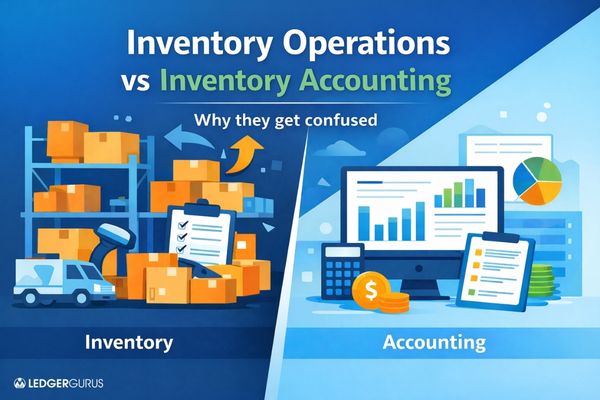
This is one of the most common structural gaps in growing ecommerce businesses, and it’s almost never intentional. What typically happens is this: operations owns the units (receiving inventory, managing stock, fulfilling orders) and accounting owns the dollars (financials, product costs, COGS). Both sides are doing their jobs. But nobody owns the full picture.
Inventory lives in both worlds.
When there’s no clearly defined ownership, things slip through the cracks quietly. Product costs don’t get updated when supplier prices change. Landed costs get added months after the fact. Inventory adjustments are made on one side without the other side knowing. We’ve seen situations where product costs hadn’t been updated in months, not because anyone was being careless, but because everyone assumed someone else was handling it.
The fix here isn’t a new software tool. It’s structure.
- Clear roles.
- Documented responsibilities.
- Regular communication between ops and accounting.
Tools can support good processes, but they can’t replace them.
The fix: Define and document who owns product costs, landed cost allocation, inventory adjustments, and monthly reconciliation. Make sure both operations and accounting understand each other’s roles.
Why a Monthly Reality Check Changes Everything
The problem: Without a regular inventory review, small errors compound over time and become expensive to fix.
How often are you actively reviewing and validating your inventory numbers? If the honest answer is “when something looks wrong,” you’re in good company. But waiting until there’s a visible problem means you’re almost always dealing with errors that have been building for months. What could have been a quick fix turns into a major reconciliation project.
Your inventory is one of your biggest assets. It deserves a regular check-in, not just an audit when the numbers stop making sense. A monthly inventory review doesn’t have to be complicated. It means consistently validating that what your system says you have matches what you actually have, that your product costs are current, and that your COGS is being calculated and recognized correctly.
The fix: Schedule a monthly inventory review and treat it as a non-negotiable part of your financial close process.
A 3-Step Fix to Get Back on Track
If any of these five issues sound familiar, here’s where to start:
Step 1: Audit your current state.
- Review your inventory records, product costs, and how inventory flows into your financials.
- Identify where gaps exist, where things are being tracked manually that could be automated, and where ownership is unclear.
Step 2: Establish clear ownership and documented processes.
- Decide who owns product costs, landed cost allocation, inventory adjustments, and monthly reconciliation.
- Write it down.
Standard operating procedures are the difference between a system that works and one that silently breaks.
Step 3: Get the right tools in place.
A dedicated inventory management system that integrates directly with your accounting software isn’t a luxury for scaling businesses. It’s a necessity. Real-time inventory tracking, automated COGS posting, and landed cost allocation make your financial data trustworthy enough to run your business with confidence.
Frequently Asked Questions
Why does my ecommerce business feel cash poor even though we’re profitable?
Your P&L can show profit while cash still feels tight when inventory costs are not being captured accurately. Missing landed costs, outdated product costs, and incorrect COGS recording all cause financials to overstate real profit. The business feels cash poor because actual margins are lower than what the numbers show.
What are landed costs in inventory accounting?
Landed costs are all the expenses associated with getting a product from a supplier to your warehouse. This includes freight, duties, tariffs, insurance, and packaging. These costs must be included in your product cost to accurately calculate cost of goods sold and true profit margins.
What is phantom profit in ecommerce?
Phantom profit occurs when a business believes it is more profitable than it actually is, typically because costs like freight, duties, or tariffs are not being captured in product cost calculations. Businesses operating on phantom profit make pricing and growth decisions based on inflated margin data.
How often should ecommerce businesses review their inventory?
At minimum, a monthly inventory review is recommended. This should include validating on-hand quantities, confirming product costs are current, and ensuring COGS is being calculated and recognized correctly in the financial statements.
When should an ecommerce business move from spreadsheets to inventory management software?
The transition becomes necessary when a business expands beyond a single sales channel, adds significant SKU volume, begins importing products with variable landed costs, or operates across multiple warehouse locations. At that point, spreadsheets can no longer maintain the accuracy or efficiency the business requires.
How to Get Help
Inventory problems aren’t always accounting problems. More often than not, they’re operational problems that show up in the financials. That means the fix starts in operations, not in QuickBooks.
Once you close the gap between what’s happening physically with your inventory and what’s reflected in your financials, you get something incredibly valuable:
- Numbers you can actually trust.
- Margins that mean something.
- A P&L that tells the real story of your business so you can make better decisions, grow with confidence, and stop wondering where your profit went.
If any of this felt familiar, the best next step is to find out exactly where your inventory setup stands right now.
Our Inventory Reality Check is a free 3-minute diagnostic built specifically for ecommerce brands doing $1M to $20M in revenue. Answer 13 quick questions and you’ll walk away with a clear picture of what’s working, what’s creating blind spots in your margins and cash flow, and what to fix first. You’ll even get a downloadable action plan sent straight to your inbox.
No fluff. No sales call required. Just immediate clarity on what’s holding your inventory back and a concrete plan to address it.
Take the Free Inventory Reality Check →
 And if your results show you need more than a DIY fix, that’s where we come in. LedgerGurus specializes in inventory accounting and operations for 7- and 8-figure ecommerce brands. We’d love to help you get to numbers you can actually trust.
Learn About Our Inventory Services →