

As an Amazon seller, are you wondering what your sales tax obligations are? LedgerGurus explains all you need to know. As accountants who primarily work with ecommerce businesses on platforms such as Amazon and Shopify, we have the experience you need to answer your sales tax questions.
Sales tax liabilities for Amazon sellers
Does Amazon collect sales tax for me?
This is the first and most important question. As an online retailer, you may be wondering if Amazon is responsible to collect sales tax for you, the seller. Amazon is a marketplace facilitator, so, yes. By law, it is required to calculate, collect, and remit sales tax on behalf of sellers like yourself.
What is a marketplace facilitator? It's just a nifty way of saying that Amazon is a marketplace that contracts with and sells other businesses' goods. In these contractual relationships, the marketplace facilitator becomes responsible for calculating, collecting, and remitting sales tax on behalf of the seller.
Most states require sales tax collection on the state level. They may also require collection on up to 3 other levels, and these are listed on Amazon's combined sales tax report:
- State
- County
- City
- Special district
Amazon automatically calculates the sales tax that is required for your state. So, the sales tax that a customer sees on their end will be one lump amount, but Amazon knows exactly how much is being collected for the various levels.
How you benefit from marketplace facilitator laws
States with marketplace facilitator sales tax laws categorize Amazon (or other marketplaces, such as Etsy, eBay, Walmart, etc.) as one retailer, so anything sold under the Amazon umbrella must be accounted for. So, every month Amazon files a return that includes its own sales, as well as sellers' sales to customers within the respective state.
For example, your California sales will be included on Amazon's monthly return filed with California. Lumping all sales on a marketplace into a single, monthly return to each state makes it easier for sellers and for the state to process. (Phew! At least one piece of this is easier now.) Since Amazon files a return for the state each month, you do not have a calculation, collection, or remittance liability. However, you may have a reporting liability once you have nexus in a state.
What Amazon sellers should do about sales tax
While you do not have to calculate, collect, and remit sales tax as an Amazon seller, there are still action steps you should take.
Step 1: Familiarize yourself with which states have marketplace facilitator tax laws.
Stay up to date with Marketplace Tax Collection on Amazon. Note that things can change over time, so it's important to revisit this information periodically. For your information, all 45 states with state sales tax laws also have marketplace facilitator laws in place, with Missouri being the last to come on board. This makes things SO much easier for marketplace-only sellers than they were before!
Where you may have a reporting liability
To your home state
Because you’re physically located in your state, you’re required to register for a sales tax permit there. (The exceptions are Alaska, Delaware, Montana, New Hampshire, and Oregon, which have no statewide sales tax, though some local jurisdictions in Alaska do.)
Your home state may not be the only one, though. You also need to register and file returns in every state where your Amazon activity creates nexus. That can be physical nexus (for example, inventory stored in an Amazon fulfillment center in that state) or economic nexus (sales into that state that exceed its threshold).
If all of your sales go through Amazon or another marketplace, you can file $0 returns in these states, because the marketplace collects and remits the sales tax for you. But if you also sell through your own website or another non-marketplace channel, those sales aren’t covered, and you’ll need to report and pay tax on them. For information on how to file a $0 return, watch this video.
If you use Fulfillment by Amazon (FBA) warehousing
Some Amazon sellers question whether the use of an FBA warehouse in state XYZ translates to mean that you have a significant physical presence, or nexus, in that state. If you're wondering if you have to file in all the states where your products are stored, the answer depends on which state. About 50% of states declare that yes, having inventory in a third-party warehouse does create a physical presence, so you are required to register and report sales taxes with the state. The other half of the states do not require you to file because you don't control where your inventory is stored before its sale.
Your Amazon reports can tell you where your inventory is housed. You can use that information to determine whether or not you have reporting liability. Be aware that some states are actively pursuing FBA sellers on their income tax liability. Those states are:
- Pennsylvania
- Wisconsin
If you store inventory in either state, consult with your accountant to determine the best course of action regarding income tax. And if you realize you've already had nexus in a state without registering, our guide on catching up on past due sales tax walks through your options.
Step 2: Understand how your Amazon activity impacts nexus, and register accordingly.
Even if you sell through Amazon, you still need to have a sales tax permit in states where you have nexus. NOTE: If you sell through a non-marketplace channel, you'll have to add all your sales from all your channels to accurately determine nexus.
We have LOTS of resources to help you with that, but the easiest place to start is our Sales Tax Compliance Checklist. It is a list of the 10 steps you need to be aware of with your sales tax, complete with lots of explanations and resources for more information. By the way, doing a complete nexus analysis is one of the services we can provide.
How Amazon FBA inventory and sales tax nexus are connected
As you can tell, nexus is definitely a crucial topic for online sellers to get super clear on. This is probably one of the areas we get the most questions about on our YouTube channel. It can seem straightforward and you'll think you've got it, and then it can get complicated again. That's because states have different laws. What creates nexus in one state may not be the same in another state.
There are several ways to create nexus that apply for ecommerce businesses:
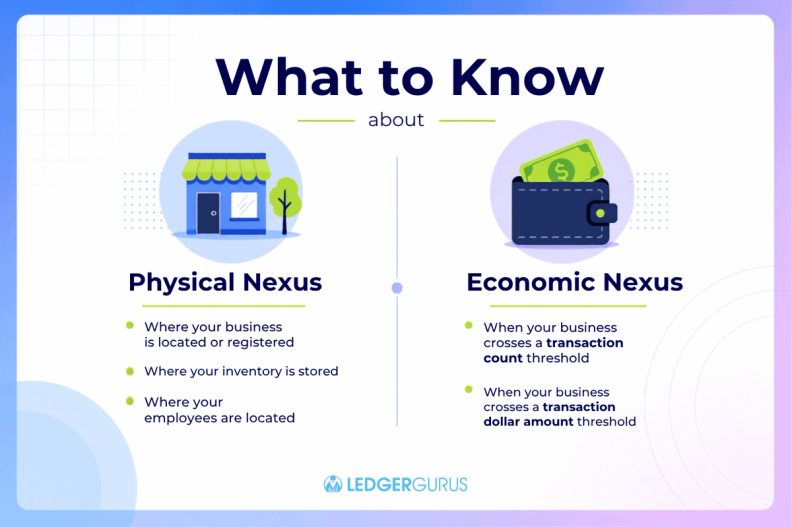
- Economic nexus: You may have nexus in a state where you have a significant number of sales (in terms of revenue and/or number of transactions). See the appendix in our Sales Tax Compliance Checklist to see what those thresholds are in each state.
- Physical nexus: You will have nexus in states where you have a physical presence. This commonly includes office buildings, where employees and salespersons live, and where inventory is housed. (Think PEOPLE and PROPERTY.)
Like we said earlier, it's important to remember that you may have nexus in states where your inventory is stored. This includes FBA sellers. Many FBA sellers forget to consider their inventory location(s) when determining sales tax nexus. And remember, if you sell on your own sales channels besides Amazon, you need to collect and remit for all states where you have nexus.
How to find where Amazon is holding your inventory
To find out where Amazon is holding your inventory, you will want to find the Inventory Event Detail report in Seller Central. As of this blog writing, you can also follow these steps after signing into Seller Central:
- Reports
- Fulfillment
- Inventory Event Detail
- Download the report for easier navigation. Choose a date range as far back as you would like to consider.
- Once downloaded, find the column titled “fulfillment-center-id.”
- Click the drop-down on the filter for this column. These are all the warehouse locations in which your inventory is stored.
- The first 3 letters of each “id” are associated with an airport. For example, “PHX3” would be a warehouse close to Phoenix, AZ. You would therefore have a nexus in Arizona. Find a complete list of warehouse ids and locations here.
Sales tax tools, such as TaxJar or Avalara, will also help identify where you have nexus due to FBA. We have a comparison of sales tax engines vs. filing tools if you want to see how these tools stack up.
Frequently asked questions
Do I need to collect sales tax if I only sell on Amazon?
No. Amazon is a marketplace facilitator and is legally required to calculate, collect, and remit sales tax on your behalf in every state that requires it. Your collection and remittance liability is zero.
If Amazon collects sales tax for me, do I still need to file anything?
Yes, in most cases you still need to register and file in your home state, though usually as a $0 return since Amazon already collected and remitted on those sales.
Does storing inventory in an Amazon FBA warehouse create sales tax nexus?
It depends on the state. About half of states say yes, inventory in a third-party warehouse counts as physical presence, requiring you to register there. The other half don't, since you don't control where Amazon stores your inventory.
How do I find out which states my Amazon inventory is stored in?
Pull the "Inventory Event Detail" report from Seller Central (Reports > Fulfillment > Inventory Event Detail), then check the "fulfillment-center-id" column, the first three letters of each ID correspond to a nearby airport code, which tells you the warehouse's state.
If Amazon handles sales tax, do I have any other tax obligations related to FBA?
Possibly income tax. Pennsylvania and Wisconsin, in particular, have been actively pursuing FBA sellers on income tax liability tied to inventory stored in their states, a separate issue from sales tax.
What if I sell on Amazon and my own website?
Marketplace facilitator laws only cover your marketplace sales. For any sales through your own site or other non-marketplace channels, you're fully responsible for collecting and remitting sales tax in every state where you have nexus, combining sales across all channels to determine that nexus.
Get the right level of help for your Amazon business
Even though selling on marketplaces takes collection and remittance off your plate, there's still real work: registering, filing $0 returns, and handling any non-Amazon sales channels correctly. However much help you want, we've got an option:
- DIY: If your business is still under $1 million in annual revenue, you likely don't have nexus in many states yet. Schedule a one-on-one consultation with a sales tax expert for your specific question.
- Do It with You: Not sure where you stand? Take our free Sales Tax Risk Assessment, 20 quick questions, about five minutes, for a personalized read on your exposure.
- Do It for You: If you're ready to hand it off entirely, see how LedgerGurus can manage your sales tax end to end, whether you're a small seller with nexus in a few states or a large one with complex filings everywhere.
