

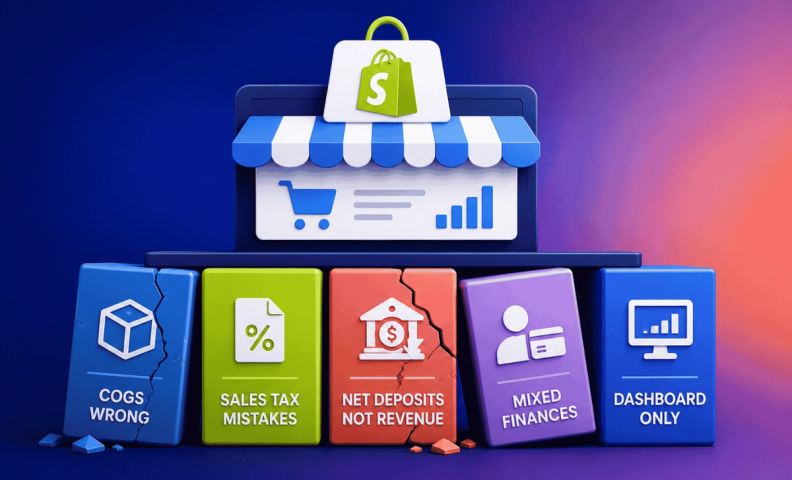
Shopify is an excellent platform to start your business journey. We've worked with many businesses who have found success with Shopify as their main sales channel. As your Shopify business grows, you will have a better chance of success you're making decisions off accurate financial data, and accurate financial data comes down to accurate accounting. Here are the five mistakes we see most often, and how to avoid each one.
Mistake #1: Getting your COGS wrong
99.9% of Shopify sellers keep inventory of the products they sell. Every product, whether manufactured or purchased for resale, will have a cost and sales price. To accurately calculate the actual cost of goods sold (COGS), gross profit margin, and value of inventory on hand, you need to determine the COGS for each SKU and record COGS at the right time.
Many Shopify sellers calculate an inaccurate COGS. Furthermore, we see many sellers record COGS at the wrong time, not at the time of the sale. These mistakes will skew your gross profit margin and reflect an inaccurate inventory value, which can lead to poor business decisions and ultimately business failure. So, this is so important to get right!
For a full picture of accurately calculating and recording COGS, read our article about ecommerce cost of goods sold.
Mistake #2: Treating sales tax like income or expense
Sales tax accounting confuses even experienced Shopify sellers, mostly because collected sales tax isn't income, and remitted sales tax isn't an expense. Both are liability transactions, and treating them otherwise is one of the most common, and costly, mistakes we see.
Common sales tax errors we run into:
- Not keeping a proper record of sales tax liability in the accounting system
- Recording collected sales tax as income instead of an increased liability
- Recording remitted sales tax as an expense instead of a decreased liability
- Not understanding which products are taxable vs. exempt
- Collecting sales tax when you shouldn't, or not collecting when you should
- Not setting up Shopify to collect sales tax from the right customers in the right states
For the exact journal entries and why this matters, read How to Record Sales Tax Journal Entries. For help figuring out where you actually owe tax in the first place, see our complete guide to sales tax nexus.
For a step-by-step guide on sales tax compliance, download our Sales Tax Compliance Checklist.
Mistake #3: Recording net deposits instead of real revenue
Because of how many daily transactions Shopify sellers process, it's tempting to just record revenue based on when Shopify deposits money into your bank account. That deposit is a net number, sales minus fees, refunds, shipping, sales tax, and discounts, all bundled together, not your actual revenue. Recording it as-is means you're missing real financial data and violating the matching principle (recording activity in the period it actually happened, not the period the cash cleared).
We cover exactly why this happens and how to fix it in 3 Accounting Basics for Shopify Sellers, and go even deeper in How to Do Shopify Accounting, including which of three accounting methods fits your revenue stage.
Mistake #4: Mixing personal and business finances
Shopify stores are often owned and run by single owners, with one or two employees. In this situation, it becomes very difficult to keep business and personal activity separately. As a result, sellers often record personal expenses or income from other sources in the Shopify store’s books. This gives you an inaccurate picture of your business and creates real legal and tax risk.
Whether your store is formally registered or not, the best practice is to keep personal and business activity completely separate, including separate bank accounts.
Mistake #5: Trying to run your books from the Shopify dashboard
Some Shopify sellers try to run their accounting entirely from the Shopify dashboard, or keep track of things mentally. This creates real problems, especially as a business grows rapidly. Without a proper accounting system, you'll miss important information, which can lead to failure or a significant loss of potential profit.
This isn't a Shopify-specific problem, it's one of the most common mistakes we see across all kinds of DIY accounting. For the broader picture, read 5 Common Mistakes of DIY Accounting.
Frequently asked questions
Why shouldn't I record sales tax I collect as income?
Because it was never your money, you're holding it on behalf of the state until you remit it. Recording it as income overstates your revenue; it should be recorded as a liability instead.
Why is recording Shopify deposits as revenue a mistake?
Because that deposit is a net number, sales minus fees, refunds, shipping, and sales tax all bundled together, not your actual revenue. Recording it as-is hides real financial data and violates the accounting matching principle.
Do I need to keep my personal and business finances separate if my Shopify store isn't a registered business?
Yes. Mixing personal and business activity creates an inaccurate financial picture and real legal and tax risk, regardless of whether your store has a formal business registration.
Can I rely on the Shopify dashboard instead of setting up real accounting?
No. The Shopify dashboard doesn't give you the full financial picture, COGS, sales tax liability, true revenue, and skipping proper accounting means you'll miss the information you need to catch problems early.
How do I calculate COGS correctly for my Shopify products?
You need an accurate cost for each SKU and you need to record COGS at the time of sale, not at time of purchase. See our full guide on calculating cost of goods sold for the exact method.
What's the single most common Shopify accounting mistake?
Recording Shopify deposits as revenue instead of breaking out the actual sales, fees, and other activity bundled into that deposit. It's the mistake we see most often, and it quietly distorts almost every other number in your books.
Stop these mistakes before they compound
Every one of these five mistakes gets more expensive the longer it goes uncaught, bad COGS data compounds into bad pricing decisions, sales tax errors turn into audit exposure, and skipping accounting altogether means you won't know there's a problem until it's a big one.
If you'd rather leave your Shopify accounting to people who catch these mistakes for a living, our team can help.
