

Are you concerned about your ecommerce business being audited for sales tax? Sales tax audits have significantly increased in the last few years, thanks to more proactive measures from states. Being sales tax compliant and understanding the audit process is critical. That's what this resource is about. Keep reading to learn what an audit is and why you should avoid waiting to register and file until states come knocking on your door.
Before we start, please note that these are not scare tactics. We see this stuff every day and we have your best interests in mind. We are trying to help you by conveying the urgency of getting compliant. If you need support to sort out your sales tax liabilities or would like tailored guidance to set you on the right path, we can help, but either way, the key is that you get this right because the costs of not doing so are significant.
What is a sales tax audit?
A sales tax audit is a process where your business and sales records are examined for a specific time period to make sure you've been meeting the state's sales tax requirements. The main questions the auditor is looking for answers to are:
- Registered sellers
- Did you cross nexus prior to your registration date?
- How long did you have nexus prior to registering?
- Unregistered sellers
- How long ago did you cross nexus? This is typically determined with the business activity questionnaire which preempts the audit. That information will determine the audit period.
- Did you collect & remit the correct amount of sales tax according to the taxable sales you made in that state?
Auditors assess whether the correct amount of sales tax owed has been collected and remitted. They examine all sales, marketplace, wholesale, exempt, and taxable sales, and request a breakdown by type and state. It's critical to understand nexus, but we are not going to go into depth about it here. We have created a lot of free resources to help you. Check out the following:
- Read the Complete Guide to Sales Tax Nexus for Ecommerce Sellers to understand nexus and how it affects your business.
- Take our free Sales Tax Risk Assessment, 20 quick questions, about five minutes, for a personalized read on your audit exposure before you keep reading.
- Download the Sales Tax Compliance Checklist for a complete list of the steps you need to take to get and stay sales tax compliant AND an updated list of all the states' economic thresholds.
What are the current trends in sales tax audits?
The landscape for sales tax compliance has changed dramatically compared to previous years. This is mainly due to the time since the Wayfair decision was passed in 2018. In the first few years after the Supreme Court's Wayfair decision, states gave some leniency for online sellers to figure out processes and become compliant.
We are now more than 6 years post-Wayfair, and the states expect compliance. Leniency is dwindling. In an effort to detect non-compliance and increase revenue, states are increasingly turning to auditing ecommerce sellers. Some of the current trends are:
- Audit task forces
- Business activity questionnaires and surveys
- Collaboration among states
Audit task forces
Our sales tax experts have noticed that states are actively hiring audit task forces to examine remote sellers. This includes both registered AND unregistered businesses. The number of auditors is greater in states with high populations like Florida, Washington, and California, potentially increasing the chance of your business being scrutinized.
Pre-audit questionnaires and surveys
It has become more common for states to send out pre-audit questionnaires and business activity surveys to business owners. In some states, you don't even have to be registered to receive one of these questionnaires that asks for 3 years of sales data. We don't recommend ignoring these notices. You are already on the state's radar and most likely moving towards an audit.
If you haven't crossed nexus, these questionnaires can work in your favor! Providing your sales details can show the state that you're compliant and there isn't a need for further investigation. It's also an opportunity for you to understand how close you may or may not be to triggering economic nexus in that jurisdiction.
For a closer look, watch What a Sales Tax Pre-Audit Questionnaire Really Means.
Collaboration between states
Many states in the US are part of the multi-state tax commission that shares business data with their members. Illinois, for instance, is now asking for sales data from eight or nine other states and then sharing their findings with surrounding states who are also looking for non-compliant businesses. This level of collaboration between states means that if you're selling in multiple states and are not compliant in one state, you can be found out through another state's audit process.
Common sales tax audit triggers
States are becoming more aggressive in selecting businesses for sales tax audits, and there are several common reasons why your business might be targeted. Here are some common triggers that could put your business on the radar:
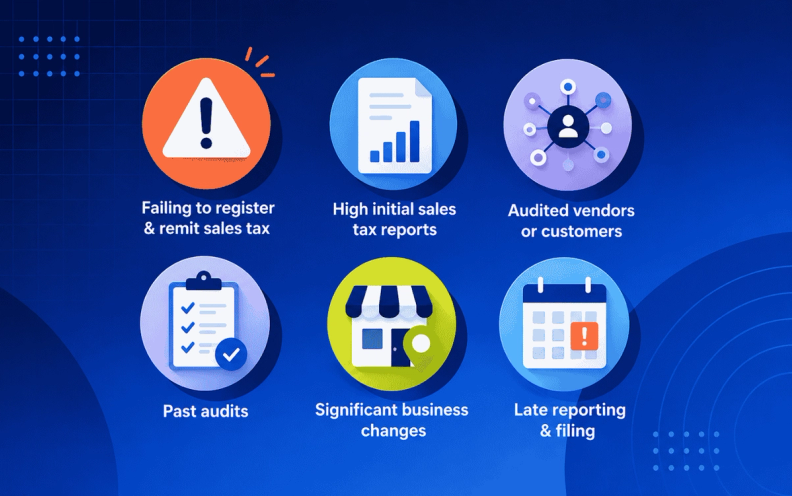
- Failing to register and remit sales tax: One of the most common reasons for an audit is failing to register & remit in a state where your business has established nexus. States are finding ways to identify these businesses and take action against them.
- High initial sales tax reports: If your business reports very high sales tax amounts immediately after registering in a state, that state will suspect that you crossed a nexus threshold much earlier than when you registered. This suspicion will often trigger an audit so the state can review your records and penalize you if you should have registered sooner.
- Audited vendors or customers: Sometimes, your business might be selected for an audit simply because one of your vendors or customers was audited. States often extend their investigations to the business networks of audited companies to identify potential compliance issues.
- Significant business changes: Major changes, such as restructuring, mergers, or significant increases in sales, can draw attention. States may audit to ensure these changes haven't led to non-compliance with sales tax laws.
- Past audits: If your business has been audited in the past, especially if issues were found, you're more likely to be audited again. States keep records and often re-audit businesses that have previously had compliance problems.
- Late reporting and filings: Consistently filing late or submitting inaccurate returns can raise red flags. States view repeated late filings as a sign of potential non-compliance and may initiate an audit to investigate further.
Each state has its own system for deciding what triggers an audit. By understanding these common triggers, you can better prepare and reduce potential audit risk.
The risks of delaying sales tax compliance
Delaying sales tax compliance is often more expensive than the initial cost of compliance would have been. Penalties and interest accumulate in the background the entire time you're out of compliance, and each state sets its own rates, some go as high as 39% of tax owed. If you're already behind, watch our guide on catching up on past due sales tax for what to do next.
Preparing for a sales tax audit
Audits are becoming more common. In some states, it's not a matter of if, but when. So, the question isn't really about audit prevention. It's about audit preparation. In other words, what can you do to help the audit run smoothly? Sales tax audit preparation really comes down to ongoing sales tax compliance, and that depends on these things:
- The basics of sales tax collection and remittance
- Collecting the right amount of sales tax based on your sales
The basics of sales tax compliance
Sales tax compliance boils down to:
- Knowing where you have nexus: This is the first and most important step.
- Registration: After you know where you have nexus, you need to register there.
- Collecting sales tax: After you have registered, set up your sales channels to start collecting in those states.
- Remitting: After you collect the sales tax, you've got to remit it according to the states' deadlines.
One thing that's super important to point out here is that it is ILLEGAL to collect sales tax without a permit, so don't do it until you're registered.
Handling your sales correctly
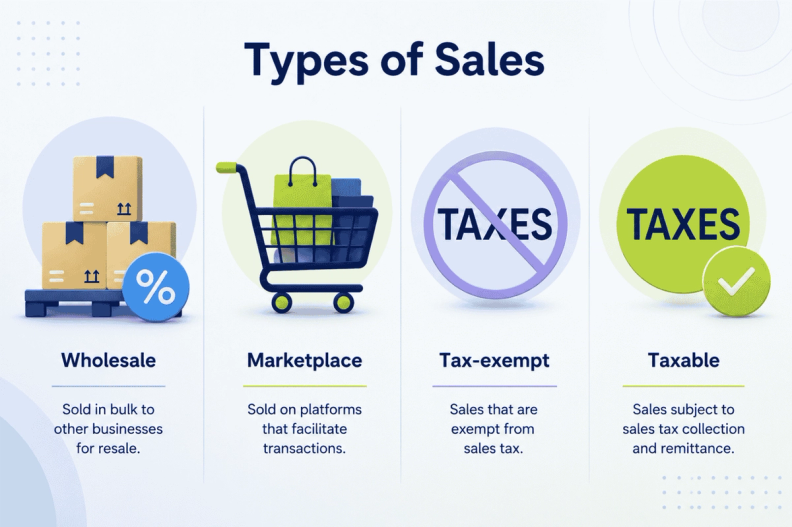
Second, you need to pay attention to your sales types to ensure you're handling the sales tax for them properly.
They include:
- Wholesale sales
- Exempt sales
- Marketplace sales
- Taxable sales
Wholesale sales
If you sell wholesale, make sure your buyers provide valid resale or exemption certificates. These certificates allow you to skip charging sales tax because your buyer will be reselling the product. Be sure to keep these on file and ensure they're valid and up to date, as you'll be on the line for the missing sales tax if they're not.
Exempt sales
Some sales might be exempt from sales tax. This include nontaxable products, such as food, clothing or supplements (determined by the individual states), or international sales where the buyer is located outside the U.S. Just make sure you are categorizing them correctly and have the proper documentation to back it up.
Marketplace facilitator (MPF) sales
If you sell on platforms like Amazon or eBay, make sure to verify that the marketplace facilitator is collecting and remitting sales tax on your behalf. States now require marketplaces to handle tax collection, but it's still your responsibility to confirm they're doing it correctly.
Taxable sales
For all other sales, make sure your sales tax engine is calculating the right amount of tax based on the buyer's location. This includes tricky areas like home-ruled jurisdictions (local governments that set their own tax rules), like Colorado, and states with unique taxes like Washington's B&O (Business & Occupation) tax. If your tax engine isn't set up correctly, you might be over or undercharging, which will make an audit messy for you.
Preparing for the audit itself
Aside from the ongoing practices needed for good compliance, here are some steps to help your business get ready for an audit:
- Gather sales data for the audit period. Make sure to include all sources of sales: wholesale, MPF, retail, etc.
- Gather all sales tax-related documents and records. This includes sales tax returns, exemption and resale certificates, and any correspondence with the tax authorities. Having everything in one place will make the audit process smoother.
- Designate a point of contact for the audit. This person will handle all communications with the auditor to ensure clear and consistent information.
- Consider hiring a qualified sales tax firm. Professional help can provide expertise and support throughout the audit process.
By following these steps, you can ensure that your business is well-prepared for a sales tax audit and reduce the risk of penalties.
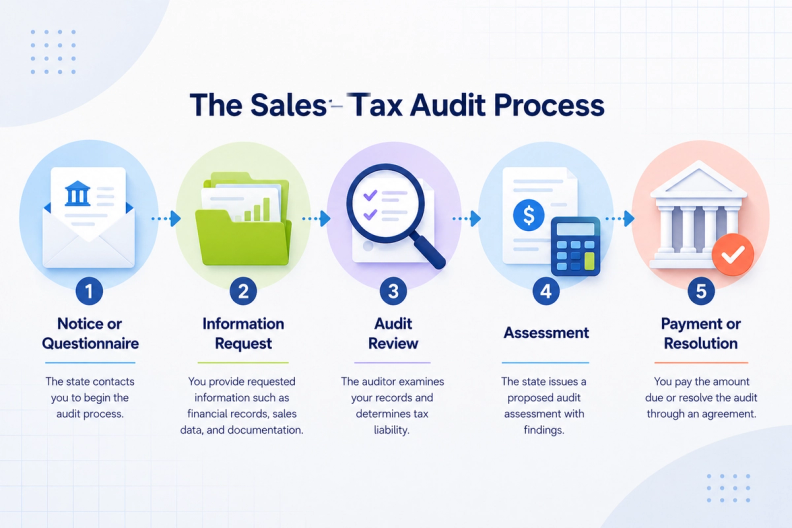
What to expect during the sales tax audit process
Who conducts sales tax audits?
The state department of revenue (DOR) will assign an auditor to your case.
Where will the audit take place?
Audits are being conducted virtually. You will be emailing back and forth with the auditor.
What records do auditors want to see?
They'll want to see your sales records, your sales tax returns, customer resale certificates, and your income tax return. They'll also ask for a breakdown of sales by state and confirm it ties out to your annual net income.
How far back can a sales tax audit go?
For physical nexus, there is no limit to how far back a state can go. They can go as far back as you've been in business. For economic nexus, they can go back to when their economic nexus laws went into effect. In some states, that's all the way back to 2018.
How long can a sales tax audit take?
That depends on a lot of factors, including how organized your company's records are, how complex the data is, and how transparent you are. The best-case scenario is that an audit will take one to six months to complete.
What happens after a sales tax audit?
A payment plan is made available after the audit has been completed, but it varies by state. These payment plans are commonly called Installment Payment Agreements (IPAs). The state may require a significant number of financial disclosures prior to agreeing to an installment payment agreement. You can apply for a sales and use tax penalty abatement, but to qualify, you have to prove that reasonable cause for non-compliance exists.
If you do a VDA, the state will waive penalties, but they do not waive interest. In either circumstance, they do NOT reduce the total liability owed. You would have to hire an attorney and prove financial insolvency for them to consider reducing the liability. Most ecommerce businesses don't have the time or means to do this.
States become inflexible once they find non-compliance, making it crucial to address any issues proactively rather than reactively. You're better off owing the federal government money than the state governments. The states do not waive penalties when assessing amounts owed during an audit.
How do I avoid an audit?
You can't avoid an audit outright, but you can meaningfully reduce your risk. It starts with understanding exactly where you have nexus, and once you know, registering and filing in those states.
Best approach for low exposure
If you are a newer seller, registering quickly after crossing the nexus threshold can help reduce future sales tax obligations. There are rare instances where immediate registration might not make sense, such as:
- Sales are primarily made through a Marketplace Facilitator
- Sales are primarily non-taxable products
If the above does apply, you should consider registering even if your exposure is low or it hasn't been that long since you crossed the threshold. It's better to register, start filing returns, and deal with back filings quickly than to wait for the state to audit you. Ignoring low exposure states may seem like a good idea at the time, but there is no guarantee that they won't eventually find you. Delays only increase the burden as penalties and interest continue to grow.
For a list of areas you need to focus on to ensure that you're fully compliant, read Sales Tax Compliance Challenges Facing Online Sellers.
Best approach for high exposure
For businesses that have high exposure, regardless of how long you have been selling into a state, the best option is a Voluntary Disclosure Agreement (VDA), especially when the cost for a VDA is the same or less than the penalties owed. VDAs can be a lifesaver. Want to find out more? Get in touch to see how we can help.
Benefits of a VDA
- Reduces the lookback period on economic or physical nexus to three to four years, significantly reducing your liability.
- Waives the penalty amounts you owe to the state.
- Registration is included in the VDA process.
- Wipes the slate clean. At the end of the VDA process, you are settled with the state and ready to move forward.
Don't forget to turn on your sales tax collection settings AFTER you've registered to avoid paying sales tax out of pocket. Even a modest penalty exposure, say $5,000-$6,000 in a single state, can be enough for a VDA to pay for itself once you factor in the reduced look-back period and waived penalties. For businesses with exposure across multiple states or years, the math tends to favor a VDA even more heavily, especially in aggressive states.
VDAs can be expensive, but they have the potential to be far less expensive than an audit, depending on your circumstances. But remember that once the state starts an audit, it's too late to apply for a VDA and potentially reduce your penalties.
Frequently asked questions
What triggers a sales tax audit the fastest?
Failing to register and remit in a state where you've crossed nexus is the single most common trigger, especially when a state later notices high initial sales tax filings that suggest you crossed the threshold earlier than your registration date.
Can I be audited even if I'm registered and filing?
Yes. Being registered doesn't mean you're audit-proof, states also audit registered sellers to check whether you crossed nexus before your registration date, or whether you're collecting and remitting the correct amount.
Does a Voluntary Disclosure Agreement (VDA) reduce how much I owe?
Not the total liability, it waives penalties and typically limits your look-back period to 3-4 years, but you still owe the underlying tax and interest. It's a lifesaver on penalties and look-back scope, not a discount on what you actually collected and didn't remit.
What happens if I ignore a state's audit notice?
Ignoring it doesn't make it go away, states become far less flexible once they've found non-compliance, and by that point your options for reducing penalties (like a VDA) are already gone.
Is it better to deal with low-exposure states now or wait?
Now. Even low exposure tends to compound with penalties and interest the longer it sits, and there's no guarantee a state won't eventually find you through data-sharing or marketplace records.
Don’t wait for an audit to find you
Staying compliant with sales tax is essential, and audits are only becoming more common. Waiting to see if a state finds you first isn't a strategy, it's a bet, and the costs of losing it are steep. If you're ready to get compliant and protect your business, schedule a call with our sales tax experts.
