

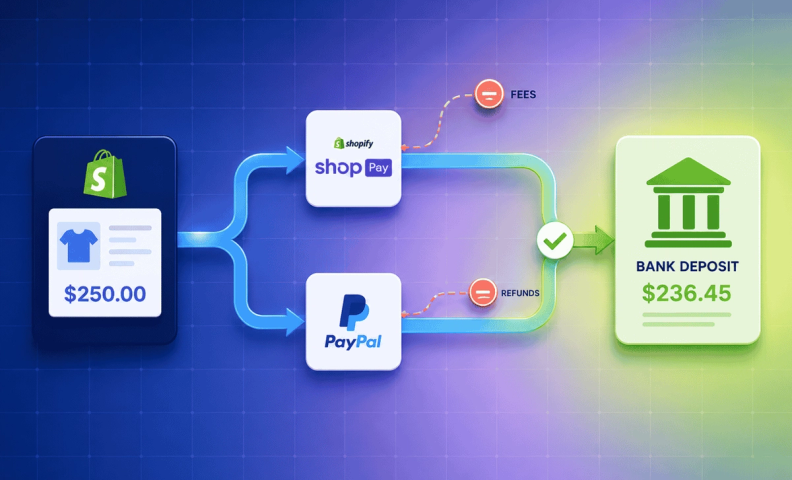
Say the words "Shopify bookkeeping" out loud. If that brings on a small wave of dread, you're not alone, and you're in the right place. Understanding what actually happens behind each deposit gives you more accurate numbers, surfaces places you might be getting it wrong, and ultimately means better-informed decisions for your company.
Shopify is a great platform for running an ecommerce business, but a lot happens behind the scenes before a sale becomes a deposit. Here's how we track it, chart it, and book it, using ecommerce accounting best practices.
Why debits and credits matter for Shopify bookkeeping
Bookkeeping uses two entries, debits and credits, to track your company's financial activity. A debit increases asset and expense accounts, or decreases equity, debt, or revenue accounts. A credit does the opposite: it increases equity, debt, and revenue accounts, or decreases asset and expense accounts.
Debiting and crediting accounts is how we adjust the balances on your financial statements, income statements, balance sheets, and cash flow statements alike. Mapping out how platforms, channels, payment processors, and your bank account relate to each other is one of the clearest ways to actually see this in action.
Mapping the path from sale to bank deposit
Shopify bookkeeping starts with channel-level activity, gross sales, discounts, shipping income, and any tax liability, which is what the customer sees at checkout. You can run reports at that level, but the deposit that lands in your bank account won't match those numbers. A lot happens in between.
Payment processors are the next stop. On marketplaces like Amazon, eBay, or Etsy, there's usually just one processor built in, so it's a single step from sales channel to processor to bank account.
Shopify (along with WooCommerce, BigCommerce, or a custom site) works differently. Customers can choose from multiple processors at checkout. That means the gross sales, discounts, shipping income, and tax liability captured at the Shopify level all need to be split out by which processor was actually used. A store running two processors through Shopify, for example, has two separate paths to track before anything hits the bank. If your setup involves syncing Shopify data automatically, it's worth understanding why a direct sync into QuickBooks Online usually causes more problems than it solves before you rely on one.
For a discussion on what tools are available to simplify the process of getting the necessary information into your accounting software without syncing, read Best Amazon QuickBooks Integrations in 2026: What We Actually Use as Accountants.
How we book the journal entries
Once the flow is mapped, our team books it using ecommerce accounting best practices, at two levels.
Channel/platform sales journal entry
At the channel level, we record total sales, returns and discounts, shipping and delivery income, and sales tax payable. Sales are split by which payment processor was used, with a receivable account tied to each one, so total sales are broken out according to where we expect each deposit to eventually land.
| Gross Sales | Debit | Credit |
|---|---|---|
| Sales of product income | $XXX | |
| Returns / discounts | $XXX | |
| Shipping & delivery income | $XXX | |
| Sales tax payable | $XXX | |
| Gift cards unearned | $XXX | |
| Accounts receivable - Shopify | $XXX | |
| Accounts receivable - PayPal | $XXX |
Payment processor-level journal entry
At the processor level, we record merchant account fees, returns and discounts, chargebacks, and uncategorized expenses. Returns show up here because a return reverses against the customer's original payment method. The holding account represents whatever the processor is holding on the company's behalf and gets reversed once the sale is actually received.
| Orders Processed by Shopify | Debit | Credit |
|---|---|---|
| Merchant account fees | $XXX | |
| Returns / discounts | $XXX | |
| Shopify holding | $XXX | |
| Accounts receivable - Shopify | $XXX |
Why reconciling the differences matters
This last step matters as much as the first two. When we compare processor receivables against the channel-level journal entry, the numbers will never match perfectly, timing differences between transactions guarantee that.
Our team reconciles payment processors every month, comparing what we expected to see deposited against what actually was. Small differences usually need no action. Large ones are worth investigating, since tracking them is what lets you catch and correct whatever's causing the gap, and keeps your numbers something you can actually trust.
If you'd rather see the broader list of ways Shopify accounting commonly goes wrong, 5 Common Shopify Accounting Mistakes covers the rest.
Frequently asked questions
Why doesn't my Shopify deposit match my sales report?
Because a lot happens between checkout and deposit, payment processor fees, holding periods, refunds, and chargebacks all sit in between. The deposit reflects all of that. The sales report only reflects the channel-level activity.
What's the difference between channel-level and payment processor-level journal entries?
Channel-level entries record what happened at checkout, sales, discounts, shipping, and tax, split out by which processor will handle each one. Processor-level entries record what happens next: fees, returns, chargebacks, and the holding account each processor uses before releasing funds.
How often should I reconcile my Shopify deposits?
Monthly, at minimum. That's the cadence that catches errors before they compound and keeps your numbers something you can rely on for decisions.
What counts as a "large" difference worth investigating?
There's no universal number. It depends on your volume, but a recurring gap or one that's growing over time is the signal to dig in. A small, one-off timing difference usually isn't.
Do I need to understand debits and credits to manage my own Shopify bookkeeping?
Not in depth, but understanding the basic flow, channel to processor to bank, helps you spot when something looks off, even if you're not the one making the journal entries yourself.
Let us handle your Shopify bookkeeping for you
Whether or not Shopify bookkeeping is your idea of a good time, we can track, chart, and record your channel activity correctly, so you're never just assuming the numbers are right. That's the foundation for the informed decisions your business's growth actually depends on.
